The Day in Numbers
- S&P 500: 7,659.44 — fell 1.09% as Friday’s risk reduction carried into the new week.
- Nasdaq: 26,140.03 — dropped 2.15%, leaving technology shares to negotiate with a 5.06% Treasury yield.
- VIX: 19.99 — jumped 21.45%, putting market insurance back on the shopping list.
- Crude oil: $99.39 — fell 1.99% as supply held despite continuing conflict.
- Brent crude: $107.30 — declined 2.40%, easing some immediate inflation pressure.
- Gold: $4,198.30 — gained 0.41% as investors kept one foot in protection.
- Bitcoin: $82,783.18 — rose 1.49%, recovering alongside weaker oil and firmer risk appetite.
Oil's Retreat Gives Risk Assets Breathing Room
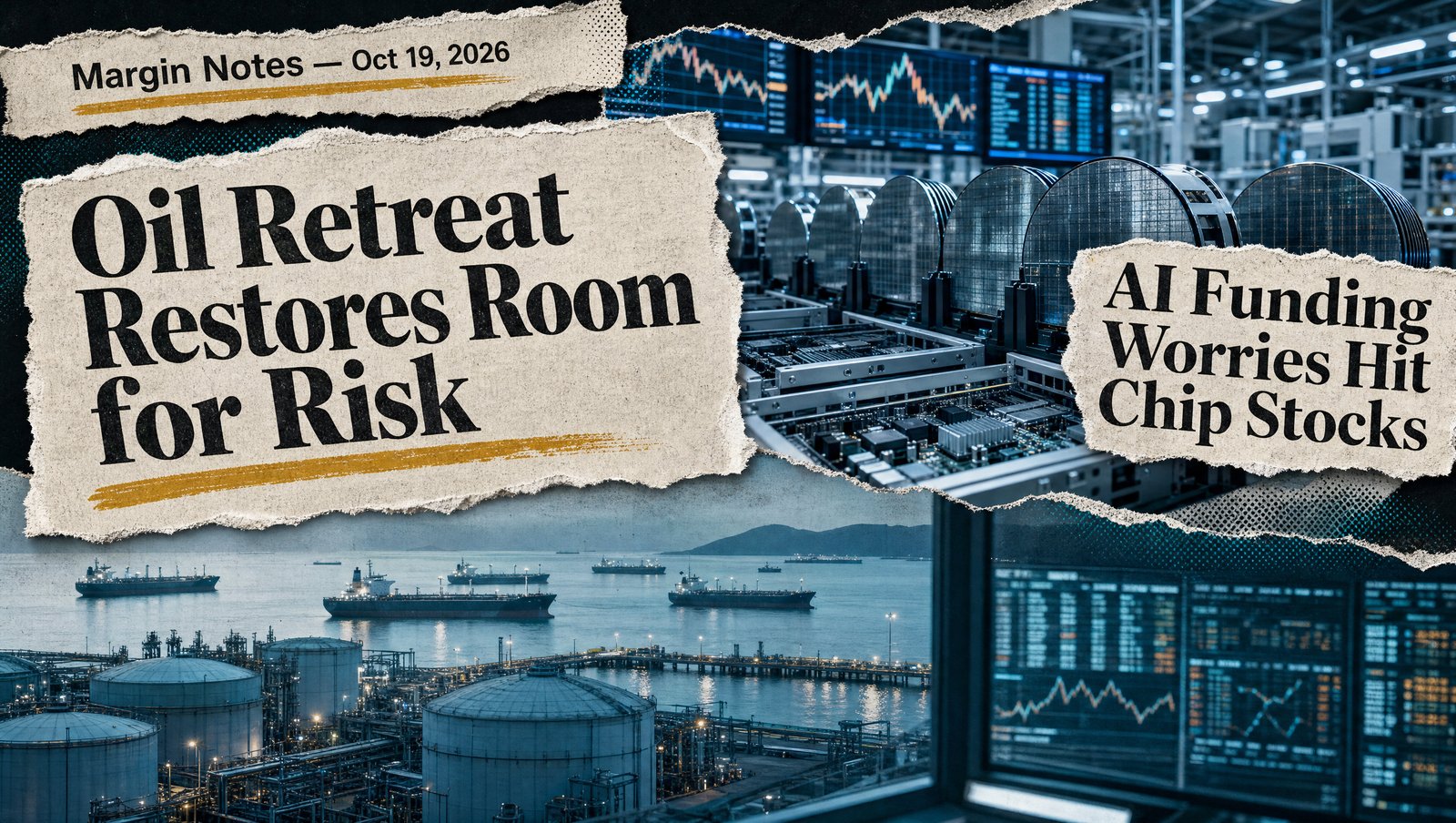
Crude oil fell 1.99% to $99.39 and Brent declined 2.40% to $107.30 as supply remained intact despite the fighting. Oil prices gave risk assets a little room to breathe, not because the geopolitical problem disappeared, but because traders found no immediate evidence of an export shutdown. Markets are often grateful for the absence of a new disaster, which is a modest standard but a useful one.
That relief helped explain why Bitcoin climbed 1.49% to $82,783.18 and why Nasdaq futures rebounded 1.28% after the cash index had lost 2.15%. Stronger-than-expected Chinese growth added to the argument: third-quarter GDP expanded 4.5%, giving global investors a reason to believe demand has not simply fallen through the floor. China's growth beat helped lift Asian equities and crypto together, though the bounce remains conditional on oil staying contained and earnings doing more than merely meeting expectations.
The split market is visible in the sector tape. Information technology rose 2.54% in the sector summary, while the broader Nasdaq still carried the damage from the previous session; energy gained 2.47%, and defensive consumer staples rose 1.31%. Investors are not leaving risk altogether. They are asking which parts of it can survive another bout of expensive money.
AI Funding Stress Rewrites the Tech Rally
The Nasdaq fell 2.15%, the VIX surged 21.45% to 19.99, and Korean chip stocks extended their losses as funding concerns collided with a new DeepSeek model. Asian chip shares absorbed a $137 billion hit to Korea's pension holdings, turning a technology selloff into a balance-sheet conversation. The question is no longer simply whether AI demand exists. It is whether the companies building for that demand can finance the waiting period.
That is why strong earnings are meeting a less forgiving market. The US 10-year Treasury yield held around 5.06%, and long-duration technology valuations have little interest in being reminded that money has a price. Options traders are positioning for more volatility, while investors rotate toward energy, staples, and other areas with nearer-term cash flows. AI investors are now listening to the bond market's warning, which is an inconvenient habit for anyone whose valuation model begins with several years of flawless growth.
Wall Street is not treating the episode as proof that artificial intelligence has stopped mattering. The more sober interpretation is that demand and financing are being separated. A useful model can still have a weak stock price; a profitable chip order can still be attached to an expensive capital program. The boom has not been cancelled. It has been handed a refinancing bill.
Tokenization Moves Into the Financial Plumbing
BlackRock said tokenized funds are moving toward the operating core of Wall Street, while stablecoin payments rose 45% even as stablecoin supply stalled. BlackRock sees tokenized funds becoming part of everyday market infrastructure, a development that matters more than another speculative token launch because it points to settlement, collateral, and fund administration rather than another promise of overnight riches.
The distinction matters in a market that is becoming choosier about risk. BIS economists found that stablecoin growth slows when banks offer more attractive deposit rates, which makes the banking system a competitor for crypto liquidity rather than a passive bystander. At the same time, Visa, Mastercard, and Stripe are connecting digital dollars to ordinary payment channels. Payment activity is growing even while stablecoin balances stand still, suggesting that usage is becoming more important than simply counting the assets parked on-chain.
Institutional adoption is advancing, but the route is not frictionless. Deutsche Bank is preparing a crypto-custody launch in Germany and targeting Asia in 2027, while issuers including Broadcom and Verizon are objecting to parts of the tokenized-stock framework. The market is therefore building the rails before it has settled every rule for the traffic. That is progress, though not the sort that arrives with a tidy regulatory bow.
Elsewhere
- French protests raised the political risk premium across Europe as violence and looting unsettled sentiment around the region’s debt markets.
- Japan’s prime minister denied responsibility for the weak yen and high rates while officials worked to reassure investors about fiscal and monetary credibility.
- Dubai offered a $592 million dividend alongside its first postwar IPO in an effort to draw investors back to the region’s capital markets.
- Indonesia’s stock selloff deepened ahead of an MSCI meeting over concerns that index removal could accelerate foreign outflows.
- The White House’s crypto chief departed, leaving the US digital-asset industry to reassess the continuity of policy support in Washington.
- Ledger introduced an Android hardware wallet with a touchscreen as crypto custody providers competed to make self-storage less forbidding.
- Zcash developers planned a quantum-resistance fix for private swaps, addressing a long-dated security risk before it becomes an immediate one.