The Day in Numbers
- Brent crude: $105.89 — rose 0.19% as attacks near Saudi energy infrastructure widened supply concerns.
- Crude oil: $94.38 — gained 0.25% despite the broader equity market’s hesitation.
- US 10-year Treasury yield: 5.19% — remained elevated as investors weighed conflicting rate signals.
- S&P 500: 7,805.45 — slipped 0.02%, leaving the index almost unchanged.
- Nasdaq: 27,204.38 — fell 0.15% as chip stocks extended their difficult run.
- Gold: $4,171.10 — eased 0.15% while safe-haven demand remained steady.
- Energy sector: +1.74% — led the US sector groups as geopolitical supply concerns returned.
Aramco’s Dhahran Hit Lifts Oil’s Ceiling
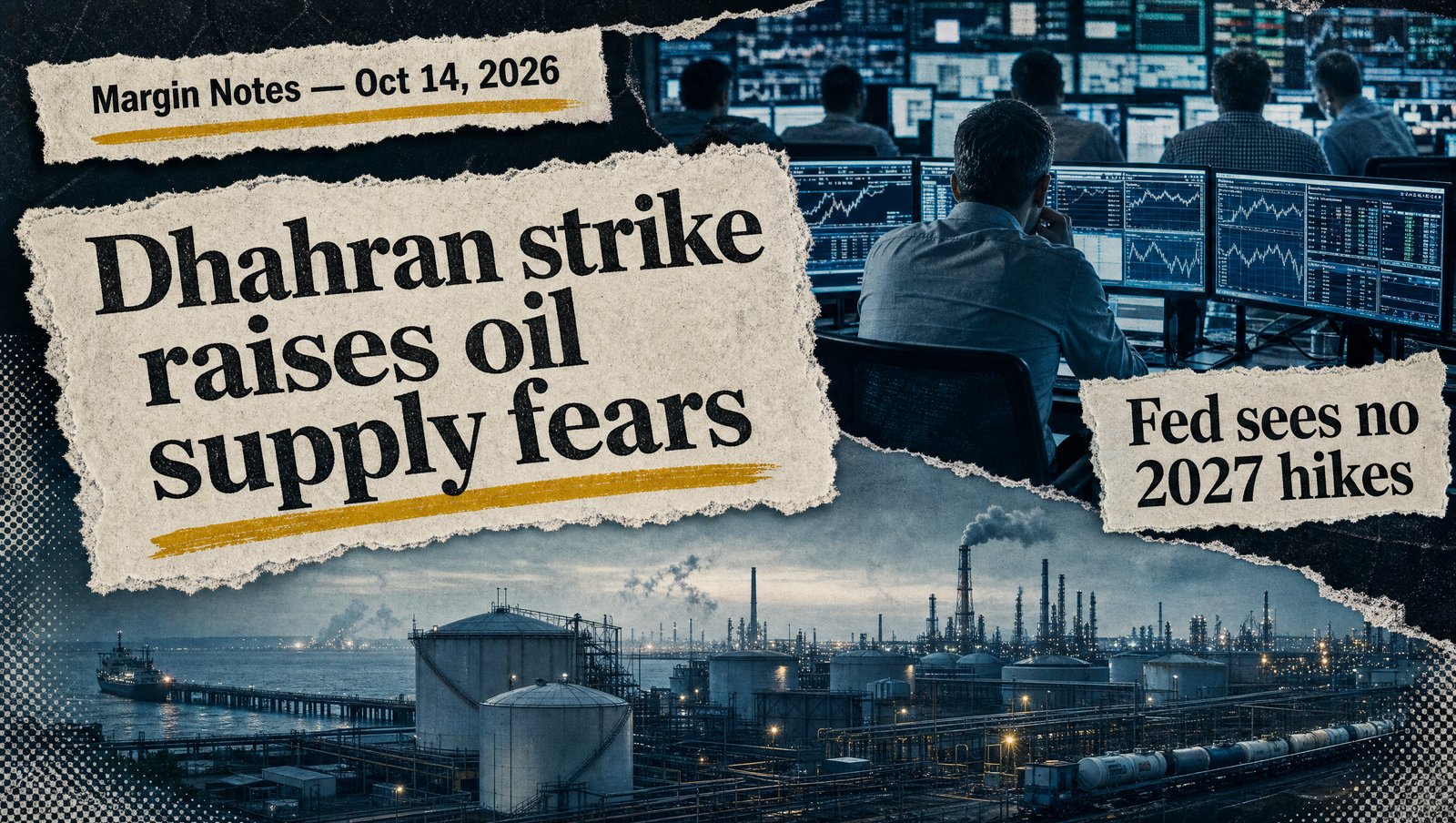
A fire at an Aramco complex in Dhahran followed another Houthi attack on Saudi Arabia, while crude oil rose 0.25% to $94.38. The strike reached Saudi energy infrastructure without causing casualties, but markets do not require a shutdown to become nervous. A limited incident can still widen the range of outcomes, particularly when Brent is already at $105.89 and sits 46.5% above its level at the start of the war.
That is why energy shares gained 1.74% even as the S&P 500 and Nasdaq barely moved. Investors are not treating the attack as proof of an immediate supply loss; they are charging more for the possibility that the next incident is less contained. The difference matters for central banks. Oil does not need to reach a new high to complicate inflation. It only needs to stay expensive enough, for long enough, to make rate relief feel premature.
Gold’s 0.15% decline to $4,171.10 adds a little nuance. The market is hedging the energy shock, but not stampeding into protection. Capital is waiting to see whether the attacks remain a series of manageable disruptions or become a direct threat to export capacity. Markets have always preferred their geopolitical crises with a timetable. This one has not supplied one.
Fed Signals Split the Rate Horizon
The US 10-year Treasury yield held at 5.19% after New York Fed President John Williams said another increase this year may be appropriate but saw no need for further hikes in 2027. Williams gave markets a stopping point beyond the current tightening cycle, which helped Bitcoin climb toward $84,000 even as long-term borrowing costs stayed high.
The message is less dovish than it first sounds. A pause in 2027 does not mean easier money now, and Boston Fed President Susan Collins is still arguing for another increase before year-end. That split leaves the market focused on sequence rather than destination: how much tightening remains, how quickly it arrives, and whether inflation eventually permits the US Fed to stand still. September consumer-price data is due later on Wednesday, with the headline measure expected to show a 0.6% monthly increase, so the rate debate has a fresh test waiting in the wings.
Bitcoin’s response shows how quickly digital assets trade the policy path rather than the policy level. Michael Saylor sees Bitcoin returning above $100,000, and Strategy bought $280 million of the asset, but the stronger near-term signal is that the token responded to a less threatening future rate curve. Strategy is still adding to its Bitcoin treasury while investors debate the next policy move. That is institutional conviction, certainly. It is not immunity from a 5.19% Treasury yield.
ASML’s Order Book Outruns AI Fatigue
ASML raised its outlook as customers including TSMC, Samsung Electronics, and Intel continued ordering chipmaking equipment, even while chip shares suffered their worst stretch in 16 months. ASML said equipment demand is running ahead of its ability to supply it, putting a physical constraint beneath the AI narrative that recent selling has made look increasingly abstract.
The contradiction is now the central feature of the trade. Applied Materials fell 6.69% in the market’s latest technology pullback, and Micron remains under pressure as Chinese competition grows, yet the machinery required to build advanced chips is still being ordered aggressively. Investors are not deciding whether AI exists. They are deciding whether the future profits arrive soon enough to justify the capital being committed today. Those are different questions, and the second one tends to produce more volatile share prices.
Microsoft’s new data-center commitments and Oracle’s effort to secure gas for computing facilities reinforce the point without settling it. Demand is real, but electricity, equipment, financing, and customer adoption all have to arrive in the correct order. The market can support the infrastructure story and still mark down the companies carrying too much expectation. A boom can have a bottleneck and a valuation problem at the same time.
Elsewhere
- China’s trade surplus approached $940 billion as export growth widened the imbalance in global goods flows.
- Bank of America faced a $1.2 billion regulatory penalty after authorities criticized weaknesses in its money-laundering controls.
- Belgian central bank Governor Pierre Wunsch supported another European Central Bank hike as inflation pressures continued to complicate the region’s policy outlook.
- Ledger began reviewing how crypto wallets are sold after a spyware incident raised fresh questions about supply-chain security.
- BNY and Citadel Securities tested tokenized US Treasuries in a practical step toward faster settlement in institutional markets.
- Solana scheduled its Alpenglow upgrade for October 21, targeting 150-millisecond transaction finality.