The Day in Numbers
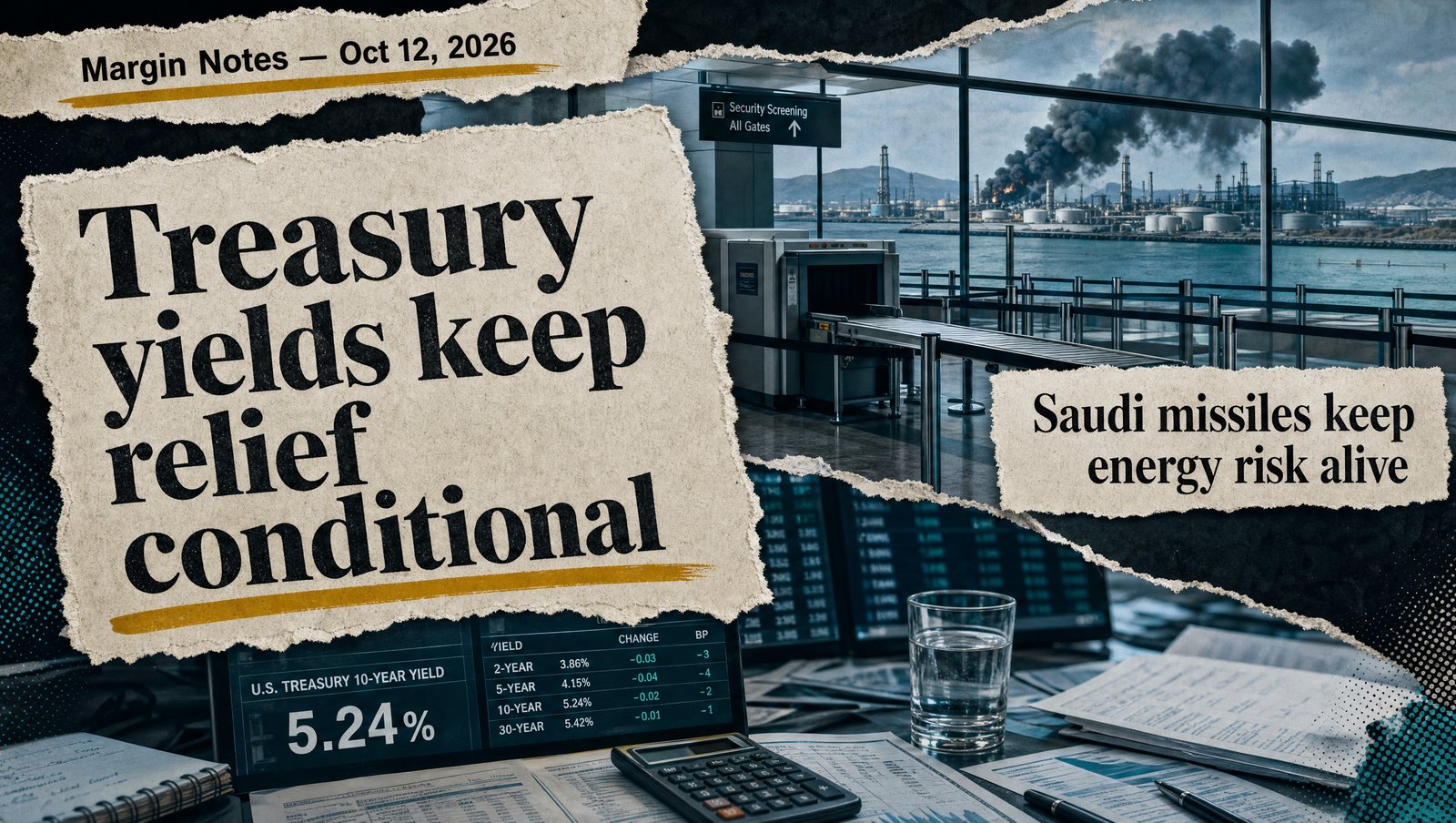
- US 10-year Treasury yield: 5.24% — flat on the session but up 1.3 percentage points since the war began.
- S&P 500: 7,811.54 — gained 0.59% as financials, health care, and consumer stocks broadened the advance.
- Nasdaq: 27,366.17 — rose 0.64%, despite mounting questions about AI valuations.
- Brent crude: $104.48 — slipped 0.23% while remaining 42.5% above its level at the start of the war.
- Gold: $4,209.80 — eased 0.15% as the Treasury yield continued to offer a formidable alternative for defensive capital.
- VIX: 14.84 — fell 3.70%, a subdued reading beside the geopolitical and fiscal risks still in view.
- South Korean Samsung Electronics: -4.39% — showed how quickly AI enthusiasm can become a source of equity-market concentration.
Treasury Yields Put Fiscal Credibility on Trial
The US 10-year Treasury yield held at 5.24% on Monday, even as the S&P 500 rose 0.59% and investors prepared for a week of inflation and earnings data. That is the market’s slightly contradictory message: equities can keep climbing while the discount rate refuses to cooperate. The US Treasury market kept financial conditions tight without another policy hike, shifting attention away from what the US Federal Reserve might do next and toward what governments must pay simply to keep borrowing.
France is where that question has become difficult to ignore. French sovereign debt is carrying a contagion concern into the wider euro area as Paris struggles to put its finances on a more credible footing before the April election. The European Central Bank has not been handed a neat technical problem; it has been handed a political one with a yield curve attached. Intervention can calm the spread, but it cannot substitute indefinitely for fiscal repair.
That is why the flat US 10-year yield matters more than the day’s calm equity tape suggests. Mortgage rates are still being pushed higher by long-duration borrowing costs, while bank earnings this week will offer the first practical evidence of how customers and lenders are coping. The bull market can survive a high yield. It has less experience surviving a high yield that investors believe may be structural.
Saudi Missiles Keep the Energy Premium Alive
Saudi authorities said new missiles were intercepted after deadly attacks on airports, keeping the region’s supply routes in the market’s line of sight even as crude prices edged lower. Saudi Arabia intercepted further missiles after deadly airport attacks, and the modest decline in Brent to $104.48 should not be mistaken for a clean all-clear. Markets can price a ceasefire headline and an active war at the same time, provided they keep one eye on the shipping lanes.
The counterweight came from the reported energy ceasefire between Russia and Ukraine, which offers the possibility of additional supply just as Middle Eastern risks are widening. A Russia-Ukraine energy truce offered oil markets a second source of relief, helping crude fall 0.39% in the Bloomberg market summary. Japan’s call for more stockpiling and domestic development tells the less comforting version of the story: governments are preparing for energy insecurity as though it will be a recurring expense, not a passing surcharge.
That split explains why gold slipped 0.15% while the US 10-year yield stayed at 5.24%. Investors are not abandoning protection; they are comparing geopolitical insurance with the return available from government debt. The result is a risk premium that has become selective rather than absent, which is usually how markets behave just before the next headline tests the distinction.
AI Shares Advance While Bitcoin Tests Its Independence
Microsoft rose 2.38% as investors looked for evidence that AI spending can produce durable business value, while the Nasdaq added 0.64% overall. Microsoft’s revival is giving the technology rally a fresh earnings anchor, but the broader enthusiasm is becoming harder to treat as a single trade. Executives from Microsoft and TikTok have warned that AI expectations may be running ahead of what companies can sensibly finance, and South Korean stocks fell 4.39% as foreign investors reduced exposure to the region’s chip-heavy market.
Bitcoin, meanwhile, traded above $84,000 despite more than $600 million in weekly exchange-traded-fund outflows. Bitcoin held above $84,000 despite institutional withdrawals, which is a useful sign of underlying demand but not proof that digital assets have escaped macroeconomic gravity. A 5.24% Treasury yield still competes with every speculative asset for capital, and the market’s narrow equity leadership suggests liquidity is being allocated carefully rather than generously.
The interesting change is that crypto’s institutional story is becoming less dependent on price. Prediction markets are seeking a clearer route through the US legal system, while the International Monetary Fund sees demand for tokenized stocks but describes the market as volatile and illiquid. Infrastructure is gaining legitimacy; liquidity is still conditional. That distinction is becoming the common language of the day, from AI financing to sovereign debt and Bitcoin itself.
Elsewhere
- India’s Reserve Bank defended the rupee near 97 to the dollar as expensive energy and foreign outflows tested emerging-market liquidity.
- China proposed a hybrid-vehicle arrangement with the European Union to contain a wider trade dispute while automakers accelerate local production.
- Hong Kong is drawing senior executives from Goldman Sachs, HSBC, and UBS ahead of a possible US-China summit and a fresh debate over Asian capital allocation.
- Beijing police opened a probe into CreditEase, adding another regulatory complication for China’s non-bank financial sector.
- The IMF kept global growth near 3% on continued AI investment, with Asia expected to capture a substantial share of the benefit.
- Amazon entered talks to acquire AI startup Decart as large technology companies continue consolidating access to specialized systems.
- The US Supreme Court is being urged to review prediction-market rules, a legal decision that could shape the boundary between event contracts and financial derivatives.