The Day in Numbers
- Brent crude: $103.35 — jumped 3.14% as renewed Middle East escalation lifted supply concerns.
- Crude oil: $90.77 — gained 2.82%, reviving inflation worries across markets.
- US 10-year Treasury yield: 5.33% — held near a level that keeps borrowing conditions restrictive.
- S&P 500: 7,801.77 — fell 0.22% as energy pressure offset otherwise resilient sector performance.
- Nasdaq: 27,538.69 — declined 0.22%, with technology shares losing their usual shelter status.
- Gold: $4,149.20 — rose 0.21% as investors weighed inflation protection against higher rates.
- Bitcoin: below $83,000 — broke support as oil’s jump triggered forced selling across digital assets.
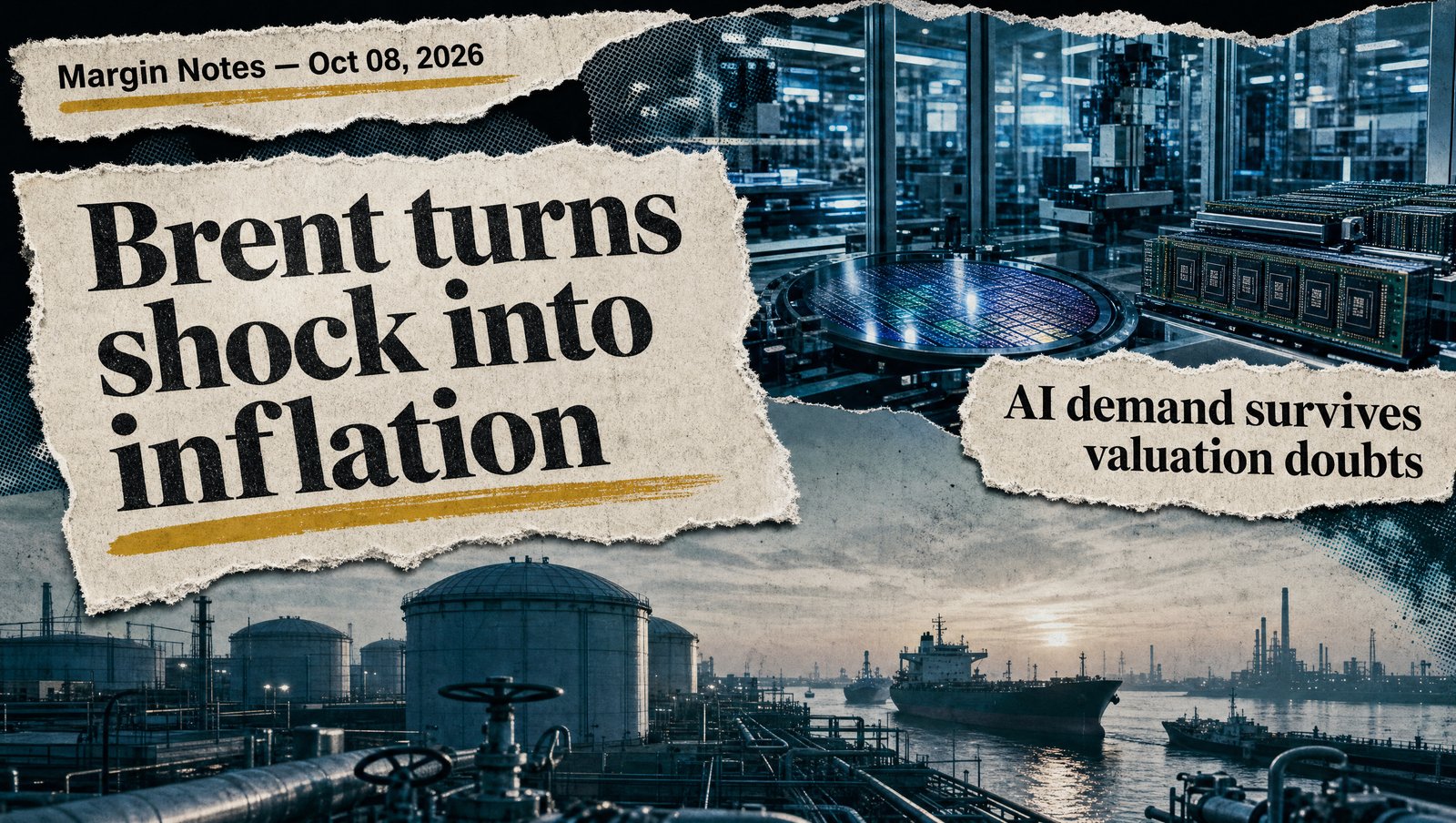
Brent Turns a Regional Shock Into an Inflation Bill
Brent crude reached $103.35 after attacks around Saudi Arabia and renewed reports of possible strikes involving Iran. Brent crude jumped 3.14% as supply fears returned to the tape, and the move was large enough to matter even though the broader equity decline remained modest. Oil does not need to crash the S&P 500 to change the market’s mood. It only needs to make the next inflation reading harder to interpret.
The attacks, which reportedly killed three people at Saudi airports including in Riyadh, add a direct human cost to what markets usually reduce to a shipping estimate. Houthi attacks killed three people at Saudi airports, tightening the link between regional escalation and the price of moving energy through the region. Gold rose 0.21% to $4,149.20, while the US 10-year yield held at 5.33%. That is not a clean flight to safety; it is capital dividing its attention between protection and income.
The US Fed’s latest minutes offer a partial counterweight. Officials showed little appetite for a sequence of rate increases, which keeps the policy path from becoming an automatic response to every oil headline. But an oil shock can still delay future easing by keeping inflation expectations elevated. The market is not choosing between growth and inflation today. It is being asked to finance both, which is the sort of compromise bonds tend to dislike.
AI Demand Survives, Valuations Do the Explaining
TSMC reported a 51% jump in quarterly revenue, offering hard evidence that artificial-intelligence demand has not yet wandered off to find a less expensive hobby. TSMC’s quarterly revenue rose 51% as AI demand held firm, while Samsung’s memory-chip profits surged almost nine-fold. The hardware cycle is real, and that matters because it makes the bearish case more difficult than simply pointing at lofty share prices.
The problem is that real demand and sensible valuation are not the same thing. Strategists warned an AI unwind could produce the S&P 500’s worst decline since 2008, a warning that lands differently with the index at 7,801.77 and the Nasdaq at 27,538.69. Technology slipped 0.22%, but the market’s internal picture was less uniform: industrials gained 2.14%, materials rose 1.53%, and health care advanced 1.06%. Investors are not abandoning growth. They are beginning to ask how much of it is already in the price.
That question is spreading beyond shares. Tencent is considering a $5 billion bond offering to fund its AI expansion, joining a global race in which balance sheets are increasingly part of the product pitch. The US 10-year yield at 5.33% gives lenders a useful negotiating position. AI can keep producing extraordinary revenue growth, but its sponsors still have to pay for the servers before the future arrives.
Coinbase Courts Banks as Crypto Finds Its Credit Function
Coinbase is positioning banks as future customers as well as competitors, a shift that says more about crypto’s maturation than another token launch would. Coinbase is pursuing banks as customers for its digital-asset infrastructure, moving the business case toward custody, settlement, and institutional trading rather than the old promise that every user will become a day trader. The distinction matters because financial plumbing can scale even when speculative appetite does not.
Price supplied the less flattering footnote. Bitcoin broke below $83,000 as the oil rally pushed traders out of leveraged positions, and crypto liquidations reached $547 million. Bitcoin broke below $83,000 as oil’s surge forced crypto deleveraging. A market can be building useful infrastructure and still sell off when collateral gets marked down. In fact, better access to credit can make the liquidation process faster, not gentler.
The institutional story is nevertheless broadening. Ripple is earning fees from financing leveraged stock positions, a business traditionally handled by banks, while Kazakhstan’s central bank is studying a local-currency stablecoin and tokenized assets with Tether. The sector is acquiring jobs in settlement and credit. It has not yet acquired immunity from oil, rates, or the ancient market tradition of selling what can be sold first.
Elsewhere
- Japan’s leaders argued the economy does not need reflationary policy, a position that could reduce expectations for another round of aggressive stimulus.
- Pakistan reached an IMF agreement unlocking $1.2 billion, giving the country additional fiscal breathing room.
- Ethereum’s Glamsterdam test processed blocks near 200 million gas, demonstrating a substantial increase in potential network capacity.
- Polygon connected its network to TRON’s $94 billion stablecoin ecosystem, reducing friction for cross-border transfers.
- Robinhood added $25 million of Bitcoin to its balance sheet, extending the corporate-treasury use case despite the day’s price weakness.
- Bitcoin-backed lenders reported funding tuition and working capital, suggesting collateralized digital-asset credit is moving beyond trading desks.
- Europol warned that exposed private keys face the main quantum-computing threat, putting migration planning ahead of the science-fiction headlines.