The Day in Numbers
- Brent crude: $101.42 — rose 0.84% as shipping risk lifted the global benchmark above $100.
- Crude oil: $90.10 — gained 0.74% despite the market’s continued habit of underreacting to geopolitical danger.
- US 10-year Treasury yield: 5.31% — stayed near its highest level in decades, keeping financing conditions tight.
- S&P 500: 7,818.93 — advanced 0.58% into record territory.
- Nasdaq: 27,599.89 — rose 0.45% as large technology companies kept the index buoyant.
- Bitcoin: $84,209.89 — fell 1.55% as oil, the dollar, and risk aversion crowded the trade.
- Ethereum: $2,617.65 — dropped 3.28%, underperforming Bitcoin as crypto liquidity thinned.
Hormuz Disruption Puts Energy Back in the Driver’s Seat
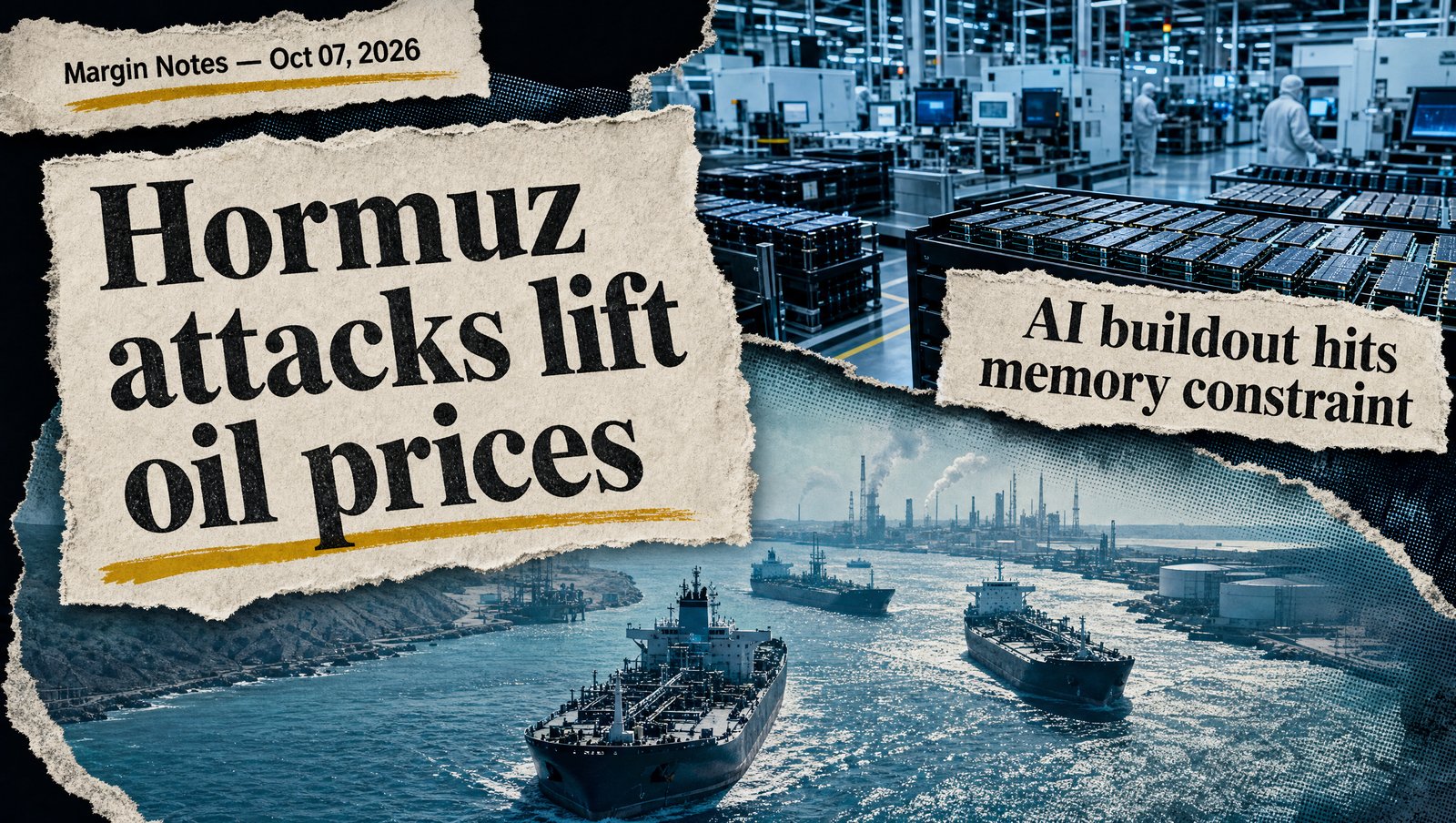
Iranian forces increased attacks on shipping around the Strait of Hormuz as Brent crude climbed 0.84% to $101.42. Iran’s attacks have made the energy chokepoint a live market variable, even though oil’s move remains smaller than the geopolitical facts would seem to warrant. The question is no longer whether the region is dangerous. It is whether the danger interrupts flows that markets still treat as broadly available.
That distinction matters because the Strait is not just another shipping lane with an unfortunate news cycle. The latest figures point to 87 fewer daily transits, while Brent is already 39.9% above its level at the start of the war. Oil is repricing the cost of supply insurance, and that cost reaches inflation expectations, household budgets, and the policy choices of central banks outside the region. Markets can absorb a frightening headline. They have more trouble absorbing a shortage that arrives on schedule.
Gold fell 0.64% to $4,160.40, an odd response only if safe havens are expected to behave like emergency sirens. The softer bullion price suggests investors are still balancing geopolitical protection against a 5.31% US 10-year yield. That is the day’s larger tension: energy risk is rising, but the return available from holding dollars and short-duration assets is still high enough to keep capital from stampeding.
AI’s Funding Story Faces a Memory Test
The S&P 500 reached 7,818.93 and the Nasdaq closed at 27,599.89, yet the rally’s technology leadership looked less comfortable beneath the surface. Investors carried the AI trade into a record-setting session, but Ray Dalio’s warning that the sector may be approaching a break point gives the advance a more conditional character. The market is still paying for future computing demand; it is simply becoming less willing to accept the invoice without checking the assumptions.
The physical bottleneck is now as important as the valuation debate. AMD chief Lisa Su is due to meet Samsung’s chip leadership as memory shortages persist, while Intel fell 3.18% even as Amazon rose 1.95%. The AI buildout is running into a memory constraint, which can raise hardware costs before it raises software revenue. SpaceX’s reported effort to secure $40 billion for Nvidia chips makes the same point from the financing side: this boom requires enormous capital, and capital tends to develop opinions when the bill gets large.
Utilities gained 3.01%, the best-performing sector, as investors continued to treat power supply as part of the AI investment case rather than an afterthought. Information technology rose 0.55%, a respectable gain that lagged the broader market. The message is not that AI has run out of fuel. It is that the fuel system, the hardware pipeline, and the financing structure are now part of the thesis. Narratives are wonderfully scalable. Memory chips are less so.
OKX Converts Crypto Enthusiasm Into Institutional Proof
OKX attracted backing from Standard Chartered, Circle, and Ripple at a $25 billion valuation, turning a crypto fundraising round into a referendum on who is willing to stand behind the market’s plumbing. Traditional finance and digital-asset firms have jointly underwritten OKX’s next phase, as the exchange moves toward payments, tokenized assets, and broader financial technology. A bank, a stablecoin issuer, and a crypto-native payments company are not exactly a random group chat. Their participation signals that counterparty confidence is becoming an investable feature.
Price action supplied the necessary caveat. Bitcoin fell 1.55% to $84,209.89, while Ethereum dropped 3.28% to $2,617.65 as oil rose and the dollar strengthened. Bitcoin slipped below the level traders had treated as support, and the movement of more than $100 million in US government-held Bitcoin and BNB added another source of supply anxiety, even without confirmation of a sale. Institutional infrastructure can improve the market without immediately improving its mood.
That split is becoming familiar but not meaningless. OKX’s capital base is expanding, Cardano is adding controls that let issuers freeze or restrict regulated assets, and Anvil has attracted a $5 million token investment led by Founders Fund. The industry is building systems that institutions can recognize. Meanwhile, the market still reacts to oil, official-wallet movements, and a 5.31% Treasury yield like a risk asset with a memory. Adoption is advancing. Patience remains in shorter supply.
Elsewhere
- Japan signaled it may review spending if yields move sharply, linking fiscal decisions more directly to the bond market.
- The European Central Bank said France does not yet qualify for intervention, leaving French debt exposed to continued investor scrutiny.
- Deeply distressed US loans reached their highest level since the pandemic, putting the soft-landing narrative on a less comfortable footing.
- China’s central bank added to its gold holdings in September, continuing its reserve diversification even as bullion weakened.
- Google expanded its nuclear-power strategy for AI energy demand, showing that computing capacity increasingly depends on industrial infrastructure.
- HubSpot cut 660 jobs in an AI-led restructuring, making automation’s labor-market consequences rather more tangible than the usual productivity slide.
- The US government moved more than $100 million in digital assets, though no sale has been confirmed.