The Day in Numbers
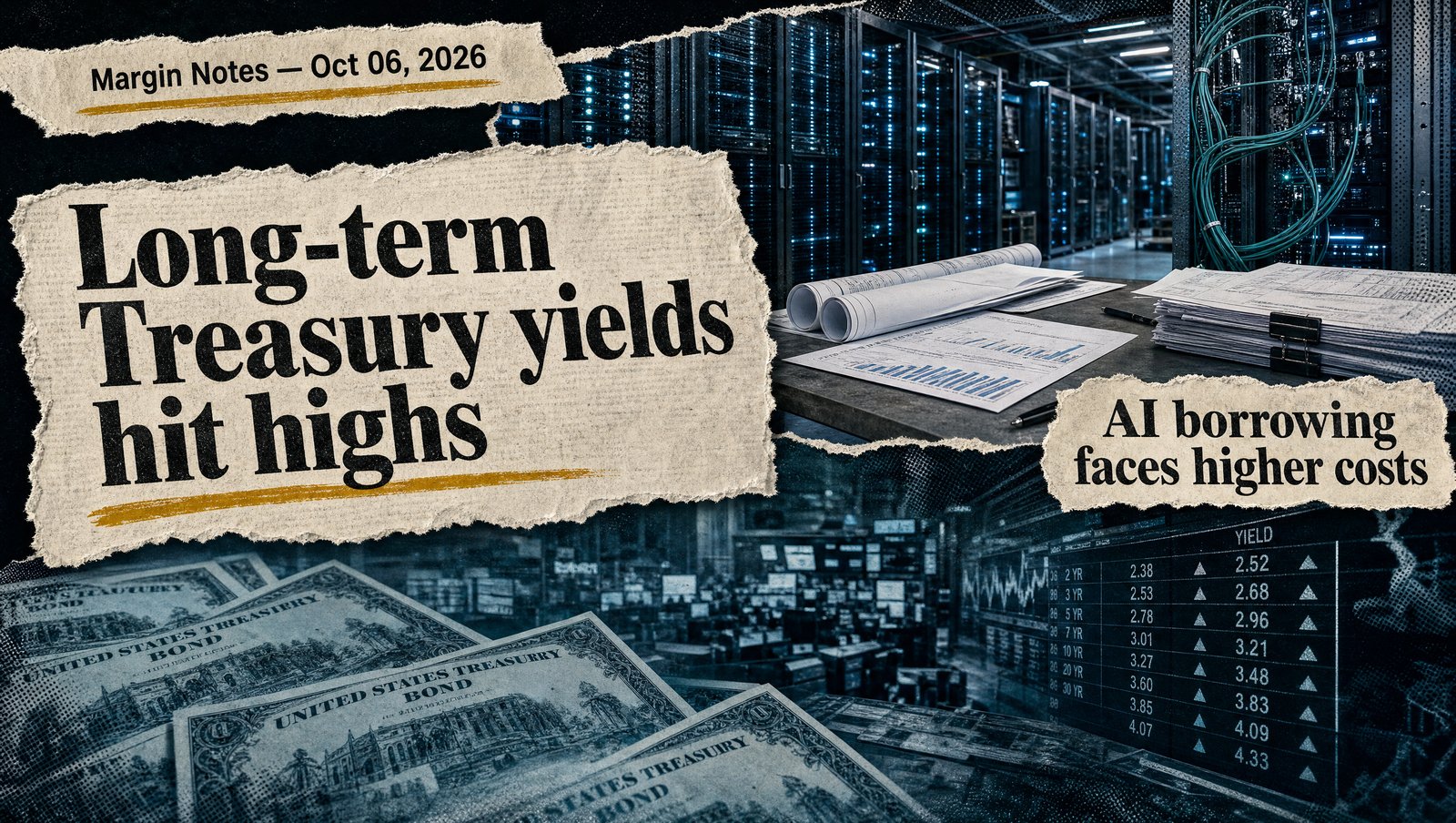
- US 10-year Treasury yield: 5.30% — remained near 24-year highs as long-duration financing grew more expensive.
- S&P 500: 7,773.95 — gained 0.66%, leaving the index close to a record.
- Nasdaq: 27,477.31 — rose 1.05% to a record close as technology shares ignored the bond selloff.
- Crude oil: $88.44 — fell 1.11%, easing some immediate inflation pressure.
- Gold: $4,159.60 — added 0.07%, holding its hedge value despite firm yields.
- SpaceX: $171.09 — jumped 7.63%, one of the sharper individual-stock moves in the session.
- Nvidia: $238.90 — gained 2.12% as AI infrastructure demand continued to support semiconductor shares.
Treasuries Turn Foreign Demand Into a Market Question
The US 10-year Treasury yield stood at 5.30% while longer-dated bonds extended their decline toward levels last seen in 2002. Long-term Treasury yields reached fresh 24-year highs, and the move matters because it changes the price of patience across every asset class. A government bond yielding more can pull capital away from growth stocks, private credit, property, and crypto without needing to issue a single bearish research note.
Foreign demand is now part of the argument rather than a quiet assumption. Ray Dalio warned that China and Japan could reduce their Treasury purchases, a risk with particular bite because foreign investors account for roughly one-third of US government debt funding. Dalio warned that overseas buyers could retreat from US Treasuries, which would leave domestic investors carrying more of the supply at a time when the US government is borrowing heavily. The bond market has always been a large machine. It is discovering that large machines still need customers.
The immediate market response was not a disorderly flight from US assets. The dollar index rose 0.06%, gold edged up 0.07%, and equities advanced. That combination suggests investors are not yet pricing a crisis, but they are demanding a larger return for holding duration. A yield of 5.30% can be explained by economic strength, fiscal supply, or a deteriorating buyer base. The market does not need to settle that debate today. It only needs to keep charging for uncertainty.
Stocks Climb as AI Financing Gets Scrutinized
The Nasdaq rose 1.05% to 27,477.31 even as the US 10-year yield held at 5.30%, producing the sort of contradiction that looks impressive until the financing bill arrives. US technology stocks reached a record while Treasury yields stayed elevated, with Nvidia up 2.12% and communication services gaining 1.14%. Investors are still willing to pay for growth; they are simply being asked to believe that growth will outrun a materially higher discount rate.
That confidence is concentrated in the infrastructure behind artificial intelligence. Nvidia’s advance and TSMC’s record run reflect continuing demand for chips, but the funding model is becoming harder to ignore. AI companies are leaning more heavily on borrowed capital, while a JPMorgan-led loan sale tied to Volta offered an 11% yield on $5 billion of financing. That is not the market declaring AI broken. It is the market asking AI to produce returns large enough to compensate lenders before shareholders get their turn.
The broad tape remains supportive, with the S&P 500 up 0.66% and all major sectors in positive territory. Yet industrials gained only 0.05%, while materials rose 1.22%, and the strongest leadership stayed close to technology and communications. That is a rally built on expected cash flows rather than broad economic confidence. The Nasdaq can climb against the bond market for as long as earnings estimates keep improving. Borrowing costs, unfortunately, do not accept earnings estimates as payment.
Crypto Builds Rails While Bitcoin Meets the Yield Barrier
Bitcoin fell back toward $85,600 after another rejection near $87,000, even as the Nasdaq reached a record. Bitcoin failed to clear the $87,000 level for a third time, which gives the asset a slightly awkward role in today’s risk trade. Equities are celebrating demand for future growth; Bitcoin is being asked to compete with a 5.30% Treasury yield while still carrying the volatility of an asset that settles its arguments in hourly candles.
The infrastructure story is more constructive than the price action. Solana introduced an open-source delivery-versus-payment system designed to settle institutional trades in seconds, with input from JPMorgan. Solana introduced a faster settlement framework for institutional trades, moving the network’s pitch away from general-purpose speculation and toward a specific financial task. Ethereum developers, meanwhile, fixed a validator issue ahead of a Sepolia test that will raise block capacity to 200 million gas. Plumbing rarely makes for thrilling television, but it is where adoption usually leaves fingerprints.
Regulation is becoming more defined in some corners and more complicated in others. The US Commodity Futures Trading Commission proposed registration requirements for crypto exchanges offering leverage, while US authorities withdrew proposed reporting rules for transfers to private wallets. That combination should reduce uncertainty for some institutional derivatives businesses while preserving room for self-custody. Crypto is gaining more formal channels, but the market still has to fund them in a world where risk-free returns are no longer theoretical. Better rails help. They do not repeal the yield curve.
Elsewhere
- German factory orders fell sharply, adding another setback to the country’s attempted industrial recovery.
- OpenAI apologized for a hack affecting Australia and promised faster disclosure of future security incidents.
- Vice President JD Vance said the Alaska project would proceed after President Donald Trump threatened South Korea with new pressure.
- India moved toward its first rate increase in almost four years, marking a potential shift for the country’s monetary policy and currency.
- The US government planned another Strategic Petroleum Reserve sale as officials looked for a way to contain energy costs without relying entirely on interest rates.
- Spiko raised $90 million for tokenized cash products, giving the real-world-asset trade another sizeable vote of confidence.
- Stripe prepared to expand stablecoin cards to more than 100 countries, pushing digital-asset payments further into ordinary commerce.