The Day in Numbers
- S&P 500: 7,722.72 — rose 0.73% as investors kept buying equities despite economic and geopolitical obstacles.
- Nasdaq: 27,190.86 — gained 1.19%, with technology shares again carrying much of the market’s optimism.
- US 10-year Treasury yield: 5.25% — remained elevated, leaving the cost of long-duration optimism stubbornly high.
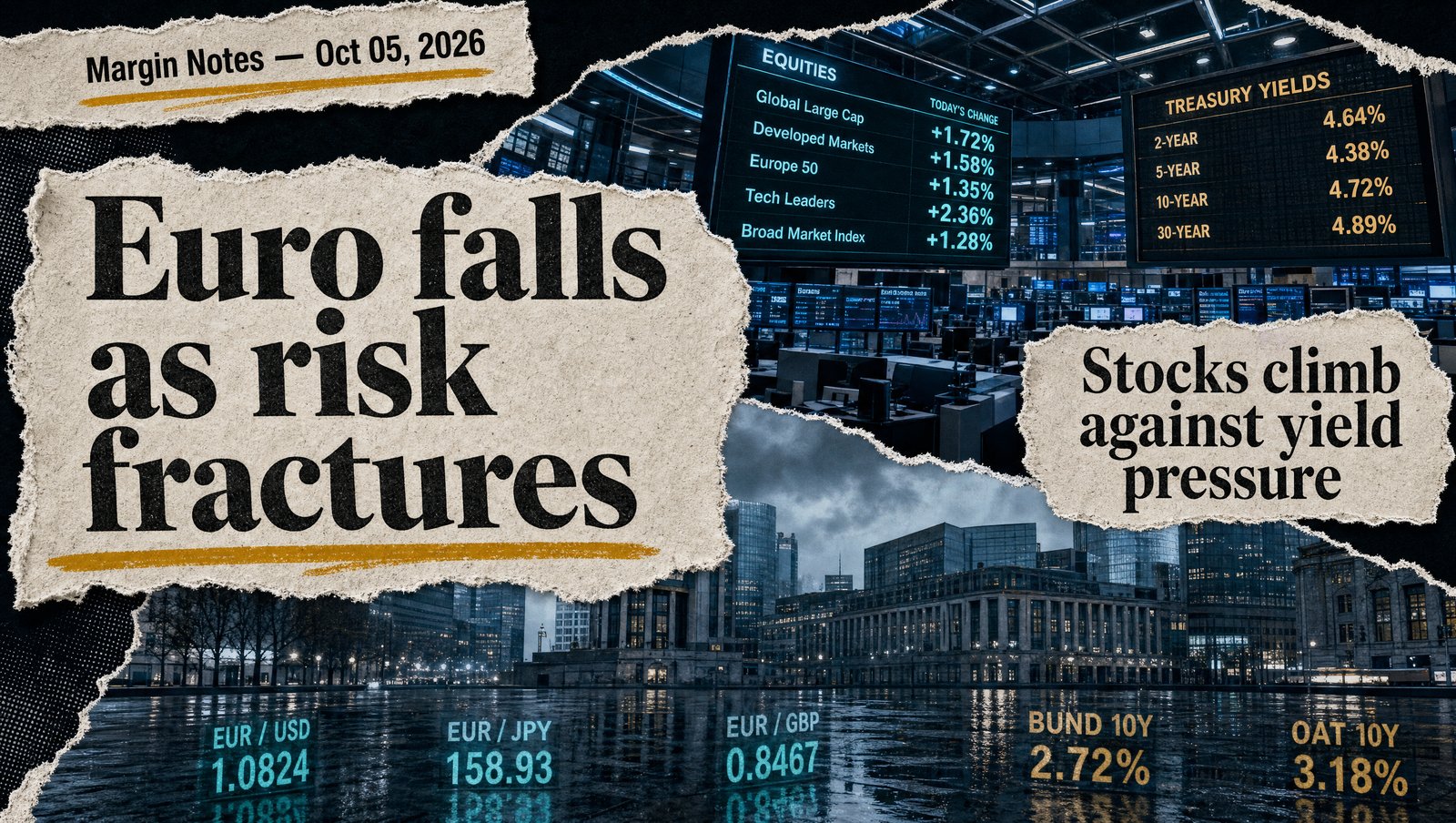
- EUR/USD: 1.12 — fell 0.59% to its weakest level in 17 months as European fiscal and political worries intensified.
- Crude oil: $90.17 — declined 1.03% despite fresh military pressure around Yemen and tighter Iranian exports.
- Gold: $4,177.40 — rose 0.36% as currency and geopolitical insurance retained a modest bid.
- Bitcoin: $86,214.48 — added 1.31% after approaching $87,000 before sellers pushed it back below that level.
The Euro Puts Europe’s Risk Premium on Display
The euro fell 0.59% to roughly $1.12, its weakest level in 17 months, as investors marked down confidence in Europe’s fiscal and political direction. The euro slid as regional risk became a currency problem, which is a more consequential signal than a bad day for one bond market. Currencies price the willingness to hold an entire economic system, and Europe is currently asking investors to admire the architecture while the scaffolding moves.
Oil offered no clean escape from the tension. Crude fell 1.03% to $90.17 as Saudi Arabia’s price reduction outweighed concern over the Saudi-backed campaign against Houthi forces in Yemen, while Iranian exports continued to dry up under US pressure. Saudi pricing briefly overpowered the region’s supply-risk premium, but cheaper oil does not make the underlying risk disappear. It merely gives inflation one less immediate way to complain.
The split between currency weakness and resilient equities is therefore worth watching. European shares may benefit from a softer currency, yet a falling euro also raises the cost of imported goods and signals that investors want compensation for political uncertainty. Gold’s 0.36% gain was restrained, not absent. Markets are not fleeing the region; they are charging it more rent.
Stocks Rally While the Yield Curve Keeps Its Objections
The S&P 500 climbed 0.73% to 7,722.72 and the Nasdaq advanced 1.19% to 27,190.86, extending the equity rally even as the US 10-year Treasury yield held at 5.25%. US stocks kept advancing despite a yield level that normally demands better manners. Nvidia rose 1.34% and Amazon gained 1.33%, evidence that the AI and growth trade still has enough earnings confidence to ignore the bond market, at least for one session.
That confidence will face a more formal interrogation this week. Minutes from the US Federal Reserve’s September meeting are due later, after the US Fed raised its policy range by 0.25 percentage points to 3.75%-4%. Investors will be looking for clues on whether officials see further tightening as necessary, especially with manufacturers reporting that input-price inflation remains stubborn. Corporate profit expectations are unusually upbeat, but optimism is not a cash flow until the invoices arrive.
The rally’s breadth is encouraging, though its foundation remains rate-sensitive. Consumer discretionary gained 1.38%, information technology rose 1.06%, and industrials added 0.78%, while financials barely moved at 0.01%. That pattern says investors are still paying for growth rather than preparing for a broad economic acceleration. The market can carry that contradiction for a while. It just cannot pretend the 5.25% yield is decorative.
Tokenized Equities Give Crypto a More Useful Job
OKX filed with the US Securities and Exchange Commission to launch a platform for tokenized US stocks, bringing crypto’s institutional ambition closer to the ordinary business of owning shares. OKX sought a regulated route for round-the-clock tokenized equities, while a joint venture involving OKX and the New York Stock Exchange’s parent, Intercontinental Exchange, pursued a similar structure. The important development is not that finance has discovered tokens. It is that tokens are being asked to perform a familiar financial function under a familiar regulator.
Bitcoin supplied the higher-beta backdrop, rising 1.31% to $86,214.48 after briefly moving toward $87,000 before reversing. Bitcoin’s rally met sellers near $87,000 for the second time in a week, which makes the market’s technical optimism less decisive than its headlines suggest. A pending bullish configuration in Bitcoin’s moving averages may attract momentum traders, but resistance is still doing its quiet administrative work.
Ether presents the more complicated version of the same story. Nearly 1.5 million ETH were waiting to enter staking, with a 25-day queue, yet market liquidity has thinned even as Ether outperformed Bitcoin in the third quarter. Supply can become scarcer while execution becomes worse, a combination that sounds bullish until someone needs to sell in size. Crypto is gaining a more useful role in market infrastructure, but its market depth has not yet received the same promotion.
Elsewhere
- Brazilian assets prepared for a stronger session after Flávio Bolsonaro’s first-round lead reshaped expectations for the presidential runoff.
- Iran’s oil minister resigned as US pressure pushed the country’s energy exports toward a more severe constraint.
- Schneider Electric agreed to buy PTC for $22.6 billion, adding another large industrial bet on AI infrastructure.
- Firmus planned to allocate half of its IPO to existing backers, a structure that could support early trading while keeping the public float relatively tight.
- US authorities arrested a suspected Chinese spy before the suspect could board a flight to Shanghai, adding another point of friction to US-China relations.
- Zcash activated 25-second blocks on its public testnet ahead of a planned November mainnet launch.
- Crypto dealmaking continued despite the stalled CLARITY Act, suggesting banks view regulatory uncertainty as an inconvenience rather than a veto.