The Day in Numbers
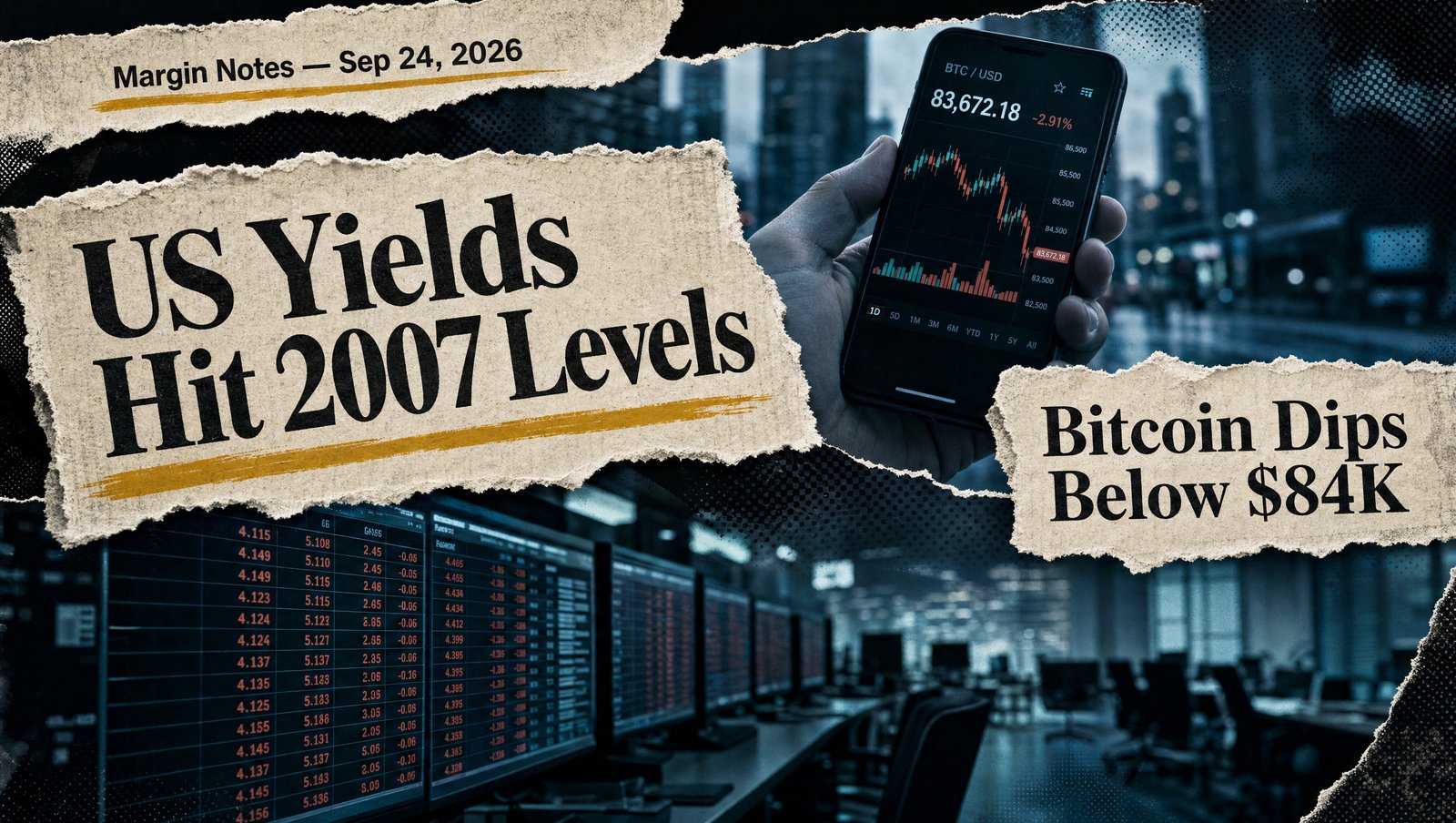
- US 10Y Yield: 5.11% — climbed to its highest level since 2007.
- Nasdaq: 26,936.04 — slid 1.13% as the market repriced Fed rate-hike bets.
- S&P 500: 7,706.03 — dropped 0.75% amid concerns over extreme market concentration.
- Bitcoin: <$84,000 — fell as macro pressure overrode institutional optimism.
- Brent Crude: $98.78 — climbed 0.67% as US-Iran tensions clouded supply outlooks.
- European Gas: +3.6% — surged daily on fears of regional energy shortages.
The 2007 Ghost Returns to the Bond Market
A surge in US 10-year Treasury yields to 5.11% has effectively ended the risk-on honeymoon. The market is no longer trading on the hope of a diplomatic thaw, but on the fear that yields surged above 5% because the US Federal Reserve is preparing for further tightening. When the cost of capital spikes this violently, the discount rate for every growth asset on the planet shifts, which is why the Nasdaq and S&P 500 retreated in tandem.
This selloff is particularly dangerous because market breadth has narrowed to levels not seen since the dot-com peak. The rally has been carried by a handful of AI giants, leaving the rest of the market fragile. So, when the bond market rout deepens—with Japan's 10-year yields also hitting multi-decade highs—the result is a systemic liquidity squeeze. The market has realized that the "AI cushion" only works if the plumbing of the global bond market remains stable.
Bitcoin’s Macro Shiver and the $15 Billion Gamble
The slide of Bitcoin below $84,000 serves as a stark reminder that macro gravity always wins. The asset's recent struggle is a direct result of the Treasury rout; as the opportunity cost of holding non-yielding assets rises, the high-beta pulse of crypto is the first to flutter. Which is why the asset is currently caught in a tug-of-war between a brutal macro backdrop and a massive derivatives event.
Bulls are essentially betting that the derivative book can override the Treasury's mood, as $15 billion in options are expiring soon. The options book is notably "call-heavy", suggesting that traders are positioning for a breakout despite the yield spike. The thesis is no longer about the asset's intrinsic value, but about whether the dealer hedging flows from this settlement can trigger a short-term rally that ignores the 5% yield wall.
The Strategic Pivot to Digital Dollar Dominance
Strategic plans to promote dollar-backed stablecoins globally are now being weighed by the US government to cement the greenback's reserve status. This move represents a fundamental shift in the US Treasury's approach: instead of fighting the stablecoin ecosystem, Washington is looking to weaponize it. By integrating the dollar into the digital plumbing of other nations, the US is attempting to ensure that the "digital age" remains a dollar-denominated age.
This institutional pivot is being mirrored in Asia, where Hong Kong sought up to $2.6 billion in digital bonds in a record sale. The logic is clear: while the price of risk assets shivers under the weight of rising rates, the infrastructure of the global financial system is being rebuilt on-chain. The market is essentially decoupling the "price" of the assets from the "plumbing" of the system; the yields are high, but the transition to tokenized finance is accelerating regardless of the Fed's mood.
Meanwhile
- BitMEX officially closed its doors after eleven years as a pioneer of high-leverage perpetuals.
- Coinbase expanded its Morpho loans to allow users to borrow against Bitcoin at fixed rates.
- BlackRock suggests AI agents will create a new wave of demand for crypto assets through autonomous payments.
- The NYSE partnered with Blockchain.com to distribute tokenized stocks to crypto-native investors.
- Palantir sealed a dramatic comeback by closing at its highest level of the year.
- Mark Carney discussed the 'extreme tail risk' of a US invasion of Canada in a recent interview.
- MoonPay agreed to acquire North Capital in a $60 million all-stock deal to boost its RWA capabilities.