The Day in Numbers
- US 10-year Treasury yield: 4.98% — stabilized as the bond market accepted the US Fed's hawkish resolve.
- S&P 500: 7,551.81 — fell 0.45% as the first rate hike in three years hit valuations.
- Dow Jones: 51,461.90 — dropped 1.21% (631 points) in a sharp risk-off reaction.
- Crude Oil: $100.77 — dipped 1.62% as Saudi Arabia worked to restore a key pipeline.
- Gold: $4,349.10 — slipped 0.88% as the immediate shock of the rate hike outweighed haven demand.
- Bitcoin ETFs: -$450 million — saw the largest single-day outflow since June.
Institutional Resolve Overrides Political Noise
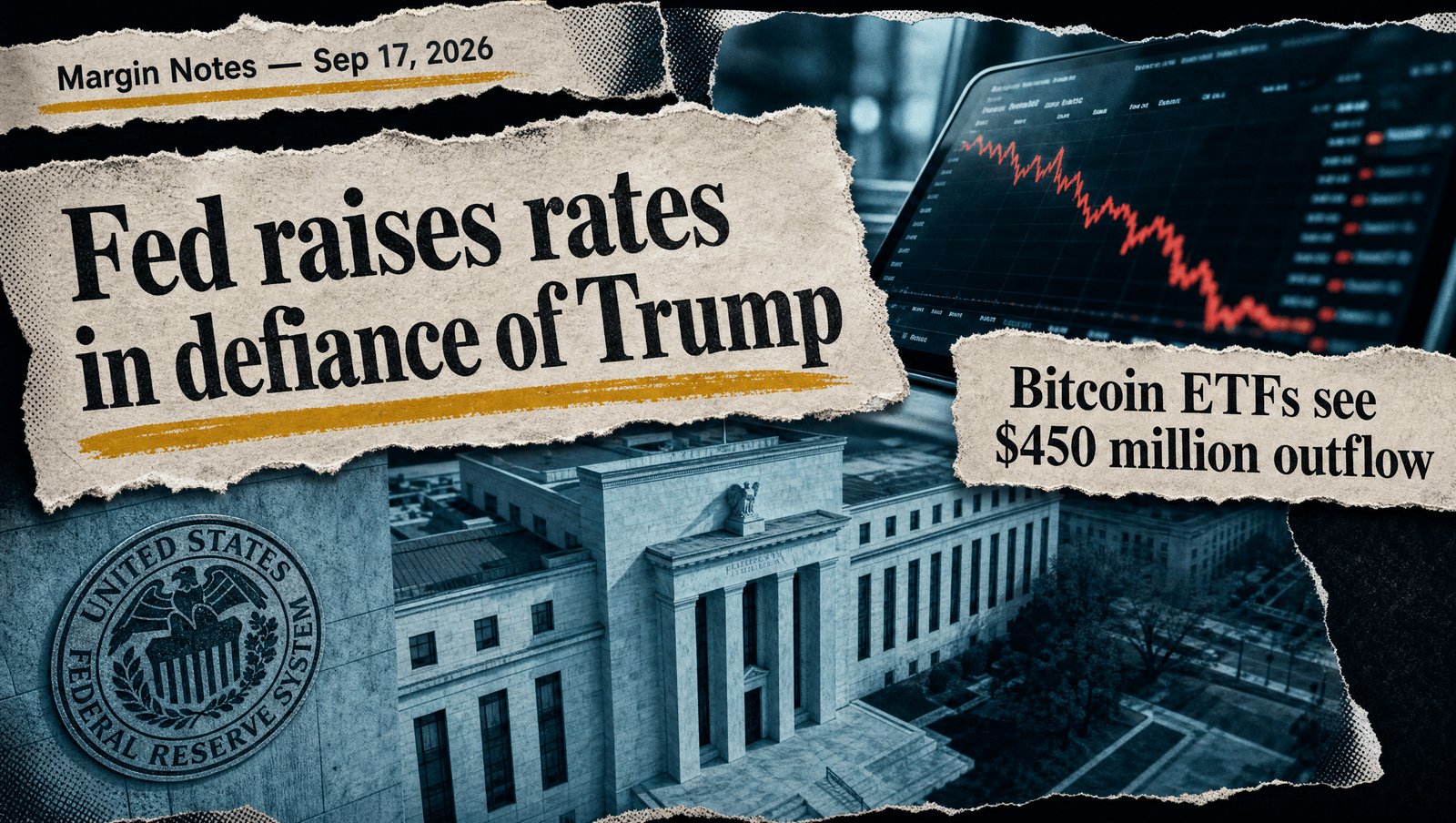
The US Federal Reserve raised interest rates by 25 basis points, marking the first hike since July 2023 and a direct defiance of President Trump's public demands for a cut. The move was a calculated play for credibility; by ignoring the White House and prioritizing price stability, US Fed Chair Kevin Warsh essentially told the market that the central bank is back in the driver's seat. The initial reaction was violent, with the Dow falling over 600 points, but the underlying bond market reacted with surprising calm.
This stability suggests that traders are more afraid of runaway inflation than they are of a slightly higher cost of capital. Global bond yields retreated once it became clear that the US Fed is committed to a hiking cycle, which in turn lowered the volatility that had plagued risk assets for the last week. The market didn't necessarily like the hike, but it liked the certainty that the US Fed has a plan—which is often the only thing a nervous investor actually wants.
The Physicality of the Inflation Fight
Russian missiles struck Kyiv just as Ukrainian forces targeted a major Russian oil refinery, ensuring that the "war-stoked inflation" cited by the US Fed remains a structural reality rather than a temporary spike. While crude oil dipped toward $100.77 as Saudi Arabia moved to restore pipeline flow, the fundamental tension is that energy prices are now being written by drone strikes and refinery fires.
This is why the US Fed's hawkish bias is now a necessity rather than a choice. Central banks cannot fix a broken refinery, but they can prevent the resulting price shocks from embedding themselves into wage expectations. By hiking rates into a geopolitical storm, the US Fed is attempting to build a firewall around the rest of the economy, effectively treating the energy market as a contaminated zone that cannot be allowed to infect the broader price index.
Crypto's Liquidity Audit
US spot Bitcoin ETFs shed $450 million, the largest outflow since June, as the sector suffered a "double whammy" of higher borrowing costs and the collapse of the Clarity Act. When the US Fed raises the cost of money and the US Senate removes the hope of regulatory sanctuary, the first thing investors do is sell the most liquid risk asset they own. Bitcoin is no longer acting as a hedge; it is acting as a high-beta proxy for global liquidity.
Yet, the wreckage is not uniform. Zcash jumped 23% as investors sought privacy-centric assets, and the US House tax committee managed to advance a crypto tax bill, proving that the "plumbing" of the industry is still being installed even as the price action falters. The institutional appetite hasn't vanished—as evidenced by Deutsche Bank nearing a debut in crypto custody—but the era of "free money" growth is over. The sector is now being asked to prove its value in a world where 5% yields are the baseline.
Elsewhere
- Apollo is considering raising a loan to $9 billion to support SoftBank's strategic bets on OpenAI.
- Tether expanded its gold-backed lending by providing a $1.5 billion facility for a US bullion dealer.
- President Trump threatened EU tariffs if Canada's invitation to the EU is deemed a hostile act.
- Crypto exchange CoinEx is shutting down after nine years, giving users until December to withdraw funds.
- Revolut hackers demanded $3 million in Monero, threatening to leak sensitive customer data.
- India's purchase of US Treasuries hit a record as capital inflows continued to stabilize the bond market.