The Day in Numbers
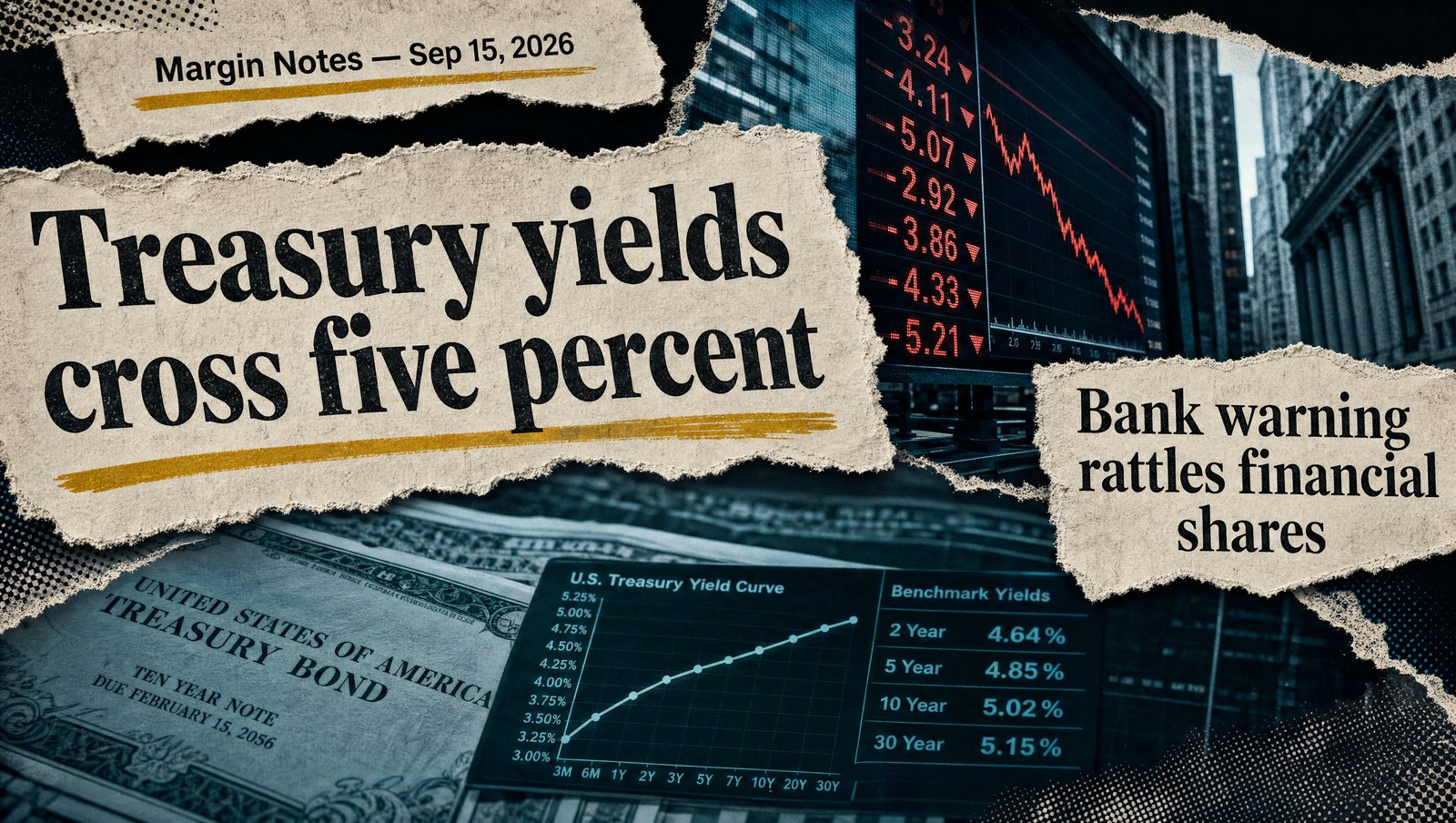
- US 10-year Treasury yield: 5.03% — reached its highest level since 2007 as the US Federal Reserve meeting approached.
- Brent crude: $107.70 — gained 1.91%, leaving oil roughly 48.3% above its level at the start of the war.
- US crude: $103.40 — rose 1.98% as the halted pipeline tightened the supply picture.
- S&P 500: 7,619.98 — fell 0.48% as higher yields pressured valuations.
- Nasdaq: 26,186.41 — declined 0.56%, with information technology down 1.67%.
- Bank of America: $59.47 — dropped 5.14% after management warned that third-quarter trading revenue would be relatively flat.
- Gold: $4,332.70 — slipped 0.44%, offering little protection against the day’s inflation and geopolitical concerns.
Treasuries Push Inflation Risk Into Every Valuation
The US 10-year Treasury yield reached 5.03%, its highest level since 2007, as investors prepared for the US Federal Reserve’s two-day meeting. Treasury yields crossed the five-percent line, and the number matters because it gives pension funds, insurers, and cash-heavy investors a respectable alternative to almost everything that does not mature with a coupon.
Oil is making the bond market’s job less forgiving. Brent crude reached $107.70 and US crude $103.40 after a pipeline halt tightened supply, while Goldman Sachs warned that the conflict could escalate. A fresh supply interruption pushed crude higher, turning an already expensive barrel into a renewed argument about second-round inflation. Central bankers cannot repair a pipeline with a policy rate, but they can try to stop an energy shock from becoming a wage and expectations problem.
That is why the coming US Fed decision carries more weight than the rate itself. The market is not merely asking whether officials tighten; it is asking whether they believe inflation is still containable without breaking demand. The dollar index rose 0.28%, the euro slipped 0.17% against it, and global shares weakened. The bond selloff is forcing investors to reprice risk assets, which is a polite way of saying that every distant cash flow has just become more expensive to own.
Bank of America Exposes the Cost of Waiting
Bank of America shares fell 5.14% to $59.47 after Chief Executive Brian Moynihan said third-quarter trading revenue would be relatively flat. Bank of America’s revenue warning hit financial shares, and the move landed awkwardly beside a 5.03% Treasury yield: higher rates can help banks’ net interest income, but they do not guarantee strong deal flow, trading activity, or a healthy appetite for risk.
The broader equity tape reflected that distinction. The S&P 500 lost 0.48%, the Nasdaq fell 0.56%, and information technology dropped 1.67%, while communication services gained 2.79% and health care rose 1.35%. Nvidia declined 3.36%, even as Alphabet gained 3.22%. Technology shares bore the heaviest valuation pressure, because long-duration growth is where a higher discount rate tends to make itself most visible.
That leaves investors with a narrower definition of resilience. A company can have strong demand and still suffer if financing costs rise faster than earnings expectations. Banks can benefit from higher rates and still disappoint if markets go quiet. The rally is not dead; it is simply being asked to show its work, which is an exhausting request for any asset that has enjoyed several years of generous assumptions.
Bitcoin Finds the Legislative Waiting Room Expensive
Bitcoin fell from around $79,530 to roughly $77,800 as the US Senate prepared to vote on the CLARITY Act. Bitcoin lost momentum as the Senate vote approached, with the retreat combining a thinner pre-vote market with the less glamorous pressure of a 5.03% Treasury yield. The token is behaving like a liquid risk asset again, which is inconvenient for anyone who had just promoted it to permanent safe haven.
The bill itself has not reached a clean binary outcome. Democratic senators sent a counteroffer, while a bipartisan group of 17 state attorneys general urged rejection over concerns about federal preemption. Senate negotiations are extending crypto’s regulatory uncertainty, so investors are discounting not only whether the legislation passes, but whether the final text gives exchanges, issuers, and custodians rules they can actually use.
There is a more durable institutional story underneath the volatility. A House committee has circulated a crypto tax bill addressing small transactions and staking, and the US Securities and Exchange Commission says it will continue work on issuance, custody, and transfer-agent rules even without legislation. The infrastructure is therefore advancing while the price hesitates. Bitcoin can fall on the vote, Ethereum can attract strategic buyers, and the industry can still be building a larger financial machine. Markets are perfectly capable of holding contradictory opinions, especially before lunch.
Elsewhere
- Japan considered raising defense spending to 3.5% of GDP, adding another potential source of fiscal pressure to the world’s bond markets.
- Chinese consumption and investment weakened while factories kept expanding, widening the gap between industrial output and household demand.
- The Bank of England reportedly planned to stop selling long-dated bonds, a move that could reshape liquidity and the UK yield curve.
- Bitmine added $68 million of Ethereum to its holdings, bringing its position close to 5% of the network’s total supply.
- Consensys separated MetaMask from its institutional blockchain business, giving the wallet and infrastructure operations distinct strategic homes.
- Oracle cut jobs as its AI investment program accumulated more debt, offering a reminder that computing capacity still has to earn a return.