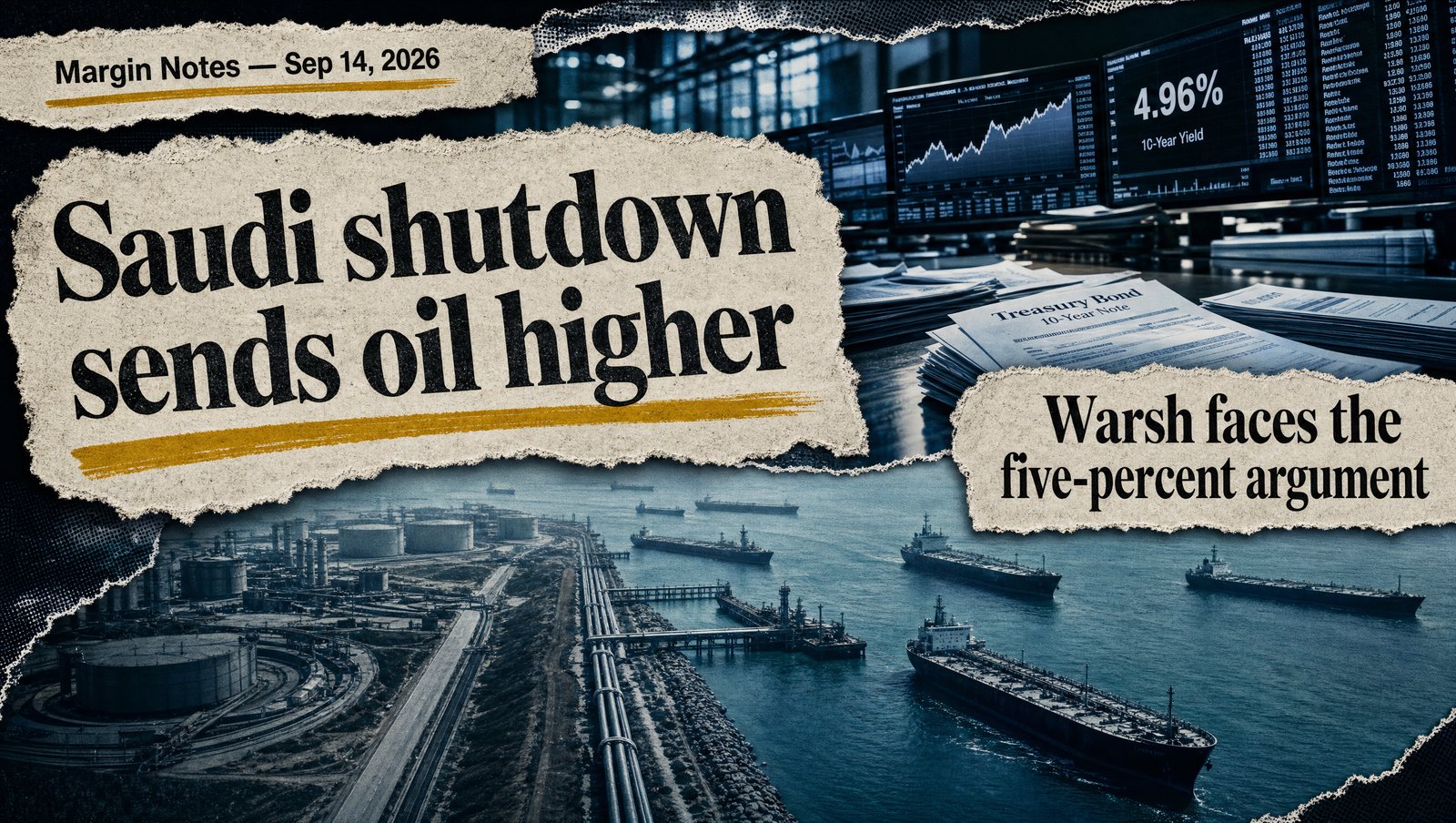
The Day in Numbers
- Brent crude: $107.22 — rose 2.49% as Saudi pipeline and Strait of Hormuz disruptions tightened supply.
- US crude: $102.60 — gained 2.55%, keeping fuel costs firmly in the policy debate.
- S&P 500: 7,656.98 — advanced 0.86% despite energy and rate concerns.
- Nasdaq: 26,333.04 — rose 0.96% as technology shares recovered, at least temporarily, from AI-slowdown worries.
- US 10-year Treasury yield: 4.96% — hovered just below 5% as investors weighed a possible rate increase.
- Gold: $4,363.20 — fell 1.04%, an oddly relaxed performance for a traditional haven during a geopolitical shock.
- Copper: $6.46 — declined 1.32% as higher-rate expectations outweighed industrial-demand optimism.
Saudi Supply Shock Leaves Central Banks With the Wrong Tool
Brent crude climbed to $107.22 after a Saudi East-West pipeline shutdown added a fresh interruption to an already strained energy system. The Saudi pipeline shutdown pushed Brent higher, while US gasoline rose 2.2% to $4.20 and European benchmark gas gained 5.4% to $83.80. There is still no clear timetable for the pipeline to resume, which makes the price move more than a one-session geopolitical premium.
Higher rates will not restore a pipeline, move a tanker through a nervous shipping lane, or manufacture another barrel of crude. They can keep the second-round effects from becoming permanent, however, and that is why bond investors are demanding a policy response even though the original shock is coming from supply. Bond traders are prioritizing inflation control over near-term growth, a decision that makes perfect sense in a model and feels less comforting at the petrol station.
That tension is spreading beyond energy. The pound slipped 0.25% against the dollar as the Bank of England’s dovish majority faced pressure from war-driven fuel costs, while emerging-market equities weakened under the combined weight of geopolitical risk and higher US yields. The S&P 500 still gained 0.86%, but the advance does not erase the problem. Equities can rise on positioning and earnings; households eventually receive the energy bill.
Kevin Warsh Faces a Five-Percent Argument
The US 10-year Treasury yield reached 5% as markets overwhelmingly prepared for a US Federal Reserve rate hike, putting Kevin Warsh’s policy judgment and political independence in the same frame. Kevin Warsh is approaching a rate decision with bond investors already asking for restraint. The White House says it supports the next decision, despite the increasingly public dispute over borrowing costs, which is a diplomatic way of saying the argument has become impossible to keep private.
The case for tightening is not that a rate increase will lower gasoline prices tomorrow. It is that officials fear an energy shock, food costs, and wage expectations could reinforce one another if demand remains too strong. Goldman Sachs and JPMorgan now expect a September hike, while the US 10-year yield held at 4.96% and the 30-year reached 5.366%. Higher yields are making cash and fixed income harder for investors to ignore, especially when the alternative is paying premium multiples for growth whose future cash flows are being discounted more severely.
Stocks managed a broad rebound, with the Nasdaq up 0.96% and the S&P 500 up 0.86%, but the leadership is becoming less automatic. Corporate profit forecasts are beating expectations unusually often, with AI a major contributor, yet warnings from OpenAI and Anthropic executives about development risks helped send SoftBank shares lower. AI earnings support remains strong while the technology narrative becomes less frictionless. That is the new test for risk assets: good profits may keep prices afloat, but they no longer get to set the entire story.
Crypto Gets Institutional Access, Not a Free Liquidity Pass
Singapore Exchange is considering crypto perpetual futures listings as US policy encourages traditional venues to bring derivatives closer to regulated financial infrastructure. Singapore Exchange is joining the race for regulated crypto derivatives, potentially widening institutional access even as higher yields make leverage more expensive. The product is becoming respectable faster than the underlying appetite for risk is becoming reliable.
That distinction matters with Bitcoin recently slipping below $80,000 and the US Senate returning to an unresolved vote on the CLARITY Act, expected September 15. Regulatory clarity could support exchanges, issuers, and compliance-heavy projects, but a delayed or altered bill would leave investors with the familiar crypto condition: plenty of infrastructure, fewer firm rules. The CLARITY Act is still suspended between progress and delay, which is an unusually accurate description for a bill being watched by an industry built around binary outcomes.
Stablecoins offer a more practical version of the same institutional push. Circle’s proposed $400 million purchase of Tazapay would add payment links in emerging markets that are difficult to build from scratch, while crypto derivatives seek a larger home in conventional exchanges. Circle is buying distribution that takes years to assemble. Prices remain tied to global liquidity, but the plumbing is steadily becoming harder for banks and regulators to dismiss.
Elsewhere
- OpenAI delayed plans for a public listing, keeping one of the largest potential technology offerings out of this year’s issuance calendar.
- Elon Musk supported calls for slower AI development, adding another prominent voice to the sector’s growing safety debate.
- Larry Ellison canceled a planned $7.5 billion Oracle share sale, removing a large potential source of near-term supply.
- China’s intelligence chief warned about artificial-intelligence risks, bringing national-security concerns into the global technology discussion.
- Firmus sought to raise $5 billion through an Australian IPO, showing that demand for data-center infrastructure has not entirely cooled.
- The Swiss public debate over neutrality moved toward a vote, reopening questions about the country’s strategic position in a more divided Europe.