The Day in Numbers
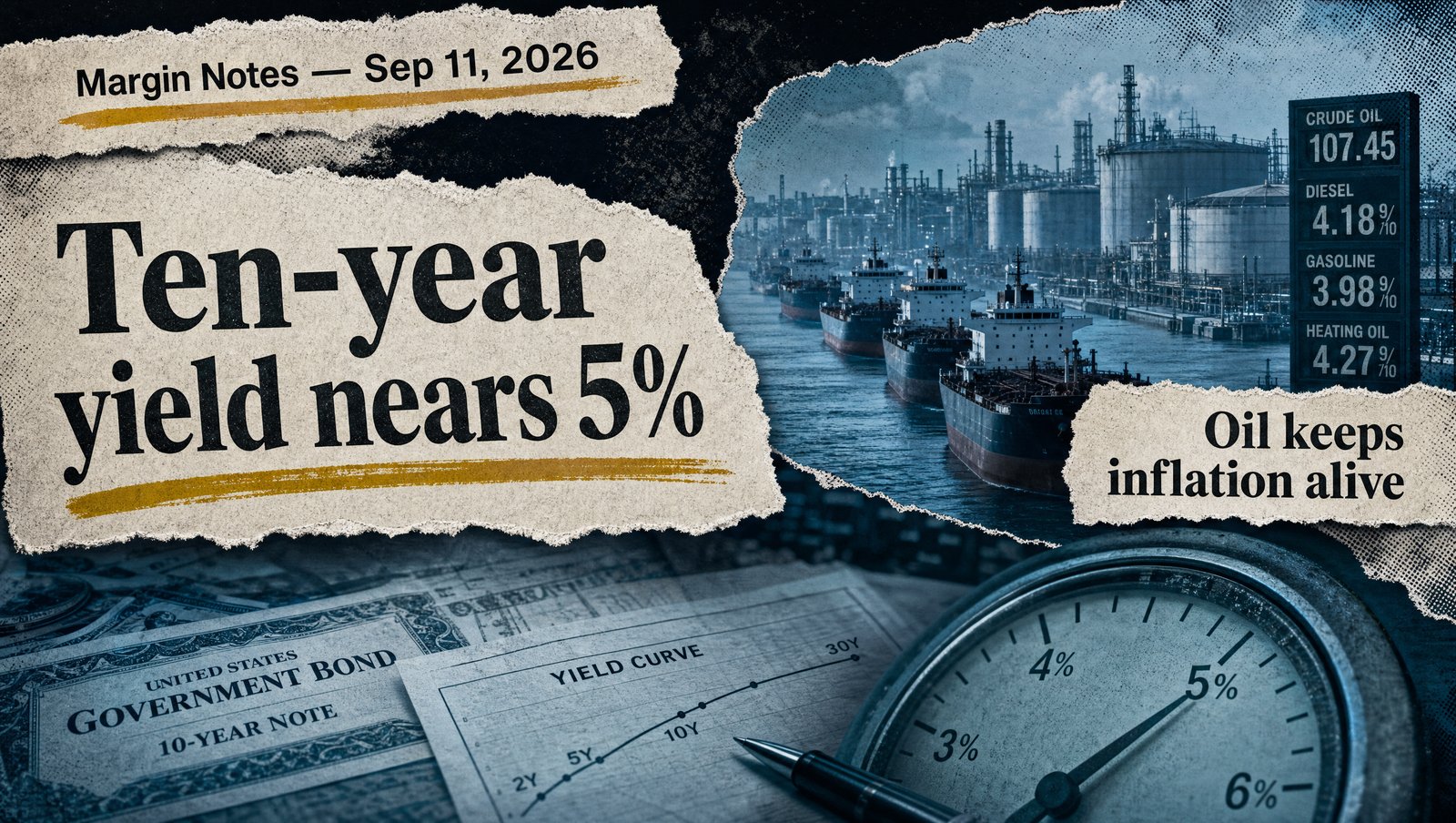
- US 10-year Treasury yield: 4.95% — approached the psychologically important 5% threshold as bond selling broadened.
- US 30-year Treasury yield: 5.363% — kept long-term borrowing costs firmly elevated.
- Brent crude: $105.94 — slipped 1.57% but remained roughly 49% above its level when the conflict began.
- US crude: $101.13 — fell 1.32% while staying above $100.
- S&P 500: 7,591.70 — declined 0.58% for a fourth consecutive session.
- Nasdaq: 26,081.72 — fell 0.65% as technology shares absorbed higher discount rates.
- VIX: 17.84 — rose 8.38%, showing that investors were paying more for protection.
Ten-Year Yields Test the 5% Ceiling
The US 10-year Treasury yield reached 4.95% as a global bond selloff brought the 5% threshold within touching distance. The US bond market pushed borrowing costs toward 5%, and the significance is less numerical than psychological: once a supposedly safe asset offers that much yield, every risk premium in the market has to explain itself again.
US Treasury Secretary Scott Bessent has argued that buybacks are improving the market’s plumbing, but the operation has not persuaded investors to stop demanding compensation for inflation, debt supply, and policy uncertainty. A larger Treasury buyback failed to calm yields, because changing the maturity mix is not the same as reducing the amount the government ultimately needs to finance. The bond market is not being rude. It is reading the balance sheet.
That pressure is now reaching equities. The S&P 500 dropped 0.58%, the Nasdaq fell 0.65%, and the Russell 2000 lost 1.04%, with information technology down 0.94% and real estate off 0.87%. Oracle fell 5.38% even after cloud sales exceeded expectations on AI demand, a neat demonstration that strong business momentum does not automatically survive a higher discount rate. The market is not disputing the AI story; it is revising the price it will pay for it.
Oil's Second Act Reaches Asian Inflation
Brent crude traded near $106 as fighting involving Houthi forces, Saudi Arabia, and wider regional supply routes kept the energy premium intact. Middle East fighting kept oil above $100, even after the latest session brought a modest decline. A barrel can fall on the day and remain an inflation problem by dinner.
The physical strain is becoming harder to treat as a temporary headline. Hormuz ship transits have fallen by 87 vessels since the conflict began, US gasoline averages $4.20, and European benchmark gas has risen 161% over the same period. Asia is absorbing a fresh inflation and fiscal shock from expensive energy, which makes the region’s policy choices less comfortable: subsidize fuel and widen deficits, or pass through the cost and weaken household demand. There is no painless setting on that particular dashboard.
For the US Federal Reserve, this is supply inflation arriving just as investors are debating whether one rate increase could become a full tightening cycle. Wholesale prices are already being stirred by the war and higher oil, while the August consumer-price report is expected to show a 0.4% monthly increase. Stocks have now fallen four sessions in a row. The market is pricing not only what the US Fed does next, but how long it may have to keep doing it.
Nasdaq Builds a Tokenized Market Bridge
Nasdaq invested $100 million in Payward, the parent of Kraken, at a $21 billion valuation, giving the traditional exchange a deeper foothold in crypto-market infrastructure. Nasdaq invested $100 million in Kraken’s parent, extending a relationship aimed at bringing tokenized, voting-enabled equities to crypto users. The point is not that Wall Street has suddenly become decentralized. It is that Wall Street increasingly wants the distribution.
India is taking the same infrastructure question into fixed income. A Securities and Exchange Board of India pilot is beginning to tokenize a $620 billion corporate-bond market, with settlement through the Reserve Bank of India’s wholesale digital rupee. India began testing digital settlement for a $620 billion bond market, which turns tokenization from a crypto-native experiment into a question of national market plumbing.
That distinction matters on a day when Bitcoin fell below $77,000 and 95 of the CoinDesk 100 assets declined. Higher yields are tightening the liquidity available to speculative assets, but institutions are still building systems for ownership, settlement, and access. Crypto infrastructure is attracting capital even as crypto prices retreat. The token may be having a difficult week; the ledger continues to receive job applications.
Elsewhere
- The UK economy grew 0.4% in July, helped in part by AI-related activity and complicating expectations for near-term Bank of England rate cuts.
- The European Central Bank kept October rate hikes in play as officials signaled that energy inflation may require further restraint.
- Bank of Japan watchers anticipated another rate increase by January, reinforcing pressure on yen-funded carry trades.
- Adobe shares fell 2.37% after its forecast disappointed investors, adding a software-specific warning to the broader AI enthusiasm.
- Apple shares rose 3.56% after its iPhone reveal, though analysts remain focused on whether pricing can protect margins without weakening demand.
- The US 30-year mortgage rate crossed 7%, offering homeowners a direct encounter with the bond market’s repricing.
- ESMA questioned whether Polymarket and Kalshi meet European authorization rules, putting prediction-market expansion under a regulatory microscope.