The Day in Numbers
- Brent crude: $100.78 — remained above the psychologically important $100 level despite a 0.42% daily decline.
- US crude: $95.77 — slipped 0.29%, leaving energy prices elevated enough to keep inflation in the policy conversation.
- S&P 500: 7,636.36 — fell 0.48% for a third consecutive decline.
- Nasdaq: 26,253.34 — dropped 0.64% as higher energy costs competed with the AI trade for attention.
- US 10-year Treasury yield: 4.83% — held near recent highs despite the equity retreat.
- Gold: $4,468.80 — gained 0.18% as investors paid for protection against policy and geopolitical uncertainty.
- Bitcoin: $78,155.58 — declined 1.39%, continuing to trade as a liquidity-sensitive risk asset.
ECB Faces an Energy Bill It Cannot Ignore
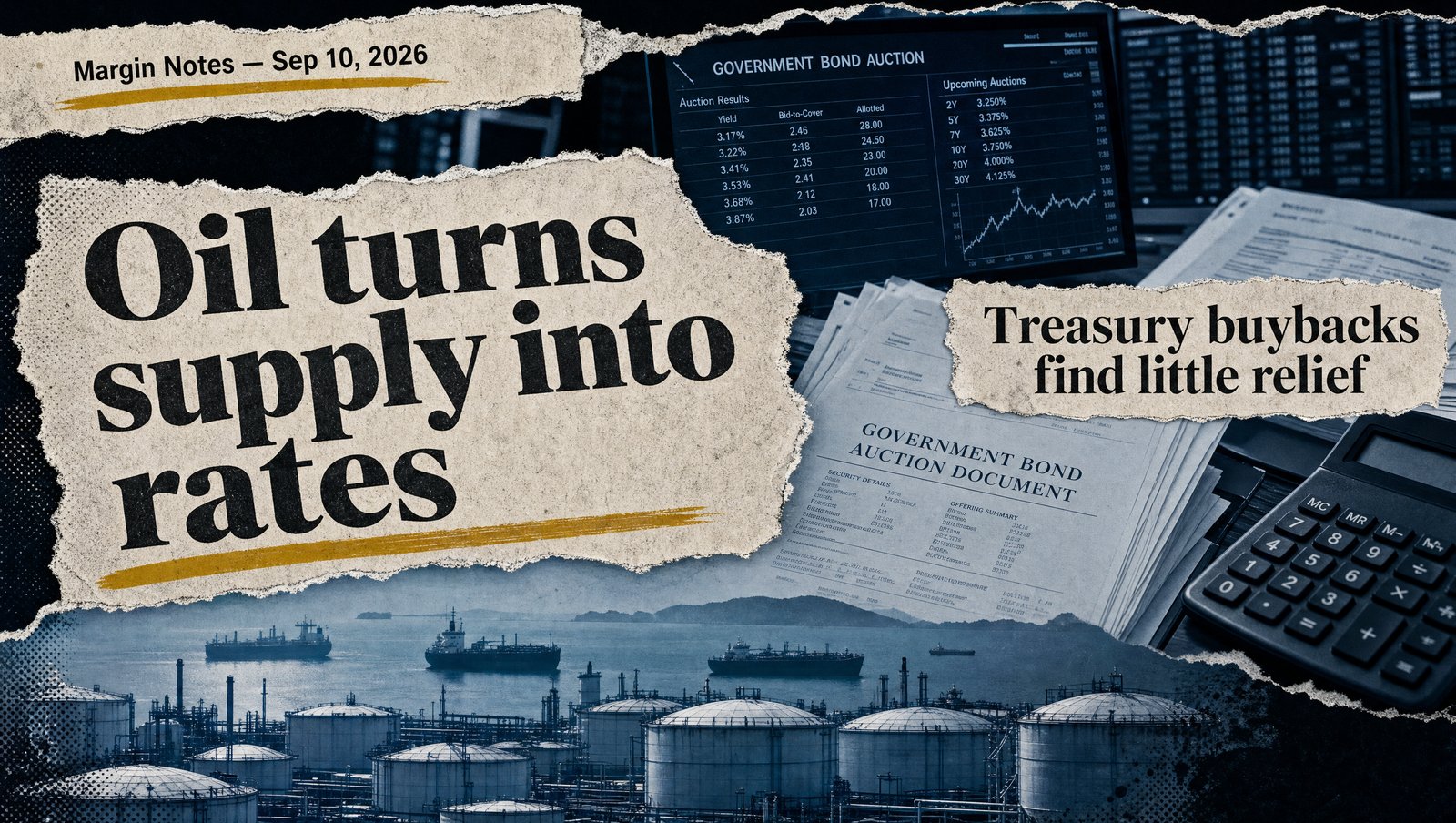
The European Central Bank is expected to raise interest rates again as Brent crude holds above $100, an awkward pairing that turns a regional war into a global policy test. The ECB is preparing to answer energy inflation with tighter money, even though the shock began with supply rather than an overheated European economy.
That distinction matters because higher rates do not produce more oil, restore shipping capacity, or lower diesel costs. They can, however, prevent a temporary price shock from becoming embedded in wages, rents, and long-term expectations. European bond yields and the euro therefore carry two messages at once: the currency has some support from the more hawkish stance, while growth is being asked to absorb another increase in financing costs.
US markets are facing the same arithmetic from a different institution. The S&P 500 lost 0.48%, the Nasdaq fell 0.64%, and consumer discretionary shares dropped 1.39%, while energy gained 1.09%. Oil is turning a supply problem into a rate problem, which is why a modest daily decline in crude does little to relieve the pressure. Prices do not need to rise every session to remain economically restrictive.
Washington Tests the Bond Market’s Patience
The US 10-year Treasury yield finished at 4.83% as the US Treasury expanded its debt buyback plans and the White House floated a possible $5,000 payment to voters if Republicans win the midterms. The two developments point in opposite directions on paper, but bond investors hear the same question underneath: how much fiscal ambition can the market absorb at current borrowing costs?
The US Treasury is buying more bonds without winning much relief, because a buyback can improve the composition and timing of issuance without changing the government’s underlying financing needs. The market has seen this film before: better plumbing is useful, but it does not make the house cheaper.
The proposed payment adds a second complication. The US president floated a $5,000 voter payment, putting fiscal support and deficit concerns in the same sentence just as inflation reports approach. If households receive more cash while fuel remains expensive, demand may hold up, but the bond market may ask whether future supply and inflation will rise with it. Stocks extended their losing streak, with the Dow down 0.77% and the Russell 2000 off 1.32%, suggesting smaller and more rate-sensitive companies have little appetite for another round of policy uncertainty.
Stablecoins Seek a Job Beyond Speculation
Bitcoin fell to $78,155.58 and Ethereum to $2,473.28, but the more consequential crypto story was not another day of token-price weakness. It was the industry’s attempt to make payments, custody, and regulated infrastructure useful enough to survive a less generous liquidity cycle.
Coinbase is treating stablecoin payments as a growth engine, a shift that puts transaction volume ahead of trading excitement. Stablecoins do not need to replace every bank account to matter; they only need to make cross-border settlement faster, cheaper, or more available outside banking hours. That is a less glamorous pitch than a new price target, which is probably why it has a better chance of surviving one.
The institutional push is spreading. Jack Dorsey’s Block applied for a bank charter to custody Bitcoin, while Ledger hired a security chief as crypto hacks reached $1.4 billion. Block is seeking bank status for Bitcoin custody, making regulatory recognition part of the product rather than an obstacle around it. The contrast with XRP’s 4.00% decline and the wider crypto selloff is useful: prices remain exposed to macro liquidity, but the industry is building services that may eventually be judged on revenue and reliability. Speculation pays the bills today; infrastructure is trying to inherit them.
Elsewhere
- TSMC reported a 53% revenue increase as demand for advanced AI chips continued to exceed available supply.
- Meta shares jumped 6.55% after the company introduced a personal AI agent aimed at easing investor concerns about its competitive position.
- The US Justice Department opened a probe into Nvidia’s Groq arrangement, adding regulatory risk to an already crowded AI investment trade.
- China signaled willingness to hold AI discussions with the United States despite the dispute over access to models and technology.
- India favored central-bank digital currencies for BRICS payments, suggesting that official digital money is becoming part of the argument over international settlement.
- Germany’s finance ministry drafted a 25% crypto-gains tax for 2027, offering clearer rules at the cost of a less forgiving tax bill.
- A political memecoin lost 95% of its value within hours, providing retail traders with another expensive reminder that branding is not a balance sheet.