The Day in Numbers
- Brent crude: $98.69 — rose 2.50% as Middle East supply concerns pushed it toward the $100 mark.
- Crude oil: $94.11 — gained 2.87%, extending the inflation risk attached to regional disruption.
- S&P 500: 7,718.60 — fell 0.38% as energy and trade uncertainty outweighed pockets of resilience.
- Nasdaq: 26,506.99 — slipped 0.29%, with technology shares offering little shelter from the broader risk mood.
- US 10-year Treasury yield: 4.80% — held steady, leaving the bond market alert rather than reassured.
- Gold: $4,449.10 — declined 0.61% as elevated yields continued to compete with haven demand.
- Bitcoin: $78,285.47 — fell 1.38%, remaining below $79,000 as security concerns met firm US rate-hike expectations.
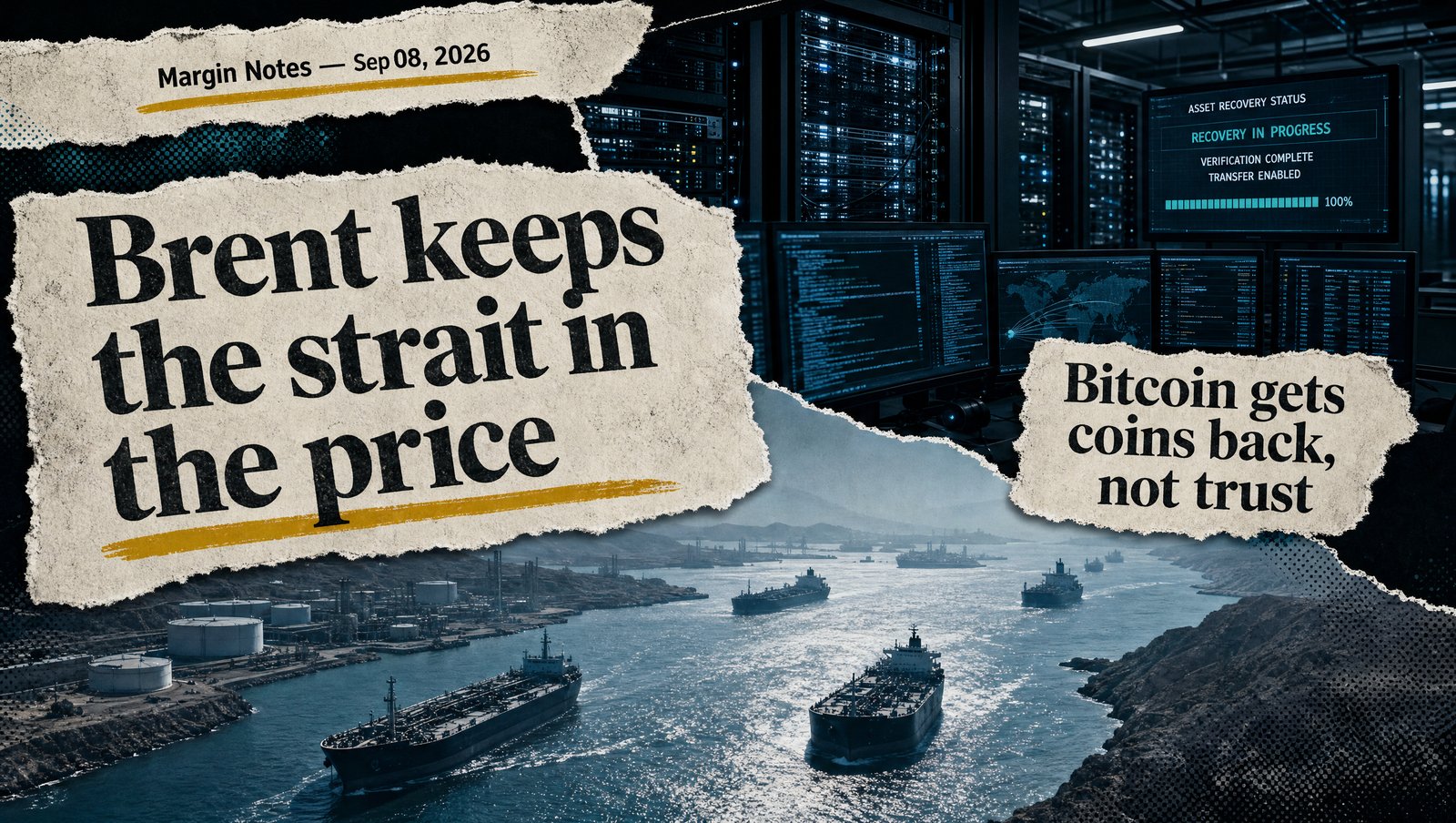
Brent Keeps the Strait in the Price
Brent crude rose 2.50% to $98.69 on Tuesday as reports of attacks on Saudi energy sites collided with Iran’s claim that a deal with Oman over the Strait of Hormuz was close. Regional attacks kept supply risk rising even as diplomacy offered a possible release valve. The contradiction is the market’s central fact: a deal may be near, but tankers, insurers, and refinery operators still have to believe it before they behave as if the route is safe.
Crude oil reached $94.11, up 2.87%, while gold fell 0.61% to $4,449.10. That combination says investors are not treating the episode as a straightforward flight into every haven. Higher energy prices threaten inflation, and higher yields make non-income-producing protection less attractive. Oil traders are charging for disruption before they receive proof of resolution, which is why a prospective agreement has not yet erased the premium.
For the US Federal Reserve, the awkward part is that the shock arrives through prices rather than demand. If the disruption lasts, the August producer-price and consumer-price readings will be judged against a market already expecting more inflation pressure. The US 10-year Treasury yield stayed at 4.80%, a quiet number carrying a fairly loud warning: bond investors are not ready to assume that the energy problem will politely leave before the data arrives.
Yen Strengthens as Trade Borders Thicken
The Japanese yen gained 0.38% against the US dollar on Tuesday, pushing through a level that has revived speculation about a run toward its 2026 high. The yen’s advance is forcing traders to reconsider how much carry they can safely fund. That matters because the position being reduced is rarely just a currency trade; borrowed-yen money has been supporting assets across technology, emerging markets, and other corners where leverage tends to travel without a passport.
At the same time, Canada announced tariffs of as much as 50% on selected US goods, while the US government threatened a possible response involving Bombardier aircraft. Canada’s tariff move widened the market’s list of risks from shipping lanes to trade lanes. Oil raises the cost of doing business; tariffs raise the cost of moving the business. Neither is especially helpful to companies trying to defend margins while investors are already questioning how much growth deserves a 4.80% risk-free yield.
That is the common pressure beneath an otherwise mixed tape. The S&P 500 lost 0.38%, the Nasdaq declined 0.29%, and Japan’s Nikkei 225 dropped as much as 1.70% in the available market data. The US dollar index fell 0.32%, but that did not translate into broad enthusiasm for risk. Capital is moving, certainly. It is simply becoming more selective about the doors through which it exits.
Bitcoin Gets Some Coins Back, Not Much Trust
Bitcoin traded at $78,285.47, down 1.38%, as traders held near a 60% probability of a US Federal Reserve rate increase next week and crypto security headlines continued to accumulate. Bitcoin recovered most of the stolen coins without recovering the market’s confidence in the rails. About 3,400 of the 4,000 bitcoin taken in the Liquid Network breach were returned, leaving roughly 600 still outstanding. A white-hat recovery is welcome; it is not the same thing as a clean bill of health.
The second problem is that the vulnerability is no longer confined to one settlement network. An attacker moved $7.7 million in bitcoin connected to a third wave of Coldcard thefts, while analysts said the transfer represented 45% of the coins stolen in that episode. A separate wallet attack kept self-custody risk in the conversation. Investors can distinguish between a protocol breach and a hardware-wallet compromise, but the headline audience often cannot, and confidence is an asset class with poor documentation.
There is a brighter technical signal in Bitcoin’s daily chart: a golden cross has appeared, even as resistance sits around $83,000. That is the sort of setup traders enjoy because it offers a bullish pattern and an inconvenient reality at the same time. With Ethereum at $2,468.79 and XRP at $1.38, the broader market is still trading as a risk asset. Security improvements and institutional rails may strengthen the long-term case, but today’s price action says the macro bill remains due.
Elsewhere
- China’s exports jumped 25% in August, driving the country’s trade surplus toward $806 billion and increasing pressure from trading partners.
- OpenAI’s Astra launch revived demand for memory-chip shares, with SNDK gaining 11.90% as investors returned to the hardware behind AI workloads.
- Brazilian banks expanded their crypto menus, with Itaú offering 15 assets and Nubank listing 28 under a clearer regulatory framework.
- Ethereum moved toward gas payments that do not require users to hold ETH, lowering one of the less glamorous but very real barriers to using its applications.
- Solana prepared to triple its transaction size, giving complex trades and proofs more room when the upgrade activates Wednesday.
- DBS and Citi completed a weekend dollar payment through Swift’s digital ledger, offering another demonstration that tokenized deposits can operate outside traditional banking hours.
- German exports fell unexpectedly for the first time since January, adding a fresh sign of fragility to Europe’s manufacturing outlook.