The Day in Numbers
- Brent crude: $97.30 — rose 34.3% from its level when the conflict began as tanker attacks kept supply risk elevated.
- Crude oil: $92.43 — gained 1.04% as the latest escalation added to the energy premium.
- S&P 500: 7,718.60 — fell 0.38% as geopolitical risk and higher-rate expectations outweighed pockets of resilience.
- Nasdaq: 26,506.99 — slipped 0.29%, with growth stocks holding up better than the broader US market.
- US 10-year Treasury yield: 4.78% — was little changed, but remained high enough to keep valuation pressure in the room.
- Gold: $4,442.90 — declined 0.75% as stronger rate-hike expectations competed with its usual haven appeal.
- Bitcoin: below $80,000 — weakened as the Iran escalation and a $320 million network exploit tested confidence from two directions.
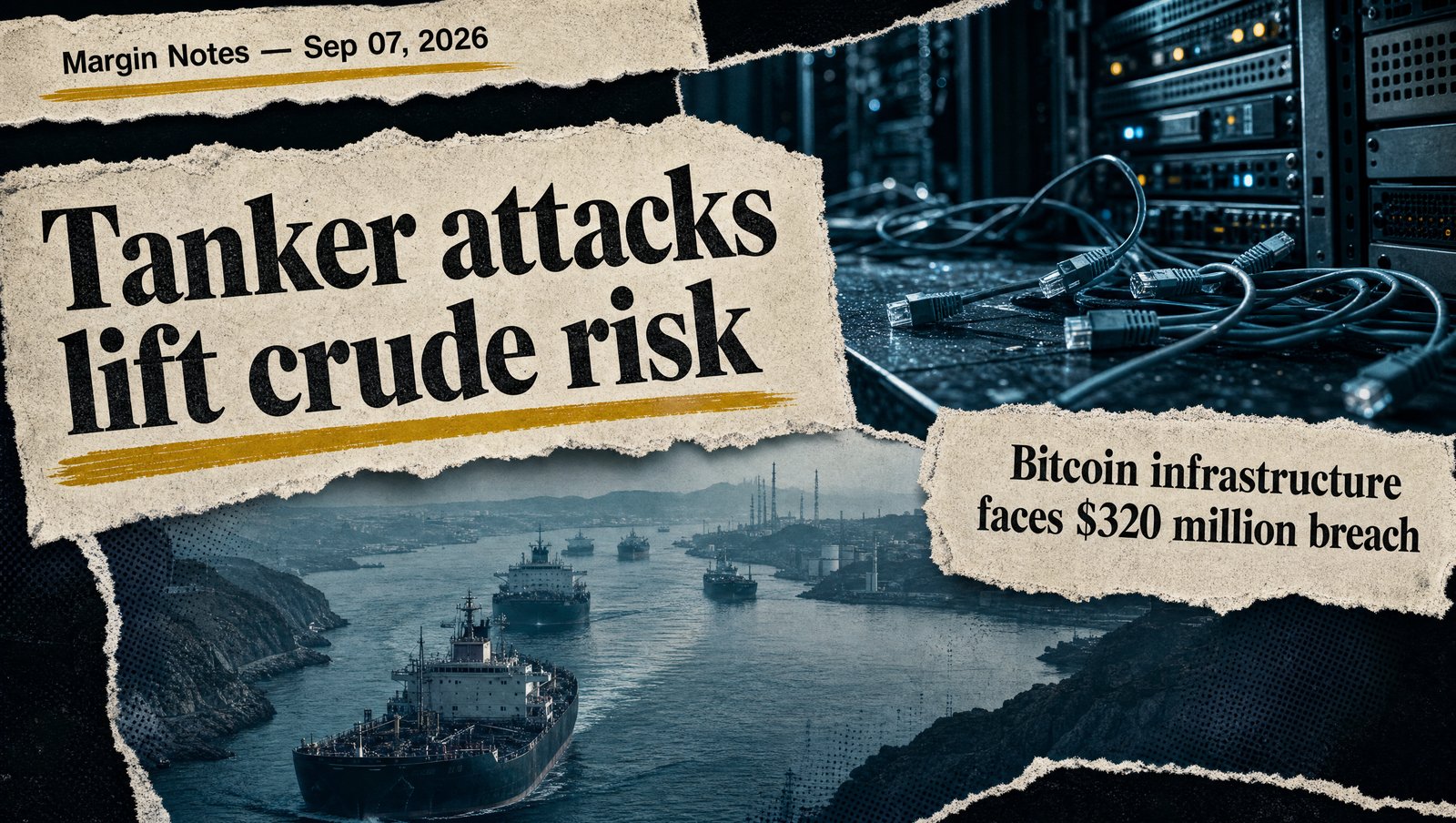
Tanker Attacks Put $120 Oil Back on the Map
Brent crude reached $97.30 as Iran and the United States exchanged attacks involving oil tankers, extending a conflict that has now lasted six months. Tanker strikes pushed crude higher as supply risk returned to the price of every barrel. The market does not need a formal blockade to demand compensation. It needs only fewer ships moving, higher insurance costs, and the suspicion that the next cargo may require a route with more paperwork and less sea.
That is why Goldman Sachs’ $120 oil scenario matters even before prices approach it. Goldman Sachs sees $120 crude as a plausible escalation outcome if attacks intensify, which would turn an energy shock into a monetary-policy problem. US crude rose 1.04% to $92.43, while the energy sector still fell 0.98%, a reminder that expensive oil is not automatically good news for energy shares when investors are worrying about the economy attached to the fuel.
The broader damage is already visible in Europe. German industrial output dropped by the most in almost a year, while European bonds came under pressure from energy and political risk. A supply disruption that begins at sea can therefore arrive in factories, sovereign debt, and household budgets without needing to announce itself at customs.
Treasuries Hold Still While Policy Bets Move
The US 10-year Treasury yield remained at 4.78% even as traders prepared for larger swings across the yield curve. That apparent calm is less reassuring than it looks. A flat yield on a volatile day can mean investors have reached agreement; it can also mean they are waiting for the next piece of evidence before choosing a direction. Treasury traders are bracing for volatility at both ends of the curve as energy inflation and strong employment data complicate the outlook for the US Federal Reserve.
Gold fell 0.75% to $4,442.90, which says more about real yields than about the absence of geopolitical fear. Investors can want protection and still prefer an asset that pays interest while they wait. The US 30-year yield stood at 5.247%, making that preference fairly easy to understand. Haven demand has not vanished; it is being charged a financing fee.
US equities reflected the same hesitation. The S&P 500 lost 0.38%, the Nasdaq declined 0.29%, and financials fell 0.76% while information technology gained 0.23%. The market is not abandoning growth, but it is asking growth to justify its discount rate. With US inflation data, producer prices, and consumer prices ahead this week, the next move will depend on whether investors see the energy shock as temporary noise or a reason for the US Fed to keep policy restrictive for longer.
Bitcoin Takes a Two-Sided Hit
A $320 million exploit affecting the Liquid Network, a settlement layer used by exchanges, landed as Bitcoin was already trading below $80,000. Hackers stole $320 million from infrastructure used by crypto exchanges, and the damage extends beyond the missing assets. When a market’s settlement machinery is interrupted, traders question not just the token price but whether withdrawals, collateral, and liquidity will behave properly when needed.
The macro backdrop offered no cushion. Bitcoin fell as oil climbed after US strikes on Iranian crude carriers, linking a security failure inside crypto with a security shock outside it. Bitcoin’s nearly 1% decline is modest beside the size of the exploit, but that is precisely the point: large institutions rarely need to liquidate everything to become more cautious. They reduce leverage, demand more collateral, and wait for the plumbing to prove it still works.
There is a more constructive signal elsewhere in the asset class. Southeast Asian crypto funding rebounded to $680 million, with investors favoring mature financial firms over early-stage experiments. That preference now looks less like conservatism and more like basic portfolio hygiene. Capital still wants exposure, but it wants audited systems, regulated counterparties, and fewer surprises disguised as innovation.
Elsewhere
- China injected $45 billion into banks and insurers to reinforce balance sheets and support growth in the world’s second-largest economy.
- German industrial output posted its steepest decline in almost a year, adding a manufacturing warning to Europe’s energy concerns.
- Japan likely sold US Treasuries to fund yen intervention, giving the bond market another source of supply to consider.
- Qatar began bringing empty LNG ships home, signaling a possible change in export logistics as regional energy routes remain unsettled.
- Ripple expanded XRP’s presence through a Florida athletics partnership, turning college sports visibility into another channel for crypto adoption.
- A Bank of Korea study found dollar-backed stablecoins can weaken local currencies, giving central banks a new reason to treat digital dollars as a monetary issue rather than merely a payments product.
- Southeast Asian crypto funding recovered to $680 million as venture investors concentrated on established financial-services firms.