The Day in Numbers
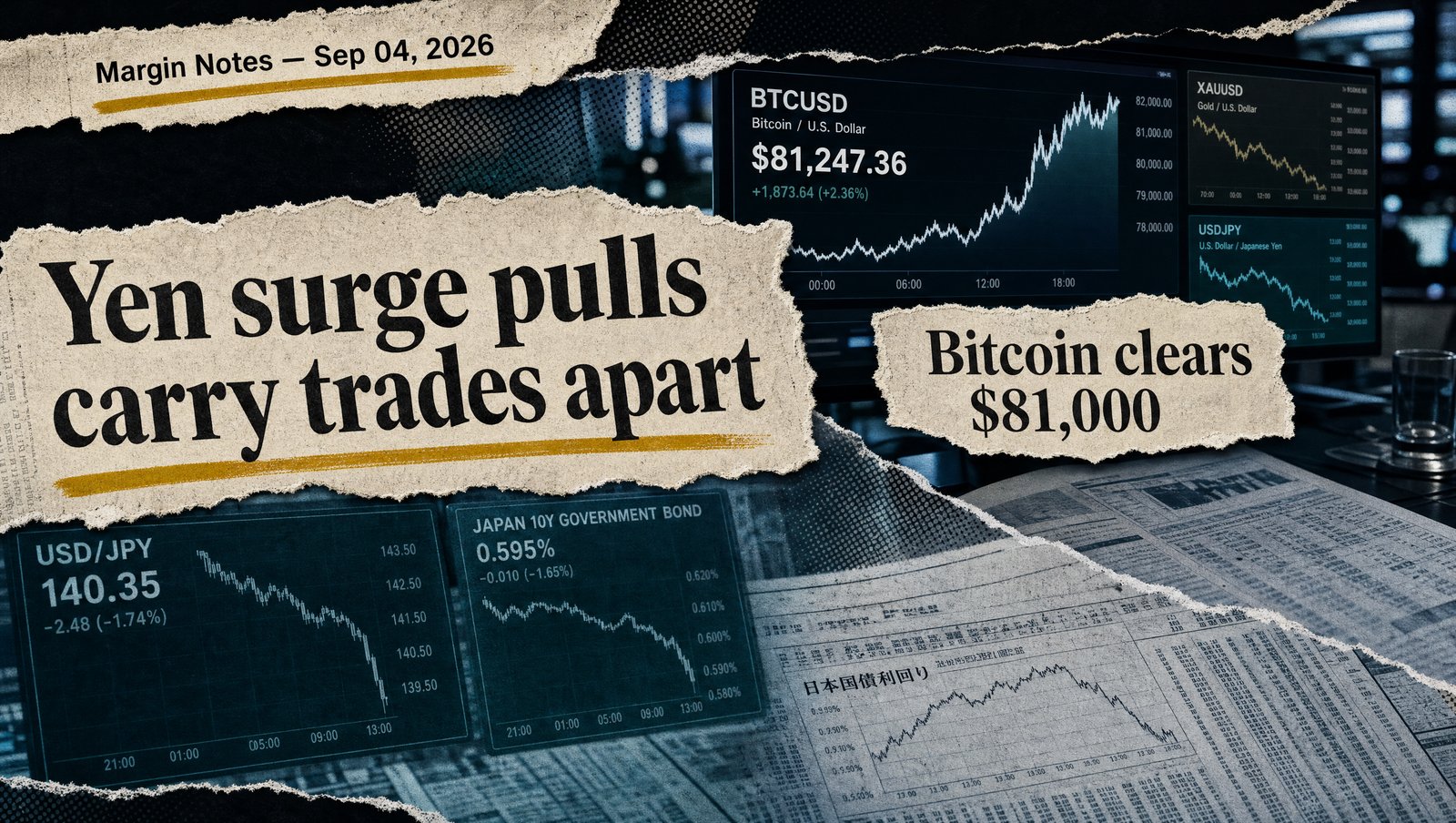
- Japanese yen: advanced more than 2% — the sharpest sign yet that carry-trade positions are being reduced ahead of a Bank of Japan decision.
- S&P 500: 7,747.71 — gained 1.06% as softer US rate expectations revived demand for equities.
- Nasdaq: 26,584.06 — rose 1.40%, extending the technology-led advance.
- US 10-year Treasury yield: 4.76% — was essentially unchanged, leaving the bond market cautious rather than convinced.
- Brent crude: $95.69 — added 0.18% and remained 31.8% above its level when the war began.
- European benchmark gas: 72.4 — was up 126.8% since the conflict began, keeping winter inflation concerns alive.
- Bitcoin: above $81,000 — recovered as traders reduced expectations for a September US rate increase.
Yen Traders Pull the Carry Trade Apart
The Japanese yen advanced more than 2% on Thursday, moving toward levels last seen in May as investors unwound positions funded in the low-yielding currency. Carry-trade investors began reducing exposure ahead of the Bank of Japan’s next policy decision, and the move matters beyond Tokyo: when borrowed yen is used to buy higher-returning assets elsewhere, closing those trades can drain liquidity from markets that had grown accustomed to the money arriving.
The prospect of further Bank of Japan tightening gives the move a policy anchor. Nomura’s Yunosuke Goto sees additional increases as possible, with three consecutive hikes conceivable in an unusually forceful scenario. That is not a baseline forecast, but markets are often moved by the possibility that the baseline has become too comfortable. The US dollar weakened as the yen strengthened, while the Bloomberg Dollar Spot Index stood at 1,189.5, down 0.02%.
That rotation did not produce a broad retreat from risk. It changed the destination of capital. Emerging-market shares and currencies rose as expectations for a US rate increase softened, while the US 10-year yield held around 4.76%. A weaker dollar redirected money toward emerging-market assets, but the energy backdrop kept the welcome conditional. Brent remained at $95.69, and European gas was heading for a fourth weekly gain. Carry trades can be unwound quickly; gas contracts have less regard for anyone’s positioning.
Wall Street Takes the Hold Trade Seriously
The S&P 500 climbed 1.06% to 7,747.71 on Thursday, with the Nasdaq rising 1.40% to 26,584.06 as investors leaned toward a September pause from the US Federal Reserve. Markets increased the value of a rate hold without declaring the inflation problem solved. Polymarket put the probability of no change at 59%, against 42% for a 25-basis-point increase, a neat illustration of a market that remains uncertain but is no longer braced for the worst policy outcome.
The equity rally was broad enough to look healthier than a single technology bounce. Financials gained 1.55%, communication services rose 1.51%, and consumer discretionary added 1.58%; Nvidia advanced 1.80% to $228.45, while Tesla jumped 5.42% to $376.37. The VIX fell 5.79% to 14.32. Yet the US 30-year Treasury yield remained at 5.241%, and the 10-year yield barely moved, suggesting that investors were willing to buy stocks without offering the bond market a full pardon.
That distinction becomes important with the August employment report due today. Economists expect a 55,000 increase in jobs, with unemployment steady at 4.1%, but Federal Reserve Chair Kevin Warsh may be less responsive to any single release than traders would prefer. Investors are treating the jobs report as evidence, not an automatic policy signal. A soft number could reinforce the hold trade; it may not be enough to force a cut when energy prices remain elevated. Markets enjoy a simple data point. Policymakers, regrettably, have several.
Bitcoin Clears $81,000 as the Rails Fill In
Bitcoin moved above $81,000 as traders cut September US rate-hike bets, while Zcash gained 15% and broader crypto markets followed the softer-dollar mood. Bitcoin reclaimed $81,000 as fading hike odds reopened the risk appetite trade. The move is not a clean haven story, especially with the US 10-year yield near 4.76%, but it does show how quickly digital assets can respond when the immediate liquidity threat recedes.
Bitcoin is also outperforming gold on a relative basis. One bitcoin now buys slightly more than 18 ounces of gold, the highest ratio since January, even though gold remains near $4,510.30. That tells us investors are not choosing between safety and speculation as neatly as the old categories suggest. They are choosing which scarce asset offers the better protection against the possibility that governments eventually tolerate more inflation to manage large debt burdens.
The more durable development is happening in market infrastructure. Banks and exchanges are joining the same settlement machinery, with SoFi linking its banking network and stablecoin to Kraken, while Standard Chartered has added spot Bitcoin and ether trading to its Dubai foreign-exchange platform. A US banking agency also gave blockchain bank OpenReserve an initial operating approval. Crypto’s bid is therefore arriving through more than a price chart. The plumbing is becoming institutional, which is useful because enthusiasm alone has never been a reliable settlement system.
Elsewhere
- Anthropic is nearing a $15 billion credit facility, showing that frontier-AI companies can still raise industrial quantities of capital before reaching public markets.
- Nvidia agreed to buy Hugging Face, extending its attempt to control more of the software layer around AI computing.
- Tesla rose 5.42% as the company sought potential operators for Cybercab fleets, giving the robotaxi story a more commercial shape.
- OpenAI committed $1 billion to cyberdefense as safety scrutiny moved from an abstract concern to a line item with several zeroes.
- Australia tightened the timetable for crypto compliance, leaving firms facing civil or criminal penalties after the October 1 deadline.
- Ireland excluded crypto from its state savings scheme, keeping public capital-preservation products deliberately separate from digital-asset speculation.