The Day in Numbers
- Brent crude: $94.53 — slipped 1.15%, but remained 31.9% above its level when the war began.
- US crude: $90.16 — fell 0.93% as traders weighed assurances of a short conflict against weaker shipping flows.
- S&P 500: 7,666.60 — rose 0.46%, recovering some ground as geopolitical fears briefly eased.
- Nasdaq: 26,217.83 — gained 0.45%, helped by a 3.21% advance in Nvidia.
- US 10-year Treasury yield: 4.77% — was broadly unchanged, leaving the bond market unconvinced that inflation pressure had gone away.
- Gold: $4,471.40 — climbed 1.29%, restoring some haven demand after its recent struggle against high yields.
- VIX: 15.20 — fell 6.98%, signaling calm that may be more tactical than durable.
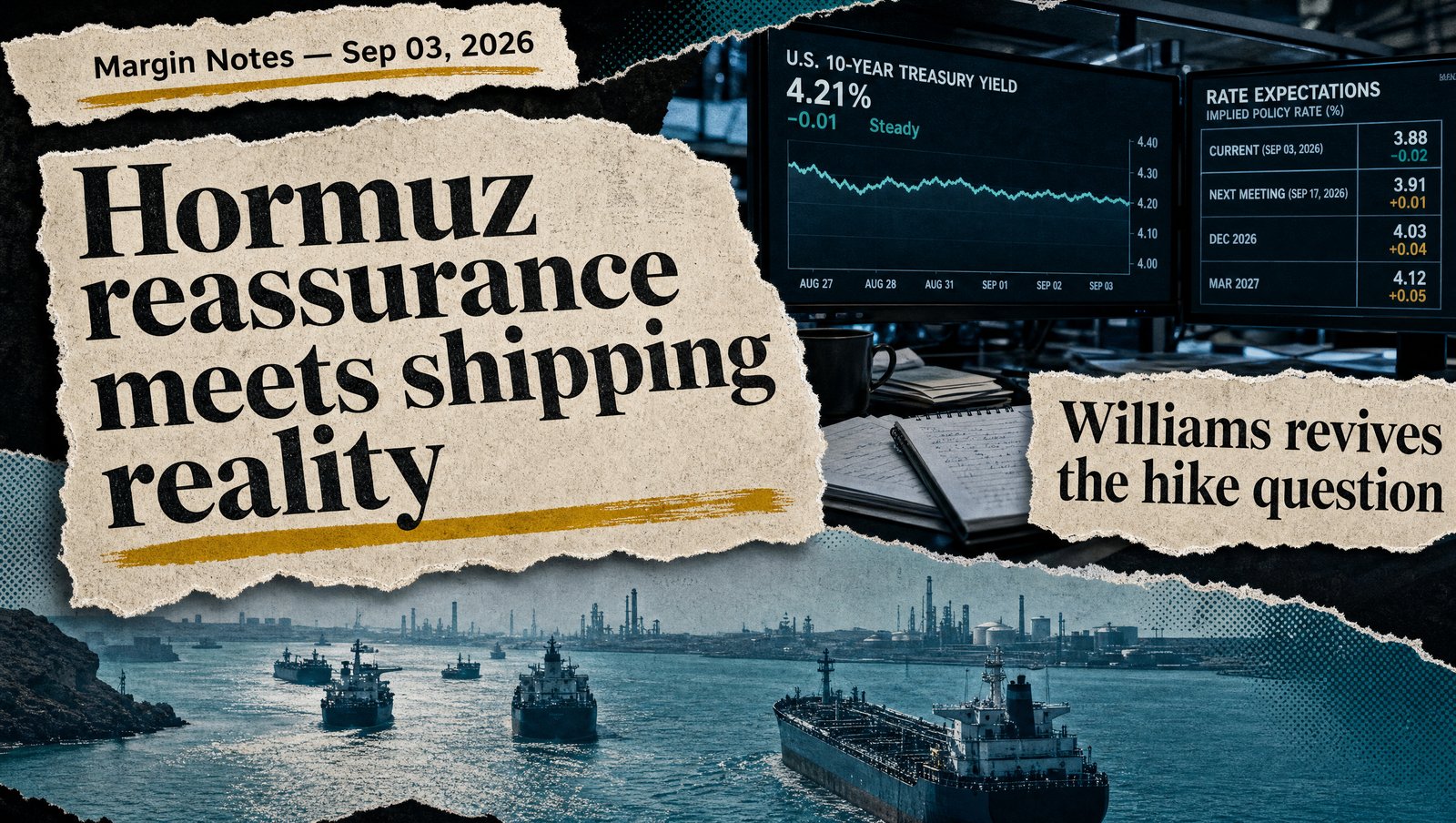
Hormuz Reassurance Runs Into the Ship Trackers
Brent crude closed at $94.53 on Thursday, down 1.15%, after President Donald Trump said the US campaign against Iran would be brief and that the Strait of Hormuz remained under control. Officials offered a shorter war as the market’s working assumption, and equities accepted the premise for a session. Oil, however, did not exactly sign the same memo. It remains 31.9% above its prewar level, while US gasoline is up about 35%.
The disagreement is over something rather less poetic than geopolitical confidence: how many ships are actually getting through. Commercial trackers are showing a far thinner flow through Hormuz than official assurances imply, with daily transits down by 87 vessels from the baseline cited in the market data. That gap matters because energy prices trade on barrels delivered, not on the quality of a press conference. A short campaign can still produce a long supply disruption if insurers, crews, and shipowners remain unconvinced.
That is why crude could fall and still carry an inflation premium. US crude settled at $90.16, while European gas has risen 132.4% since the conflict began. The S&P 500 gained 0.46%, but the relief was conditional: investors were willing to buy the dip in energy anxiety, not declare the supply problem solved. Reassurance lowered the temperature. It did not repair the plumbing.
Williams Reopens the Hike Question
The US 10-year Treasury yield held near 4.77% on Thursday after New York Federal Reserve President John Williams left room for interest-rate increases, keeping policy uncertainty alive beneath a calmer equity tape. John Williams reopened the possibility of a US rate hike, which is awkward timing for investors hoping that weaker hiring would give the US Federal Reserve a straightforward reason to ease. ADP reported the fewest new private-sector jobs in seven months, but soft labor demand does not automatically win against energy inflation.
The market is now being asked to hold two ideas at once: growth is slowing, and prices may remain troublesome. That combination is less friendly than either condition on its own. The 10-year yield barely moved, while the US 30-year yield sat at 5.244%, suggesting investors are not rushing to price a clean disinflationary escape. The bond market has heard the softer employment signal. It has also noticed the war.
Equities managed a modest advance because the calm was broad enough to be useful, if not convincing. The Nasdaq rose 0.45%, the Russell 2000 added 1.13%, and the VIX fell to 15.20. Yet the positioning backdrop is unusually clean, which raises the possibility that investors begin chasing gains simply because the exits look quiet. A less crowded equity market may now invite a more crowded rally. That is not a forecast of an immediate reversal. It is a reminder that low anxiety can become a source of anxiety when everyone discovers it at once.
Crypto Finds Buyers Beyond Bitcoin
Bitcoin moved back above $77,500 as the implied probability of a US rate increase eased to 62%, giving digital assets a temporary reprieve from the policy debate. Bitcoin reclaimed $77,500 as hike odds softened, while XRP led the major tokens higher. The move fits the day’s broader pattern: when the dollar eases and yields stop climbing, liquid risk assets get a little more room to breathe. It does not mean macro has left the building. It merely stepped into the hallway.
More interestingly, XRP exchange-traded funds recorded $170 million of inflows over 11 consecutive sessions, with Goldman Sachs among the largest institutional holders. XRP ETFs sustained an $170 million institutional bid, showing that crypto demand is spreading beyond the familiar Bitcoin allocation. The amount is meaningful because it represents persistence, not a single burst of enthusiasm. A market can survive a geopolitical headline more easily when buyers keep arriving through regulated channels.
The signal is still selective. Bitcoin’s prospective golden cross and supportive USDT liquidity metrics offer a technical tailwind, while Japanese listed-company Remixpoint is selling altcoins to concentrate more heavily in Bitcoin. Institutional capital is broadening, but it is not becoming indiscriminate. Crypto’s new maturity appears to involve choosing what to ignore, which is progress of a sort.
Elsewhere
- ByteDance secured a $30 billion loan, underscoring how much capital Asian technology companies can still command for AI and digital infrastructure.
- China and the US failed to settle a G20 dispute over a single word, a small linguistic quarrel carrying larger consequences for trade and technology policy.
- The yen rallied as intervention fears returned, putting carry-trade positions back under scrutiny before the next Bank of Japan policy signals.
- The US Securities and Exchange Commission proposed its first transfer-agent overhaul in four decades, bringing tokenized assets closer to the operating rules of traditional securities markets.
- Coinbase appointed Anthony Armstrong to its board, strengthening the exchange’s links to the wider Musk-linked technology and payments ecosystem.
- US private employers reported their weakest hiring in seven months, adding a softer labor-market note ahead of Friday’s employment report.
- Broadcom shares fell despite an earnings beat, showing that AI infrastructure companies still need to exceed expectations, not merely meet them.