The Day in Numbers
- US 10-year Treasury yield: 4.77% — held near levels associated with the global bond selloff.
- US 30-year Treasury yield: 5.269% — kept long-duration assets under pressure.
- Brent crude: $88.86 — rose 0.55% as the Iran conflict revived supply concerns.
- US crude: $86.43 — gained 0.78%, extending the energy shock’s inflation risk.
- S&P 500: 7,686.14 — fell 0.33% as higher yields outweighed a resilient technology sector.
- Gold: $4,479.10 — slipped 0.05%, showing that rising income from bonds is competing with haven demand.
- Strategy’s Bitcoin purchase: $370 million — marked the company’s return to accumulation after roughly two months away.
Bonds Put the Cost of Risk Back on the Page
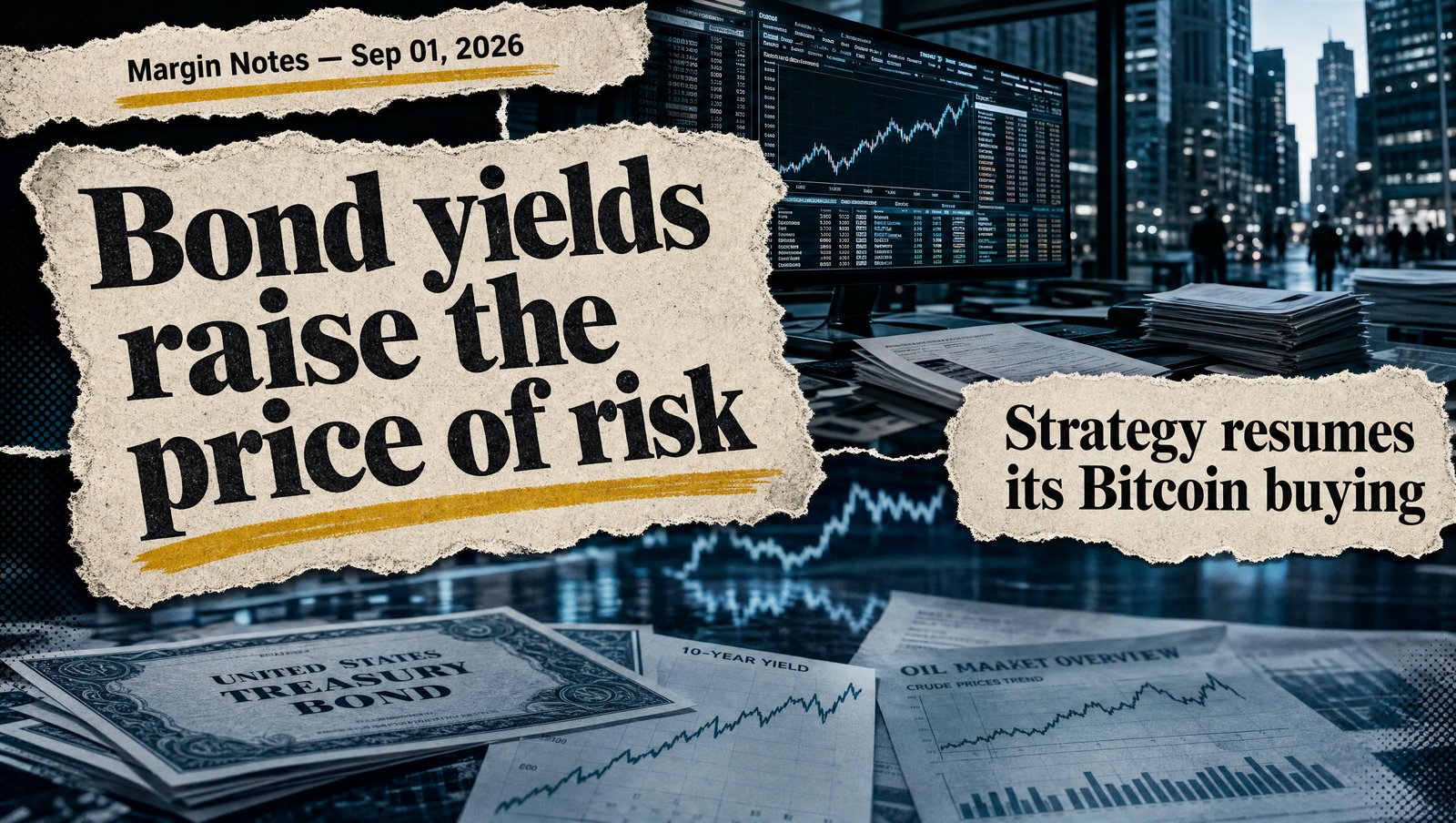
The US 10-year Treasury yield held at 4.77% on Tuesday, while the 30-year yield reached 5.269%, giving September an expensive opening paragraph. Global bond yields climbed to their highest levels since 2008 as investors increased bets that the US Federal Reserve will respond to energy-driven inflation with a more restrictive policy path. Long-term borrowing costs do not need to reach a new record to cause trouble; they only need to remain high long enough for every valuation model to notice.
Oil supplied the reason for the caution. Brent crude rose 0.55% to $88.86, and US crude added 0.78% to $86.43, while Brent is now up 25.7% since the conflict began. US-Iran escalation pushed the oil premium higher again, with US gasoline prices up 35.5% and European benchmark gas up 123.6%. Energy shares gained 2.10%, but the S&P 500 fell 0.33% and financials, real estate, and industrials all declined. Producers can enjoy the shock; most balance sheets simply receive it.
That explains gold’s modest 0.05% decline to $4,479.10. The metal remains valuable as insurance, but the insurance premium is being compared with a government bond yielding nearly 5%. Investors are not abandoning hedges. They are becoming unusually strict about what those hedges cost.
Strategy Brings a Buyer Back to Bitcoin
Strategy spent $370 million on Bitcoin last week, ending an approximately two-month pause and giving the market a concrete buyer while global liquidity grew less friendly. Strategy restarted its Bitcoin accumulation with a $370 million purchase, a signal that corporate treasury demand has not disappeared simply because yields are rising. It is also a reminder that institutional conviction often arrives in installments, preferably after someone else has absorbed the first round of volatility.
Bitcoin remained above $78,000 even as major altcoins weakened on higher US rate expectations. The return of South Korea’s premium over global Bitcoin prices adds another layer to the bid, because it shows renewed local demand rather than a rally carried exclusively by US institutions. South Korean buyers pushed Bitcoin back into a local premium, while the market’s broader behavior remained selective. Bitcoin can attract strategic capital; smaller tokens still have to pass the liquidity test every morning.
The distinction matters in a market where the US dollar is firm, the US 10-year yield is elevated, and non-yielding assets face a higher opportunity cost. Strategy’s purchase does not repeal that arithmetic. It simply places a committed buyer on the other side of it. That is support, not immunity, which is a less glamorous but more useful description.
AI Spending Survives Where Cash Flows Can Defend It
MediaTek shares jumped 10% after Nvidia committed $3.5 billion to the chip designer, turning an Asian semiconductor supplier into a more consequential participant in the AI build-out. Nvidia invested $3.5 billion in MediaTek, reinforcing the view that demand for computing capacity is still broadening beyond the best-known names. The technology sector gained 0.30% even as the wider S&P 500 weakened, which is the market’s way of saying that growth is welcome when it arrives with a plausible customer.
That selectivity is the common thread with bonds and Bitcoin. High yields are not killing risk appetite; they are charging admission. AI infrastructure can justify the fee if demand converts into revenue, while Bitcoin needs durable institutional demand and deeper market access to make the same case. Everything else is being asked to explain itself, preferably with cash flow and fewer adjectives.
The pressure is visible in the long end of the bond market, where the US 30-year bond entered September after its weakest stretch since 2006. A project with a long payback period must now clear a higher discount rate, even when the technology behind it is compelling. The AI trade still has a runway. It no longer has free parking.
Elsewhere
- Japan’s 10-year government bond yield reached 3% for the first time since 1996, adding another pressure point to global carry trades.
- Hyperliquid opened talks with Kraken’s parent company about bringing its derivatives business into the US market, a step toward regulated access for decentralized trading.
- The US 30-year bond posted its weakest opening stretch since 2006, extending the duration problem beyond the 10-year benchmark.
- Shein shares dropped 10% in Hong Kong on their first trading day, testing appetite for high-growth consumer listings.
- Tesla shares rose 5.51% as investors positioned for the company’s Cybercab launch.
- The US Federal Trade Commission and 22 states sued Amazon over alleged inflated advertising prices, sending Amazon shares down 2.50%.