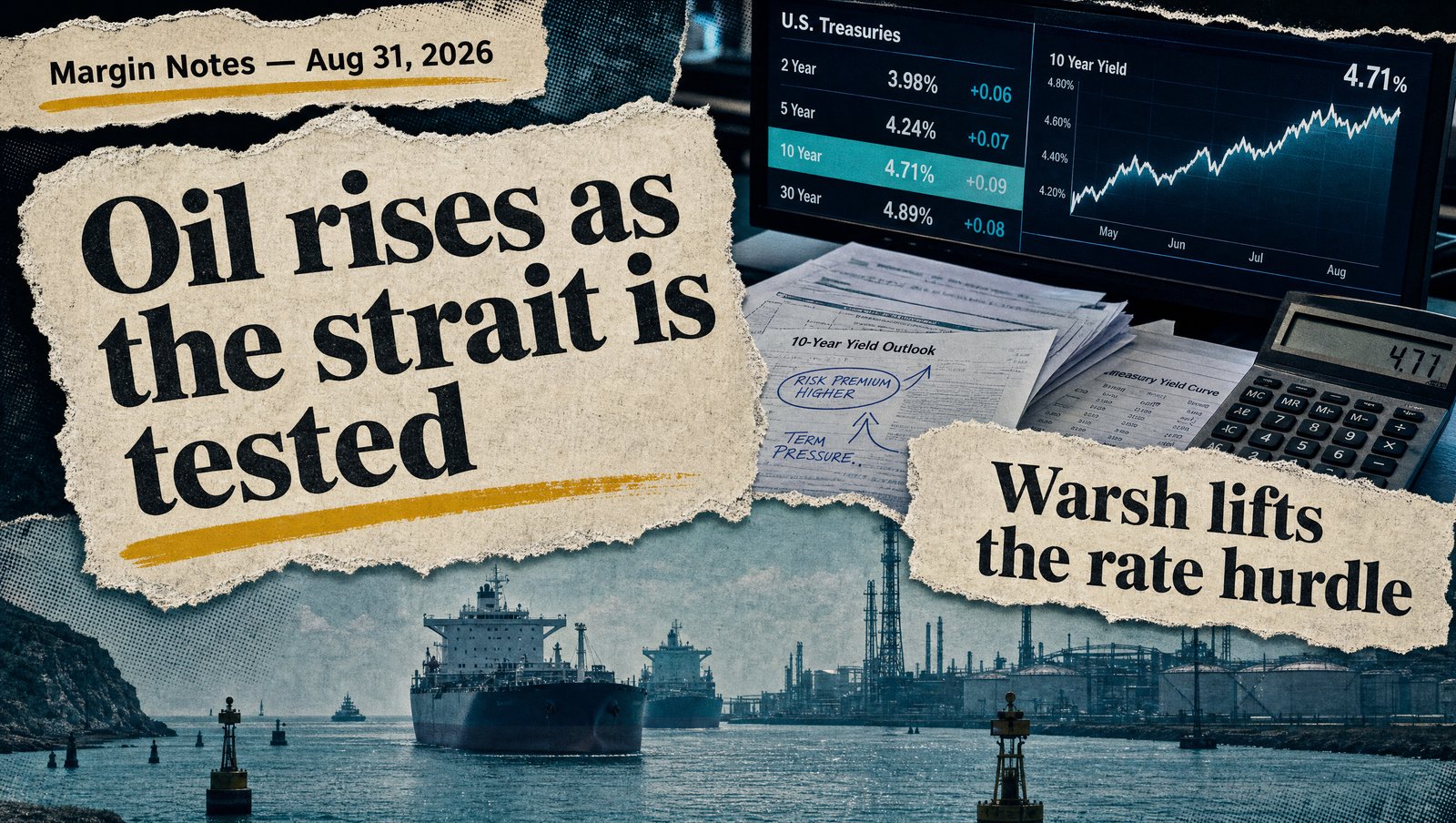
The Day in Numbers
- Brent crude: $90.53 — climbed 2.76% as attacks revived fears around Middle East supply.
- US crude: $85.47 — gained 2.48%, reinforcing the inflationary shock from the conflict.
- US 10-year Treasury yield: 4.71% — stayed near recent highs as Kevin Warsh’s inflation message strengthened rate-hike bets.
- S&P 500: 7,711.76 — slipped 0.25% as energy pressure outweighed resilience in selected sectors.
- Nasdaq: 26,402.42 — fell 0.52%, with information technology down 1.29%.
- Gold: $4,491.30 — declined 0.85% despite renewed military escalation.
- September US rate-hike probability: 58% — elevated, but still well below the roughly 90% feared by some traders.
Oil Reprices the Strait Risk
US strikes on Iranian rocket launchers sent Brent crude to $90.53, a move that puts the Strait of Hormuz back at the center of the market’s inflation calculation. The immediate concern is not simply that oil costs more; it is that Iranian forces were preparing to send mines into a waterway through which the global economy would prefer not to conduct a stress test. US and Iran exchanged attacks after a month of relative calm, and the risk premium returned before anyone had time to call it a trend.
Crude gained 2.48% to $85.47 in the US market, while European benchmark gas has risen 115.4% since the war began and US gasoline prices are up 35.5%. Those are not distant commodity-market curiosities. They are inputs into inflation expectations, transport costs, and the policy debate now taking place in Washington. Energy shares gained 0.59%, but the broader equity market did not share the celebration. A higher oil price can help producers while making almost everyone else pay closer attention to the receipt.
The strange part was gold’s reaction. It fell 0.85% to $4,491.30 even as geopolitical risk increased, showing that the market currently values the income available from cash and government bonds more highly than the comfort of a traditional haven. A minefield in the strait is alarming. A 4.71% Treasury yield is, apparently, more persuasive.
Warsh Turns Inflation Into a Market Variable
Kevin Warsh’s insistence that the 2% inflation goal is “firm and fixed” pushed the US 10-year Treasury yield to 4.71%, keeping bond investors wary even as growth assets weakened. Warsh’s Jackson Hole message lifted expectations for a September US rate increase, though futures-based estimates put the probability at 58%, not the near-certainty some of the louder commentary implied. The market is tightening its assumptions, not yet writing the decision into permanent ink.
That distinction matters because oil has now joined the argument. A supply shock that raises energy prices gives the US Federal Reserve less room to look through inflation, while a hawkish chair makes investors less willing to assume that policymakers will do so. Emerging-market stocks fell as the dollar and US yields became harder competition for capital. The S&P 500 lost 0.25%, the Nasdaq declined 0.52%, and the Russell 2000 dropped 1.39%, which is a fairly efficient way for smaller companies to remind everyone that financing costs are not an abstract concept.
Market breadth offered a few exceptions. Consumer discretionary rose 1.69%, communication services gained 1.56%, and Apple advanced 1.63% to $319.70. Those pockets of strength do not invalidate the tightening signal; they show that investors are still willing to own businesses with enough earnings momentum to carry it. The hurdle has moved higher, and the market is becoming choosier about who gets over it.
Bitcoin Holds the Line While DeFi Takes the Hit
Bitcoin traded near $78,069 as US strikes on Iran pushed oil higher and stocks lower, making its relative calm the day’s most conspicuous cross-asset result. Bitcoin barely moved while traditional risk assets absorbed the Iran shock, a sign that the asset is behaving less like a simple Nasdaq satellite in this episode. That does not make it a guaranteed haven. It means the market has not rushed to sell it merely because the headlines became worse.
The macro backdrop remains inconvenient. Higher oil supports a more restrictive inflation outlook, and higher real yields usually make non-yielding assets work harder for capital. Yet the rate-hike probability sits at 58%, which leaves enough uncertainty for Bitcoin’s institutional demand story to remain active. Michael Saylor has hinted at a possible first purchase in two months, while Strategy’s 840,447 Bitcoin position carries an unrealized gain of more than $2.8 billion. Corporate accumulation is still part of the bid, even if it is now competing with a more expensive dollar.
Crypto’s resilience also has limits, and they appeared elsewhere in the sector. Cronos halted its blockchain after a $75 million lending exploit in which a thinly traded token was manipulated as collateral. Bitcoin can absorb a geopolitical shock without blinking; a lending protocol can be stopped by a distorted price feed and a badly designed collateral assumption. That is the useful distinction for the day: the macro thesis may be holding, but the machinery underneath smaller crypto markets remains very much on probation.
Elsewhere
- Software shares extended their rally beyond chipmakers as investors reassessed whether AI will supplement, rather than erase, established enterprise businesses.
- Leverage has reached multi-year highs across stock-market positioning, leaving crowded trades more exposed to abrupt margin calls.
- The yen moved through ¥160 per dollar, putting Japanese Ministry of Finance intervention on traders’ watchlists.
- Japan’s industry ministry requested a $49 billion budget to support domestic technology and industrial self-reliance.
- Crop prices recorded their strongest monthly advance since 2012 as war-related disruption met unfavorable weather.
- China ordered additional checks on military-linked supply chains as Beijing pushed further toward technological self-reliance.
- A helium shortage threatened to make party balloons a luxury item, a small but oddly vivid example of how conflict reaches beyond the assets that usually get a ticker.