The Day in Numbers
- S&P 500: 7,675.70 — slipped 0.02% as Nvidia enthusiasm met inflation caution.
- Nasdaq: 26,130.20 — fell 0.08% despite stronger-than-expected AI earnings.
- Nvidia: $209.66 — declined 1.59% in regular trading before recovering after hours.
- Crude oil: $81.19 — dropped 1.26% as supply fears eased, though Hormuz remains unsettled.
- Gold: $4,659.10 — gained 0.12% as investors hedged policy and geopolitical uncertainty.
- US 10-year Treasury yield: 4.64% — stayed elevated while markets kept higher-for-longer rates in view.
- Bitcoin: $79,000 — slipped below resistance ahead of a $6.4 billion options expiry.
Nvidia Extends the AI Runway, Not the Easy Money
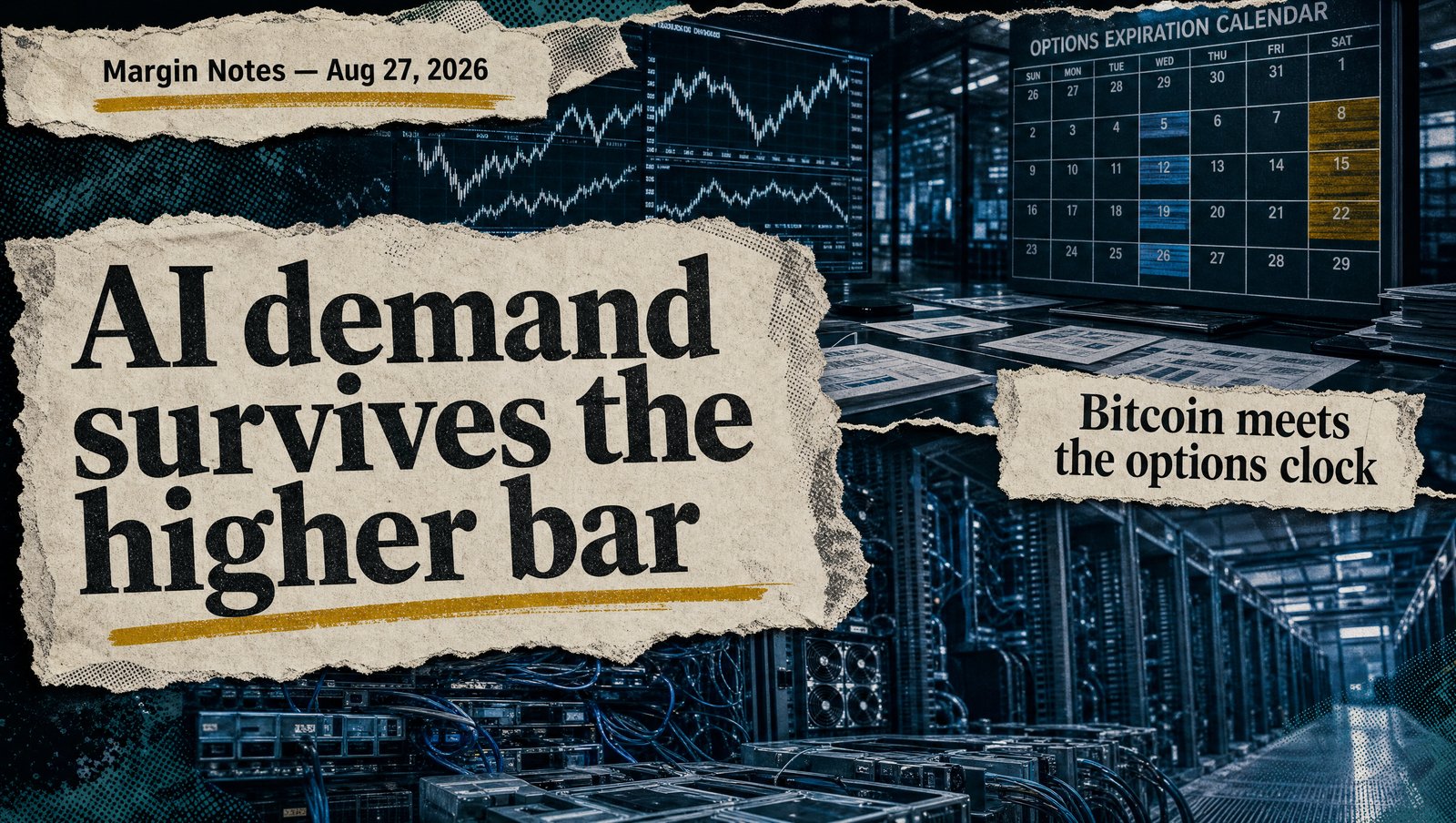
Nvidia reported $96.2 billion in quarterly revenue after the market close, beating expectations and pointing to continued demand for AI infrastructure. The result supports the central growth story, but the muted regular-session performance matters too: Nvidia finished at $209.66, down 1.59%, because investors are no longer impressed by merely enormous numbers. They want proof that enormous numbers can keep getting larger.
That is why the company’s forecast for AI-led sales growth into 2028 landed as reassurance rather than a fresh permission slip. Amazon’s planned purchase of 2 million Nvidia chips confirms that the build-out still has industrial momentum, while a US investigation into a Singapore company over alleged chip smuggling shows how valuable the hardware has become. Demand is expanding, but the distribution network is now part of the investment case. AI spending is still accelerating, but export controls are raising the cost of reaching the customer.
The broader market understood the distinction. The S&P 500 was essentially flat and the Nasdaq lost 0.08%, even as technology was one of the better-performing sectors at 0.37%. Investors have not abandoned the AI complex; they are asking whether the next dollar of spending produces enough revenue to justify a 4.64% 10-year yield. The boom remains intact. Its discount rate has simply turned up uninvited.
Inflation Keeps Central Banks Comparing Notes
US inflation remained above the US Federal Reserve’s target, reviving speculation that a rate hike could enter the conversation rather than another cut. Hotter US inflation is reopening the rate-hike question just as political pressure on the institution is intensifying. US Federal Reserve Governor Lisa Cook denied wrongdoing while President Donald Trump renewed his effort to remove her, a confrontation that turns a policy debate into an institutional one. Markets can price a hike. They are less comfortable pricing uncertainty over who gets to make it.
The message is not confined to Washington. The Bangko Sentral ng Pilipinas delivered its third consecutive rate increase, while South Korea’s central bank followed with a second straight hike as semiconductor-driven growth fed inflation concerns. Japan’s central bank, meanwhile, kept the door open to a September increase. The common thread is not synchronized policy, but synchronized discomfort: stronger demand is welcome until it starts sending the bill for imported goods and wages.
That leaves the US Fed with an especially awkward backdrop. The US 10-year yield held at 4.64% and the 30-year yield remained at 5.165%, while gold pushed up to $4,659.10. Gold is holding its bid despite high yields because investors are hedging two kinds of policy error at once, an overly tight response to inflation and a weaker response to political interference. A safe haven that pays no income usually dislikes high yields. Today it merely looks unconvinced.
Bitcoin Finds Its Next Test in the Plumbing
Bitcoin fell below $79,000 after a 23% seven-day advance, with XRP leading losses as traders began to price a possible US Fed hike. The move is less a rejection of the scarcity thesis than a reminder that crypto still trades on the marginal dollar. When the cost of money rises, even a credible long-term hedge has to pass a short-term liquidity exam.
Friday’s $6.4 billion options expiry supplies the exam paper. Positioning built around Bitcoin’s move from $62,000 to $80,000 leaves market makers managing a much larger range of possible outcomes, so a relatively ordinary price move can acquire rather theatrical consequences. ETF demand remains steady and August inflows have exceeded $3 billion, which gives the market a floor, but floors do not prevent volatility. They merely make the fall less lonely.
The institutional question is widening beyond the price chart. The Dallas Fed warned that tokenized deposits could reduce US bank lending capacity by $700 billion if money can move instantly toward higher yields. That is not a crypto footnote; it is a challenge to the way banks fund credit. Tokenized deposits could move liquidity faster than banks can replace it, forcing traditional lenders to pay more for funding just as digital markets make capital more mobile. Bitcoin may be testing $80,000, but the more consequential experiment is whether the financial system can keep its plumbing attached while everything else goes on-chain.
Elsewhere
- CrowdStrike posted its strongest quarter on record as AI demand lifted cybersecurity results.
- Salesforce gained support from its Anthropic partnership as investors looked for evidence that enterprise AI spending is becoming revenue.
- Meta agreed to a $16.68 billion settlement with US states, removing one large legal overhang from its balance sheet.
- Amazon committed to buying 2 million Nvidia chips for its expanding data-center network.
- Ethereum developers proposed quantum-resistant staking keys to address a threat that remains distant but decidedly inconvenient.
- Shinhan Financial Group partnered with Visa on stablecoin trials covering issuance, remittances, and business settlements in South Korea.
- Abercrombie shares jumped 35.67% after the retailer reported a $100 million tariff refund.