The Day in Numbers
- S&P 500: 7,677.28 — gained 0.32% as technology shares led a modest advance.
- Nasdaq: 26,151.30 — rose 0.66% ahead of Nvidia’s earnings.
- Nvidia: $213.05 — climbed 2.19% before the AI bellwether reports.
- Brent crude: $85.59 — fell 1.93% as reopening talks eased supply fears.
- US 10-year Treasury yield: 4.65% — held near recent highs despite softer oil.
- Bitcoin: $79,000 — consolidated after a roughly 25% weekly advance.
- XRP: +44% — rallied sharply, with leverage returning alongside the price.
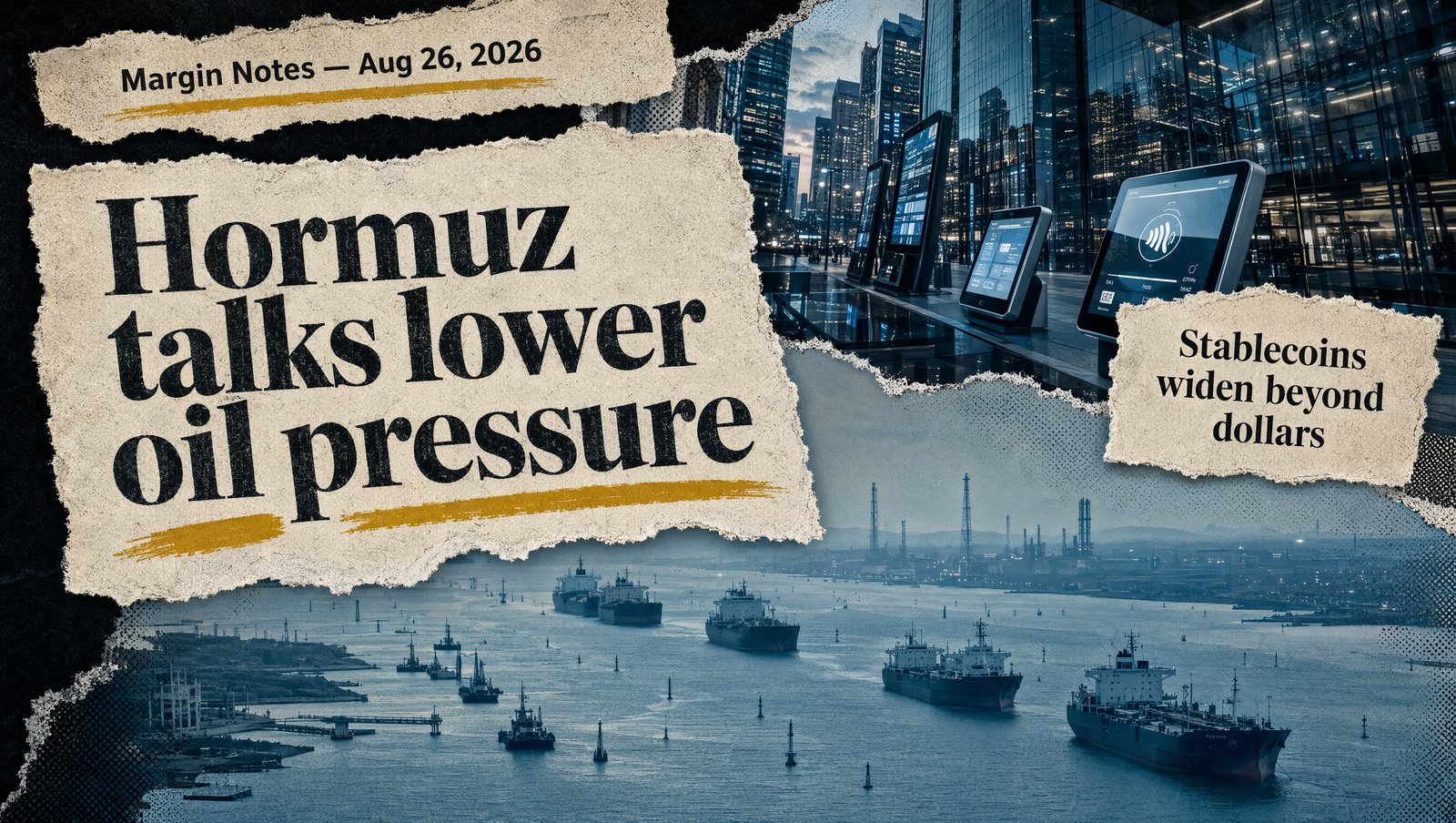
Hormuz Talks Lower Oil’s Ceiling
Iran and Oman are discussing an interim reopening of the Strait of Hormuz, and Brent crude fell 1.93% to $85.59 as traders marked down the immediate chance of a prolonged supply shock. Talks lowered the oil premium before they lowered the geopolitical risk. That distinction matters: an interim arrangement is not peace, merely a cheaper form of uncertainty.
The relief travelled quickly through the inflation channel. US crude slipped to $80.33, down 2.46%, while the S&P 500 rose 0.32% and the Nasdaq added 0.66%. Lower energy costs give the US Federal Reserve a little more room to watch the economy rather than chase every barrel, though Europe is not receiving the same policy message. Isabel Schnabel of the European Central Bank is arguing that rates may need to rise further because the euro-area economy remains resilient, which is an awkward reminder that one region’s oil relief does not create a global easing cycle.
Stablecoins Build the New Financial Plumbing
Revolut is preparing a euro-backed stablecoin, putting a major European fintech directly into a market that has until now been dominated by dollar-based tokens. Revolut is widening stablecoin access beyond the dollar system. The significance is less about another coin joining the parade and more about distribution: a consumer-facing financial platform can place digital cash in ordinary payment and savings channels without asking users to first become crypto specialists.
The institutional version is arriving at the same time. Franklin Templeton’s tokenized Treasury fund has landed on HashKey, giving Asian investors access to a yield-bearing government-asset wrapper through a digital exchange. Bitcoin, meanwhile, was holding around $79,000 after a roughly 25% seven-day rise, while the crypto greed gauge climbed from 27 to 74 in two weeks. That is the market’s way of saying the infrastructure is maturing and the positioning may be getting ahead of itself. XRP’s 44% rally has brought leverage back with it, so the next test is not whether demand exists, but whether it can survive a less forgiving price tick.
AI Financing Meets a Less Forgiving Economy
SoftBank is considering as much as $20 billion of bond financing for OpenAI, a remarkably large cheque for a sector whose future earnings remain mostly a matter of confidence and electricity bills. SoftBank is reaching for debt to keep AI expansion funded. Nvidia rose 2.19% to $213.05 ahead of its earnings, and options traders are positioned for an unusually quiet reaction, which may be the market’s polite way of admitting that expectations are already doing much of the work.
The capital story becomes less comfortable when placed beside the macro backdrop. The US 30-year Treasury yield was 5.183%, the US 10-year yield was 4.65%, and the US Federal Reserve’s Raphael Bostic Barkin warned that rising US debt will eventually bring a reckoning. Expensive money does not necessarily stop AI spending; it makes the returns required to justify that spending much higher. Add Washington’s consideration of further trade measures against Canada, after Canadian retaliation, and the cost of servers, components, and financing all start moving in the same direction. The market can tolerate a grand technology plan. It is less certain about paying for one twice.
Elsewhere
- US state banking associations planned a nationwide blockchain network aimed at supporting stablecoins and tokenized deposits within existing regulatory structures.
- BlackRock reportedly cut its Bitcoin ETF swap minimum to $1 million, lowering the entry point for large investors moving between custody arrangements.
- Solana ETFs extended their inflow streak to five days after attracting $33.5 million in one session.
- Ethereum DeFi liquidations reached $36 million after a token moved only 3%, exposing how quickly collateral chains can snap.
- US authorities widened Iran-related enforcement to include crypto, gold, shipping, and technology channels.
- LayerZero introduced institutional trading infrastructure for crypto and tokenized markets with backing from major financial-market participants.
- Dubai International Airport reported a 31% passenger decline as the Iran conflict disrupted regional travel flows.