The Day in Numbers
- S&P 500: 7,785.76 — slipped 0.17% as investors waited for a clearer US Federal Reserve signal.
- Nasdaq: 26,729.16 — fell 0.28%, with information technology down 0.37%.
- Crude oil: $81.80 — declined 0.73% despite renewed Middle East tensions.
- Gold: $4,456.60 — gained 0.43% as investors added protection.
- US 10-year Treasury yield: 4.67% — was unchanged while rate expectations shifted.
- Japanese 10-year government bond yield: highest since 1996 — reflecting stronger Bank of Japan tightening bets.
- Indian lenders’ dollar bond sales: $8 billion — a record amount, showing continued appetite for emerging-market credit.
Goldman Sachs Reprices the Rate-Hike Question
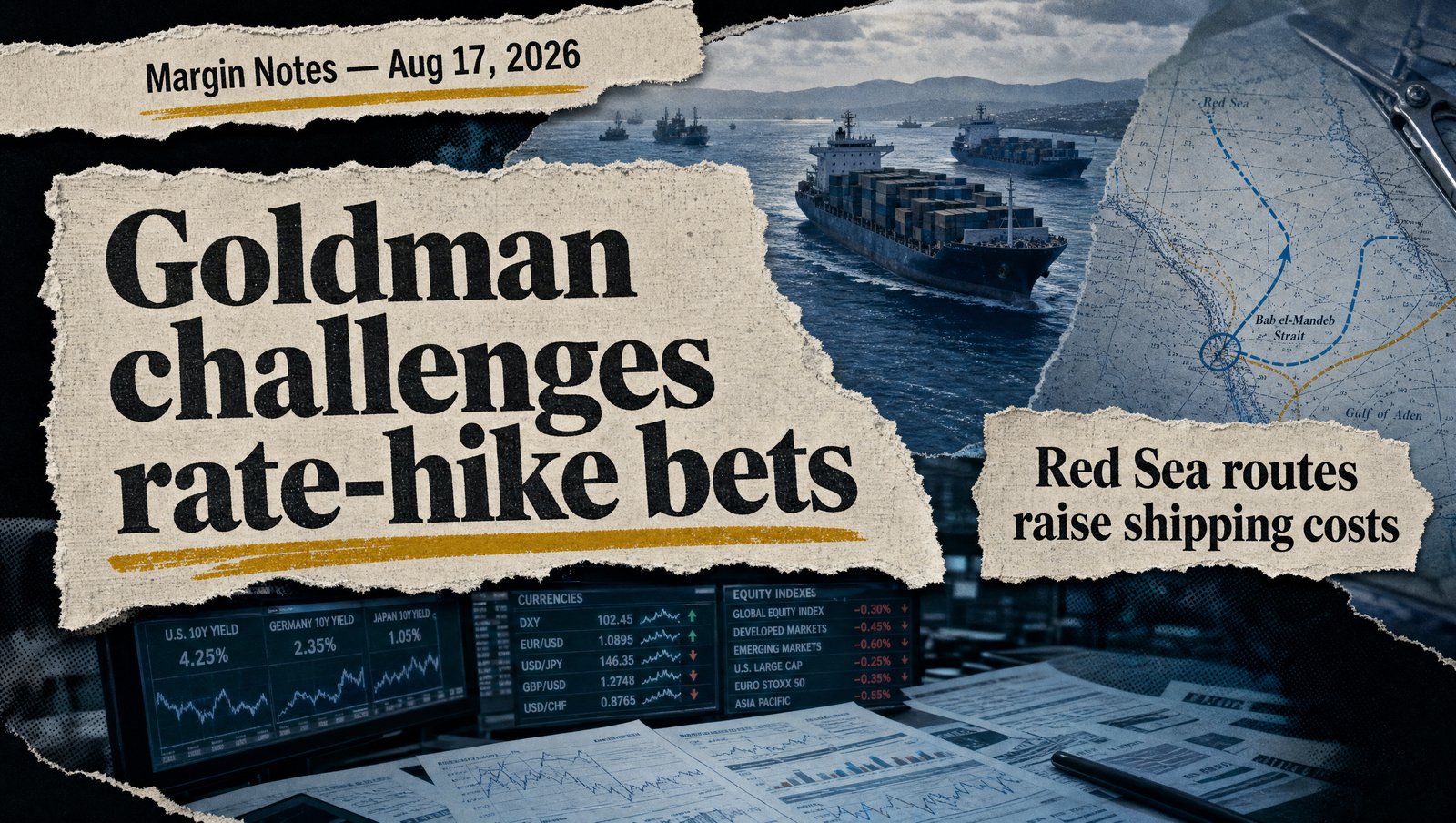
Goldman Sachs said markets are too aggressive in betting on further US Federal Reserve rate increases, while emerging-market currencies climbed to records as those expectations softened. Goldman Sachs is challenging the market’s hawkish policy pricing, which gives investors a reason to buy duration and higher-yielding assets without first waiting for a formal policy change.
The US 10-year Treasury yield held at 4.67%, the S&P 500 eased 0.17%, and the Nasdaq fell 0.28%. That is less a verdict on growth than a pause while investors decide whether a weaker dollar and gentler rate path are durable. The euro rose to $1.16, and the pound reached $1.36, modest moves that nevertheless fit the broader retreat from peak US-rate expectations.
The complication is that Japan is moving in the opposite direction. Japan’s 10-year government bond yield reached its highest level since 1996 on expectations of Bank of Japan tightening, raising the cost of yen-funded positions just as emerging-market currencies are benefiting from easier US policy. Japan’s rising bond yield is putting a price on global carry trades. Liquidity may be improving in one corner while becoming less forgiving in another, which is how markets turn a dovish headline into a selective rally.
Middle East Tensions Raise the Cost of Moving Oil
Crude oil fell 0.73% to $81.80 even as Israeli strikes in Lebanon and new US measures aimed at Iran raised the prospect of a wider regional confrontation. Israel’s strikes have added pressure to stalled US-Iran talks, but oil prices are responding to the difference between political danger and immediate lost supply.
Asian refiners are already acting on that distinction. Asian refiners are seeking Saudi oil outside the Red Sea, choosing more expensive logistics over routes that now carry a larger security premium. Oil does not need to surge for this to matter. Longer voyages, higher insurance costs, and altered cargo flows can feed inflation through the supply chain while the headline price sits quietly enough to appear innocent.
Gold rose 0.43% to $4,456.60, while energy was down 0.17% and utilities gained 1.36%. That mix suggests investors are buying protection without pricing a full supply shock. The market is not forecasting that every barrel disappears; it is charging more for the chance that the next barrel takes the scenic route.
Bitcoin Meets a Less Forgiving Market Structure
Bitcoin exchange-traded funds recorded their largest outflow in six weeks as the token stalled, an awkward development for a market receiving help from a softer US-rate outlook. Bitcoin ETFs have lost institutional demand at the moment liquidity should be improving. The problem is not simply direction; it is that the marginal buyer has stepped back while leveraged positions remain in place.
Bitcoin futures open interest is running well ahead of trading volume, leaving too many positions dependent on a relatively narrow exit. Bitcoin futures are carrying more leverage than the market can comfortably absorb. A small move can therefore become a larger one once margin calls begin doing the selling. Markets are generous with upside narratives and much less sentimental about collateral.
XRP offers the sharper version of the same problem. Its futures open interest reached $2.78 billion while social sentiment fell to a three-month low, a mismatch that leaves traders heavily positioned for a rebound even as conviction outside the derivatives market deteriorates. XRP’s long positioning is rising as confidence falls. Easier money can support crypto, but it cannot guarantee that crowded trades will unwind politely.
Elsewhere
- Stripe is reportedly pursuing a $7 billion-plus AI acquisition, keeping strategic capital flowing toward the software layer that connects businesses to models.
- Mastercard is expanding stablecoin payment infrastructure, showing that established payment networks would rather integrate digital assets than wait for them to become someone else’s problem.
- Alibaba is selling its gaming business for $1.5 billion, redirecting capital toward artificial-intelligence projects as Chinese technology groups narrow their ambitions.
- Geely reported stronger profit as exports offset weak Chinese demand, offering a small but useful reminder that overseas sales can cushion domestic softness.
- Google’s internal AI disputes are beginning to weigh on its execution, putting management discipline back into a sector that prefers to discuss compute.
- Walmart and Target are preparing results that will test US consumer resilience, with spending strength now one of the cleaner clues to the next policy debate.
- SafePal disclosed a breach affecting nearly 40,000 customers’ order information, although private keys, seed phrases, and customer funds were not reported stolen.