The Day in Numbers
- Crude oil: $82.08 — climbed 1.02% as Middle East shipping risks intensified.
- Brent crude: $87.93 — gained 0.99%, keeping supply disruption priced into energy.
- US 10-year Treasury yield: 4.65% — held steady despite an expensive long-term debt sale.
- US 30-year Treasury yield: 5.229% — remained near its highest level in a quarter-century.
- S&P 500: 7,798.99 — rose 0.65% even as geopolitical and borrowing risks accumulated.
- Nasdaq: 26,803.03 — advanced 0.81%, extending the technology-led rally.
- Gold: $4,390.80 — fell 0.67% as equities absorbed the latest policy shocks.
Washington Raises the Cost of Middle East Logistics
The US government is preparing an economic isolation plan for Iran next week, adding port restrictions and financial pressure to a conflict already disrupting how Middle Eastern oil reaches buyers. Washington is preparing a broader economic squeeze on Iran, and that matters because supply risk is now being transmitted through shipping decisions rather than only through lost production.
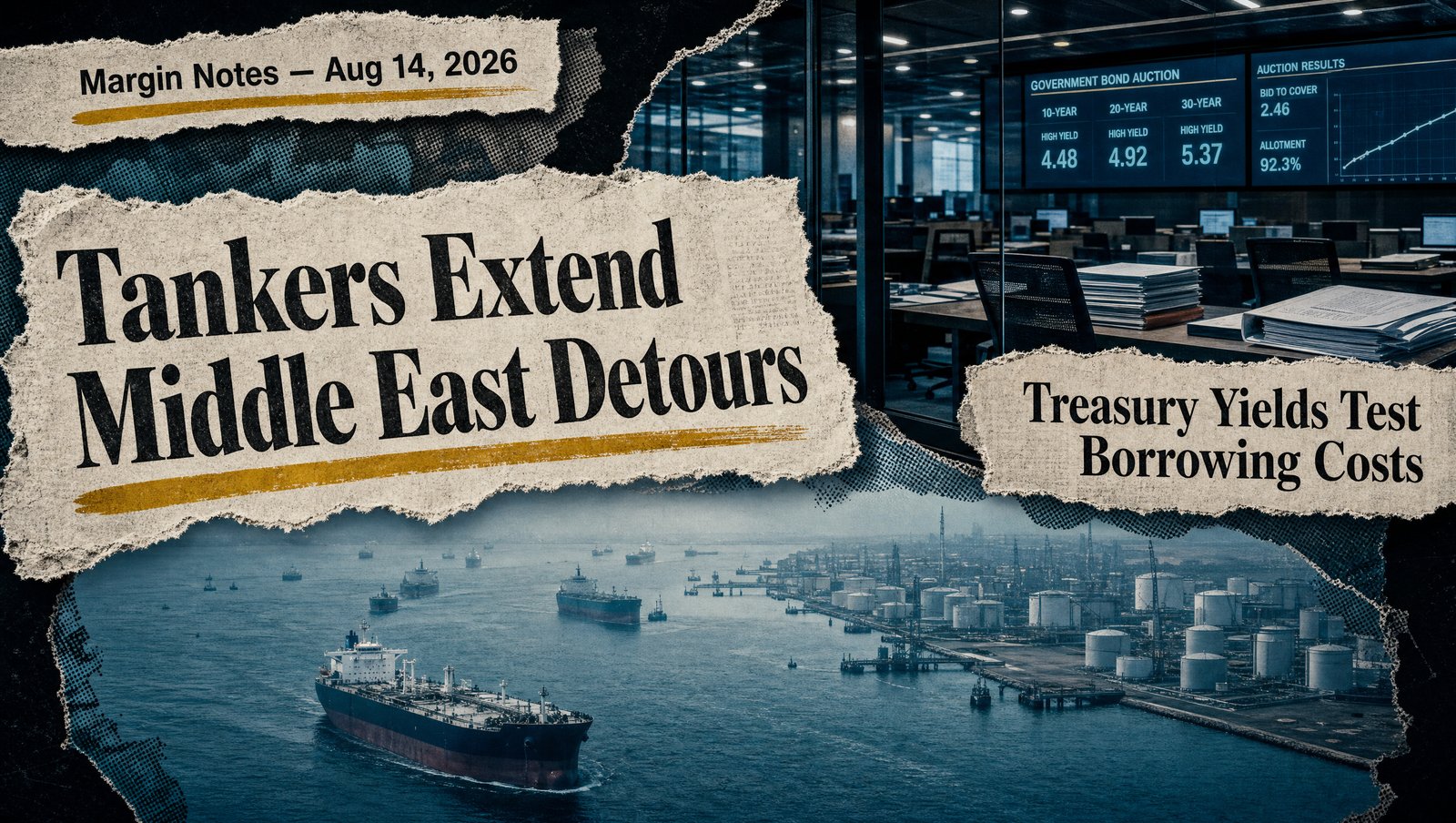
Tankers are taking longer routes and, in some cases, limiting their visibility to reduce exposure, increasing insurance, transit, and financing costs even when barrels remain available. Hormuz traffic is down by 98 ships, Brent has risen 20.2% since the war began, US gasoline is 32.9% higher, and European gas has climbed 91.9%. The physical market has not vanished; it has become more expensive and less predictable, which is usually how inflation gets invited back into the room.
Crude still rose only 1.02% to $82.08, while gold fell 0.67% to $4,390.80. That combination suggests investors are not pricing an immediate energy collapse. They are pricing a longer period in which every shipment requires more caution, more time, and more money. Middle Eastern tankers are extending the detour around a damaged supply chain, making the market’s concern logistical before it becomes outright physical.
Treasuries Turn Borrowing Into a Market Test
A US 30-year Treasury sale pushed borrowing costs to 5.229%, giving investors a fresh reason to question how comfortably the US government can finance its obligations. The US 10-year yield remained at 4.65%, but the stability at the benchmark maturity should not be mistaken for approval. The longer end is doing the complaining on behalf of the whole curve.
The issue is not merely that yields are high. It is that heavy government issuance is competing with corporate investment, housing demand, and the technology sector’s appetite for enormous infrastructure spending. AI can produce remarkable revenue growth, and OpenAI’s reported revenue run rate has passed $40 billion, but a project still has to clear the hurdle set by a 5.229% long bond. The US Treasury market is charging more for duration as government financing expands.
That helps explain the curious split in Friday’s trading. The Nasdaq rose 0.81% and the S&P 500 gained 0.65%, while gold declined and the 10-year yield barely moved. Investors are still willing to buy growth, but they are doing so against a bond market that refuses to become inexpensive. The rally has momentum; the discount rate has memory.
The SEC Leaves Crypto Waiting on the Sidelines
The US Securities and Exchange Commission canceled a meeting that had been expected to advance its digital-asset framework, extending a regulatory pause just as traditional finance is trying to build more products around blockchain markets. The US SEC has postponed another attempt to define crypto’s operating rules, leaving issuers and exchanges with less clarity than their marketing departments would prefer.
The delay is especially awkward for tokenization. Figure reported quarterly revenue of $226 million while loan-marketplace volume reached $4.3 billion, and MUFG is preparing a real-time blockchain settlement test for Japanese government bonds. Those are signs of practical adoption, not speculative slogans. Yet firms building regulated products still face a US rulebook that moves more slowly than the technology it is supposed to govern. The US SEC has again delayed its tokenization exemption, making institutional progress dependent on workarounds.
Tether’s completed KPMG audit offers the counterpoint: the stablecoin issuer says its reserves have now received the long-promised Big Four review, a useful credibility gain for the plumbing that supports much of crypto trading. But better documentation at one major issuer cannot substitute for a stable regulatory perimeter. Bitcoin fell 0.26% on the session, a small move that says little about long-term demand and rather more about investors having no fresh policy catalyst to price.
Elsewhere
- Reddit shares gained 3.04% on planned S&P 500 inclusion, though analysts remain wary of its valuation and dependence on advertising.
- Nubank’s quarterly profit topped $1 billion, giving digital banking another strong result to place beside the fintech expansion story.
- The White House accused 40 trading partners of helping China bypass tariffs, raising the prospect of broader trade enforcement.
- The US government imposed 100% tariffs on certain drones, deepening the technology and supply-chain dispute with China.
- Pony.ai and Uber agreed to deploy more than 2,000 robotaxis in Europe, extending the autonomous-driving competition beyond its usual US-China boundaries.
- Kalshi is seeking $750 million at a $40 billion valuation, showing that prediction markets can attract serious capital even while banks remain cautious about the sector.
- JPMorgan ended its banking relationship with Polymarket, a reminder that institutional funding and regulatory comfort are still separate products.