The Day in Numbers
- Crude oil: $83.54 — rose 0.41% as the Strait of Hormuz standoff kept supply risk elevated.
- Brent crude: $89.26 — added 0.39%, extending the market’s geopolitical insurance bill.
- Gold: $4,460.10 — gained 0.43% as investors kept protection against inflation and conflict.
- S&P 500: 7,728.20 — fell 0.32% as fading hopes for a US-Iran agreement weighed on equities.
- Nasdaq: 26,445.45 — dropped 0.60%, showing technology was not immune to the day’s macro concerns.
- US 10-year Treasury yield: 4.68% — held steady ahead of the July inflation report.
- Energy sector: up 1.11% — the strongest major US sector as crude prices climbed.
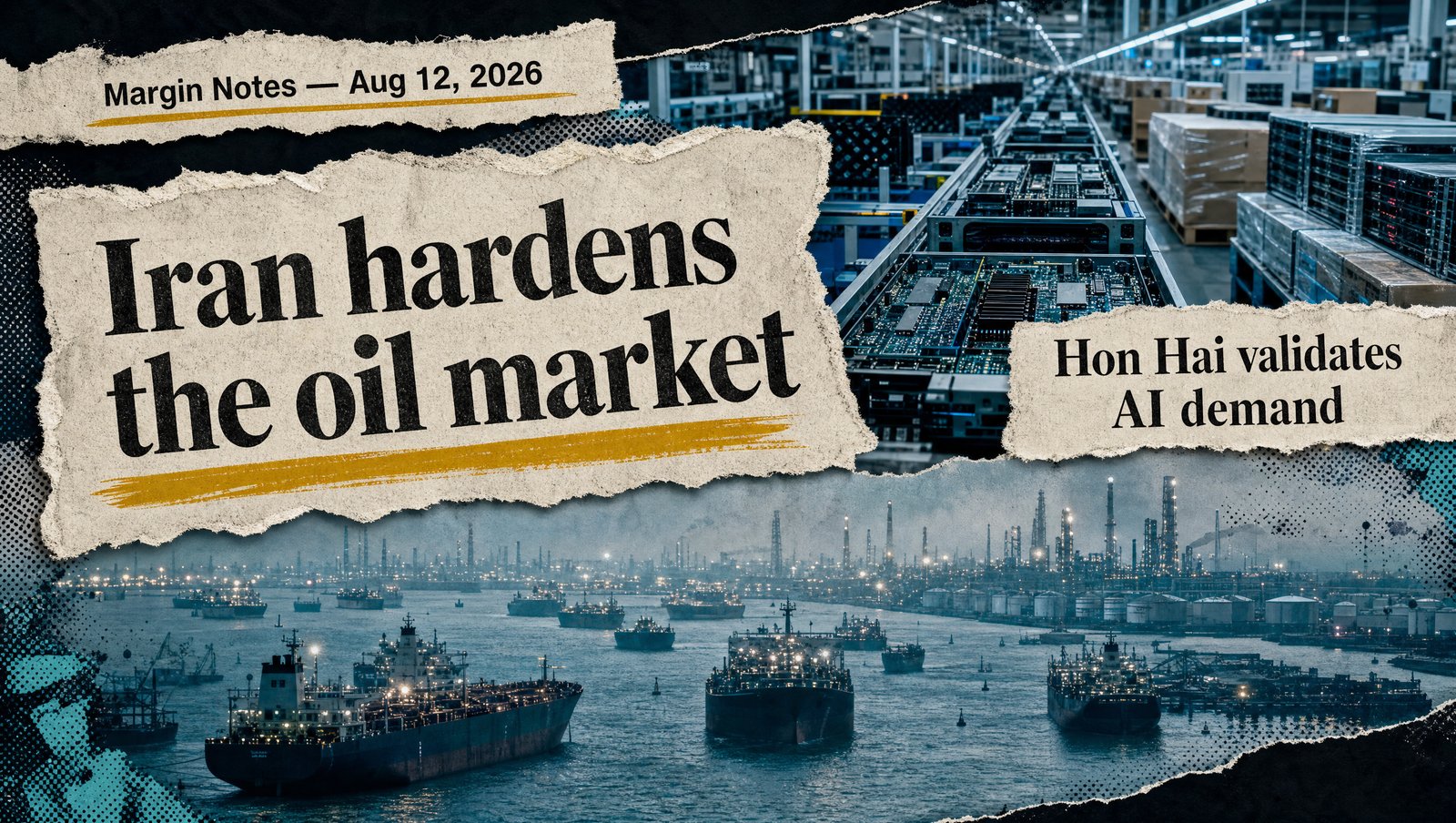
Iran Hardens the Oil Market's Deadline
Crude oil reached $83.54 on Wednesday as President Donald Trump claimed control over the Strait of Hormuz while the US and Iran moved further apart on the terms of any settlement. US-Iran positions have made a near-term shipping deal harder to price, which leaves the market paying for barrels that may still move, but may not move smoothly.
Brent traded at $89.26, while gold rose to $4,460.10. That combination says investors are not forecasting an immediate supply collapse; they are refusing to assume that diplomacy will repair the logistics on a convenient timetable. Brent is up 23.6% since the war began, US gasoline prices have risen 32.9%, and European benchmark gas is 91.2% higher. A supply shock becomes economically important long before the pumps run dry.
The timing makes the inflation data more consequential. The July US consumer-price report is expected to show headline prices up 0.1% month over month, with core prices rising 0.2% and core inflation at 2.5% year over year. A soft print would help, but oil is already telling bond traders that the next inflation surprise may come from a shipping lane rather than a wage spreadsheet.
Hon Hai Keeps AI Orders on the Clock
Hon Hai posted a stronger-than-expected profit as customers continued spending on artificial-intelligence infrastructure, offering fresh evidence that the buildout still has physical demand behind it. Hon Hai's results confirmed that AI orders remain broad and durable, extending the message from memory-chip makers, server companies, and cloud providers rather than leaving it to Nvidia alone.
That matters because the market has started asking a better question than whether AI demand exists. It is asking whether the profits generated by that demand can outrun the cost of building the machines, data centers, and power capacity required to capture it. Nvidia’s financial strength has also helped calm credit-market nerves, while CoreWeave rose 2.42% to $90.32 after narrowing its quarterly loss. The demand is real; the financing is where the plot thickens.
Equities nevertheless marked down growth exposure. The Nasdaq fell 0.60%, Google dropped 3.84%, and information technology slipped 0.26%, even as energy and industrials gained 1.11% and 1.06%, respectively. AI spending is holding up better than AI valuations. That distinction is becoming the market’s preferred footnote.
Crypto Rules Advance Into the Legislative Gap
The US Securities and Exchange Commission is preparing a broad digital-asset agenda while the US Senate’s Clarity Act remains stalled. The US SEC is moving to fill the crypto rulemaking vacuum, shifting the next major regulatory catalyst from legislation to agency action.
That creates opportunity, but not much certainty. New SEC rules could affect exchange compliance, stablecoins, and the structure of crypto funds, while the absence of congressional legislation leaves firms guessing about which interpretation will survive the next policy turn. Bitcoin and ether traders have consequently kept positions tight ahead of the US CPI release, treating the data as a binary event rather than a gentle update to the forecast.
The operational risks have not gone away while Washington debates the paperwork. A Harmony exploit allegedly created 4 billion additional ONE tokens, roughly a quarter of supply, sending the token down 26%. The lesson is unglamorous but useful: regulation can define the perimeter, yet it cannot repair bad code. Markets require both.
Elsewhere
- The US Treasury and Japanese officials diverged over currency intervention risks, leaving the yen exposed as traders hedge around the US inflation report.
- Norway’s $2.3 trillion sovereign fund returned 9.4% in the first half, with technology holdings doing much of the lifting.
- Trump Media reported a $238 million quarterly loss after more than $190 million in unrealized digital-asset losses weighed on its results.
- eToro agreed to acquire TradeZero for $231 million, but the brokerage’s shares fell 10% as investors questioned the cost of expansion.
- An attacker drained $200,000 from an XRP bridge after the software accepted fabricated deposits as genuine collateral.
- China’s private soybean crushers held back despite purchase pledges, testing whether official trade commitments can translate into physical demand.