The Day in Numbers
- Nvidia funding package: $500 billion — the scale of Wall Street’s proposed commitment to AI infrastructure.
- Crude oil: $83.62 — gained 1.81% as hopes for a dependable Hormuz agreement faded.
- Brent crude: $89.35 — rose 1.86%, keeping the geopolitical premium firmly attached to energy.
- Gold: $4,425.60 — added 0.13% as investors waited for US inflation data.
- US 10-year Treasury yield: 4.72% — unchanged, leaving the long bond as a stubborn price of risk.
- Nasdaq: 26,605.36 — fell 0.32% despite the enormous AI financing announcement.
- Health care: up 4.63% — the strongest US sector move as investors favored defensiveness over duration.
Hormuz Turns Diplomacy Into an Inflation Premium
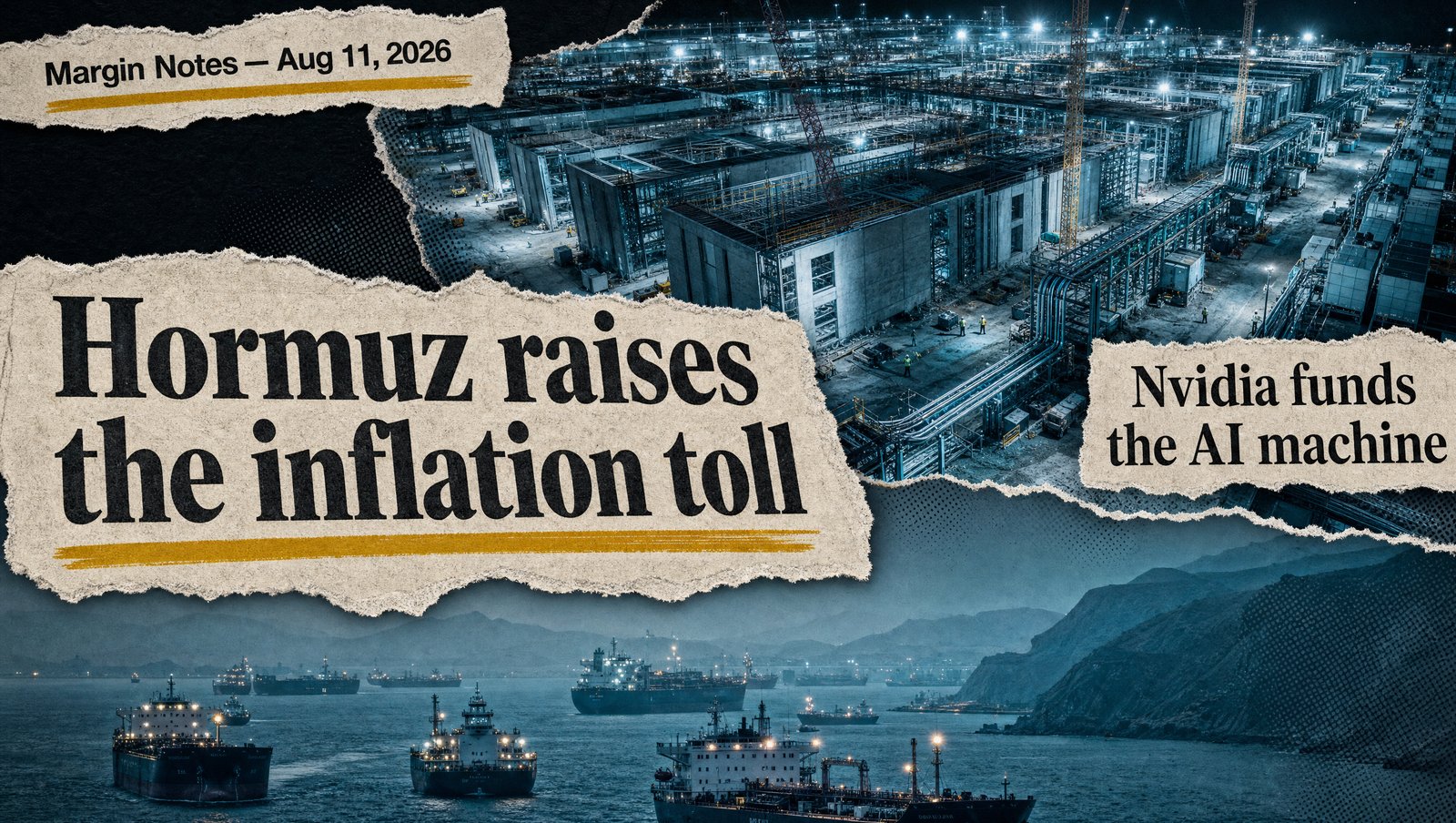
Crude oil climbed to $83.62 on Tuesday after President Donald Trump hardened his position on Iran, making a negotiated reopening of the Strait of Hormuz harder to price as an imminent event. Hopes for a stable Hormuz arrangement have deteriorated, and the market has responded in the traditional manner: by charging more for every barrel that might have to pass through the chokepoint.
Brent reached $89.35, up 1.86%, while gold rose to $4,425.60. The combination is not a panic trade, but it is an insurance trade, with energy pricing physical disruption and bullion pricing the possibility that inflation proves less obedient than investors would like. Brent is now 21.3% above its level at the start of the war, US gasoline is up 35.3%, and European benchmark gas has risen 96.7%. Those are not merely geopolitical headlines anymore; they are inputs into household budgets and central-bank arithmetic.
The US 10-year Treasury yield held at 4.72%, which is the bond market’s way of refusing to give the equity market a clean bill of health. Wednesday’s US inflation figures arrive with oil already higher and gold already above $4,400, so a soft number would need to overcome a fairly loud energy signal. The inflation story has not broken; it has acquired a shipping lane.
Nvidia Finds Capital, Not Instant Applause
Nvidia shares fell 2.86% to $217.55 even as Wall Street firms assembled a proposed $500 billion financing package for AI infrastructure. Nvidia is asking institutional capital to fund AI at industrial scale, a remarkable vote of confidence in future compute demand that nevertheless failed to produce a positive stock-market reaction.
That mismatch is the useful news. The financing commitment says money is available for data centers, chips, and power capacity, but the share-price decline says investors are beginning to ask who absorbs the cost before the revenue arrives. AI infrastructure is no longer being financed in startup-sized increments; it is being planned like a national utility. The market, having seen several very large numbers recently, would now like to see margins.
Anthropic’s agreement to source cloud capacity from Riot Platforms adds a second route through the same capital cycle. Anthropic has turned a crypto miner's capacity into a $9 billion AI contract, showing how scarce power and data-center assets can migrate between business models. That is constructive for the infrastructure thesis, but it also makes valuation more dependent on execution, financing costs, and the ability to keep expensive machines busy. A server can be useful in two industries and still be overpaid for in both.
Bitcoin Buyers Ignore the Hack, Not the Bill
Bitcoin fund inflows reached a four-month high despite a security breach that unsettled holders, creating one of those market signals that is bullish only after reading the footnotes. Bitcoin funds attracted unusually strong inflows despite fresh custody anxiety, suggesting institutional demand remains present even when the asset’s operational risks are impossible to ignore.
The price action is less comfortable. Bitcoin has traded below $65,000 for a fourth day, while ether and XRP have led broader crypto losses as traders weigh the oil rally and Wednesday’s US price data. Meanwhile, Strategy sold 1,690 bitcoin and raised $653 million through stock issuance, lifting its dollar reserve to $4.65 billion. Strategy is building cash while reducing its Bitcoin position, a balance-sheet decision that adds supply to the market and quietly concedes that dollars still do some jobs Bitcoin cannot.
Security is becoming part of the demand equation rather than a side note. A Bitcoin payment-server exploit prompted BTCPay to offer a $190,000 bounty, while a separate attack drained $8 million from Coinsbuy across two blockchains. Long-term holders may be accumulating, but institutions do not purchase infrastructure merely because the philosophy is elegant. They want custody, settlement, and liquidity to work on a bad day. Crypto is discovering that adoption comes with an audit.
Elsewhere
- Bessent renewed his support for yen intervention, though analysts questioned how much firepower the US Treasury can bring to the effort.
- The Bank of Korea signaled that more rate increases remain possible as officials focused on persistent inflation risks.
- The Reserve Bank of Australia held its key rate while keeping elevated inflation ahead of growth concerns.
- Intel prepared a large equity sale to finance its AI ambitions, adding dilution to the list of costs investors now expect from the semiconductor race.
- The US Securities and Exchange Commission scheduled a vote on a new crypto rulemaking process, potentially giving digital-asset offerings a more formal regulatory path.
- BlackRock expanded tokenized money-market products across Ethereum and Solana, pushing traditional cash instruments further onto public blockchain rails.
- OpenAI agreed to buy back $7 billion of employee shares, providing another example of the extraordinary liquidity circulating around private AI companies.