The Day in Numbers
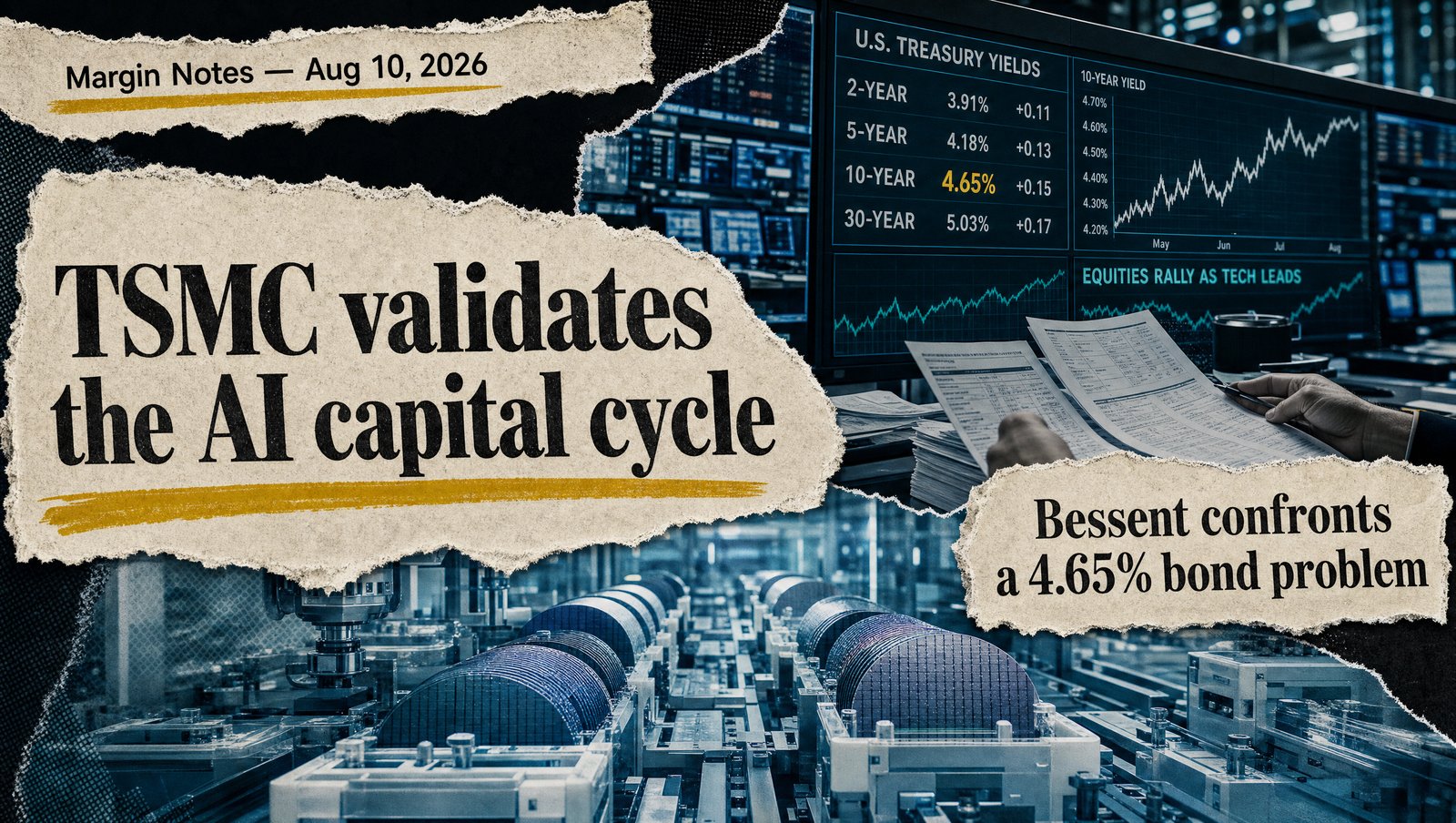
- TSMC sales: up 45% — evidence that AI hardware demand is still outrunning market nerves.
- Nasdaq: 26,690.62 — gained 1.30% as technology shares led the session.
- S&P 500: 7,757.64 — rose 0.62%, with the advance broadening beyond a handful of mega-cap names.
- US 10-year Treasury yield: 4.65% — unchanged as bond-market anxiety kept the risk-free rate elevated.
- Crude oil: $78.10 — slipped 0.10%, though unresolved Gulf shipping risk continued to support prices.
- Gold: $4,415.40 — added 0.36% as investors kept some insurance against geopolitical and inflation shocks.
- Bitcoin: above $65,000 — held its advance ahead of US inflation data and despite the Senate delaying crypto legislation.
TSMC validates the AI capital cycle
TSMC reported a 45% rise in sales as demand for advanced AI hardware stayed strong, giving the technology trade something more useful than another optimistic forecast. TSMC sales climbed 45% on persistent AI demand, confirming that the capital-spending cycle still has real orders behind it. That helped the Nasdaq rise 1.30% to 26,690.62, while information technology gained 1.25%.
The wider equity move matters more than the chipmaker’s headline. The S&P 500 added 0.62%, the Russell 2000 gained 1.10%, and materials rose 1.52%, suggesting investors were not merely rotating between the same seven expensive names. S&P 500 participation has broadened beyond the market's largest companies, which gives the rally a sturdier base, although “sturdier” remains a relative term when the index is still priced against a demanding interest-rate backdrop.
That backdrop is why the good news does not settle the argument. AI infrastructure is producing revenue, but investors still need to decide whether that revenue can grow fast enough to justify the spending required to produce it. The market is willing to fund the buildout; it is simply sending the invoice earlier.
Bessent confronts a 4.65% bond problem
The US 10-year Treasury yield sat at 4.65% on Monday, unchanged even as the Nasdaq advanced and crude oil eased marginally. Treasury Secretary Scott Bessent has moved to contain a rise in borrowing costs, a signal that the bond market has become an active policy concern rather than a quiet discount-rate input.
The pressure comes from several directions at once. Oil remains near $78.10 because an agreement between Oman and Iran has not produced a dependable reopening of the Strait of Hormuz, while gold reached $4,415.40 as investors retained a hedge. European benchmark gas is up 80% since the conflict began, and daily Hormuz transits are down 92 ships, figures that make the inflation risk harder to dismiss as mere headline weather.
US inflation data due later this week will therefore arrive into a market with less room for a comfortable interpretation. Softer US jobs data has helped emerging-market stocks and currencies, but the bond market is not yet granting the US Federal Reserve a clean path toward easier policy. Equities can celebrate strong earnings and still be reminded, by the long bond, that money has a price.
Bitcoin clears $65,000 without Washington
Bitcoin traded above $65,000 on Monday as investors looked past the Senate’s decision to delay the CLARITY Act vote until the fall. Bitcoin moved above $65,000 despite the legislative delay, showing that demand is currently being supplied by markets rather than by Washington’s timetable.
Institutional flows are doing much of the work. Spot Bitcoin exchange-traded funds recorded $853.54 million of net inflows last week, the strongest weekly result since mid-April, with BlackRock’s IBIT taking the largest share. Spot Bitcoin ETFs attracted $853.54 million in a week, giving the rally a source of demand that is easier to measure than enthusiasm on social media and marginally less combustible.
The broader crypto market has also improved, with Bitcoin, Ethereum, and BNB each up nearly 3% on the week, while XRP has fallen 5%. That divergence says capital is becoming selective rather than indiscriminately bullish. Strategy’s $105 million Bitcoin sale adds another wrinkle, but its $4 billion dollar reserve suggests liquidity management rather than a wholesale retreat. Crypto is attracting money, just not handing every token an invitation.
Elsewhere
- The Bank of Japan flagged a faster path toward rate increases as officials highlighted upside risks to prices and the yen continued to lag other G-10 currencies.
- China began directing its capital markets toward the AI race, shifting more of the burden from subsidies to market-funded technology investment.
- Indonesia nominated Destry Damayanti to lead Bank Indonesia in an effort to steady confidence around the country’s financial markets.
- The Philippine central bank left a rate increase on the table despite weak economic growth, keeping inflation above activity in the policy hierarchy.
- Shein was valued at $22 billion to $25 billion ahead of its IPO, below the $30 billion figure some investors had hoped to see.
- Robinhood expanded no-fee crypto trading into the United Kingdom with AI-assisted news tools, bringing another regulated-market test to the retail platform model.