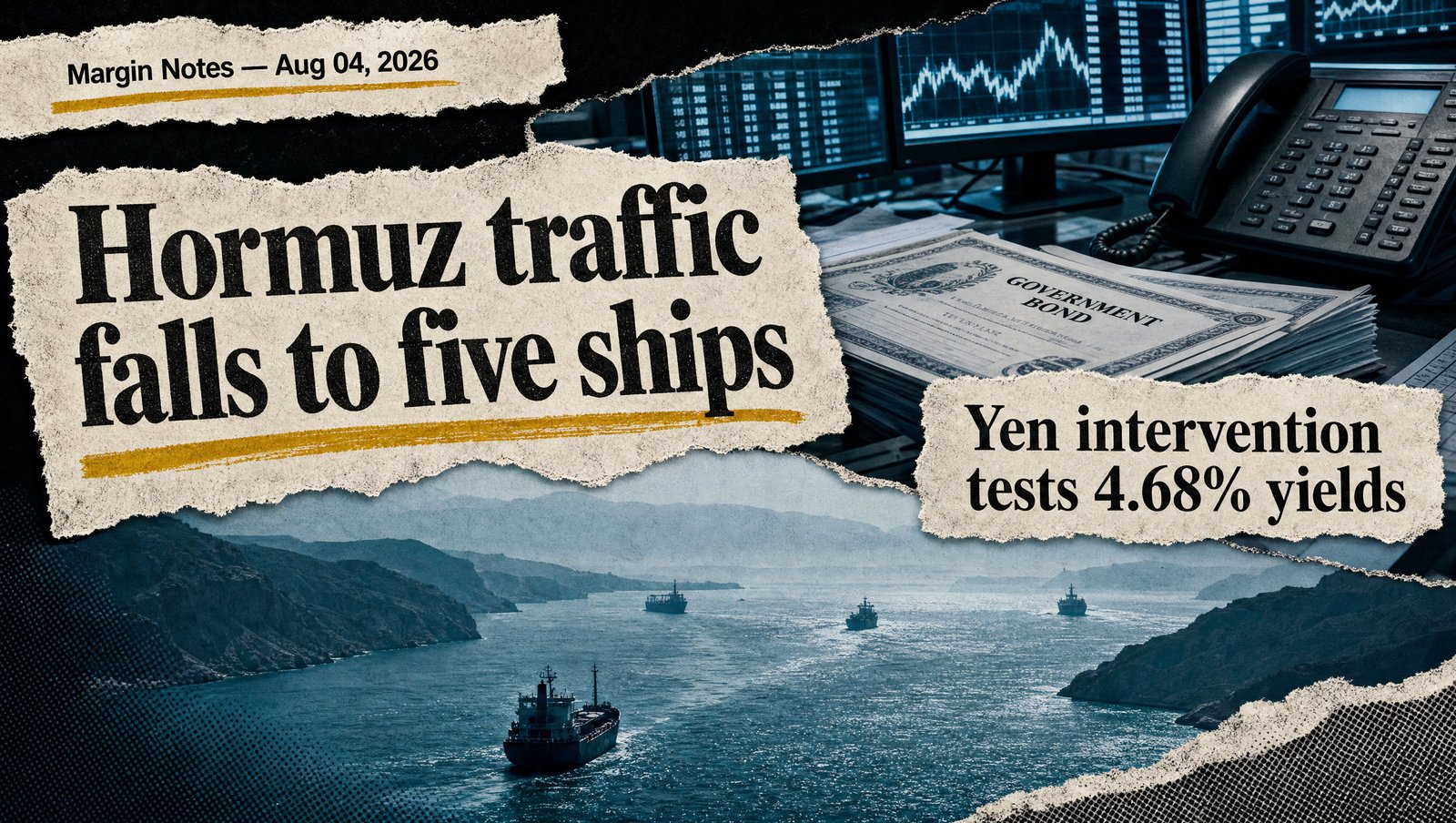
The Day in Numbers
- Strait of Hormuz traffic: 5 ships — daily transits fell by 99 as attacks raised closure fears.
- Brent crude: $84.69 — gained 1.10% as shipping risk kept a premium in energy markets.
- Crude oil: $80.70 — rose 0.45%, a smaller move than Brent’s but still higher amid supply anxiety.
- S&P 500: 7,600.50 — climbed 1.48% as investors welcomed signs of US-Iran de-escalation.
- Nasdaq: 25,913.90 — rose 2.13%, with technology shares recovering despite a flat reading in separate market data.
- US 10-year Treasury yield: 4.68% — held near elevated levels as inflation and policy credibility remained in question.
- Gold: $4,117.90 — gained 0.67%, showing that risk-on equity trading did not eliminate demand for protection.
Hormuz Traffic Shrinks as Talks Keep Oil on Edge
Five ships crossed the Strait of Hormuz, down 99 from the previous count, as attacks pushed the world’s most important energy passage toward operational paralysis. Hormuz traffic has fallen to a trickle, which makes the market’s modest crude move look less reassuring than it first appears. Brent rose 1.10% to $84.69, while crude gained 0.45% to $80.70. Prices are not sprinting because traders still see diplomacy as a possible release valve, not because the supply problem has gone away.
President Donald Trump described negotiations with Iran as a final opportunity after threats and canceled strikes, leaving markets to price two incompatible futures at once. Washington has kept talks alive without making the supply risk disappear. That ambiguity helped the S&P 500 rise 1.48% and pushed gold up 0.67%, a combination that says investors are buying the diplomatic possibility while keeping a small insurance policy. Energy companies, meanwhile, are collecting the more straightforward part of the story: fewer ships and higher margins.
Bessent Puts the Yen Under Official Supervision
USD/JPY stood at 157.678 even after the United States and Japan confirmed coordinated support for the yen, while the US 10-year Treasury yield held at 4.68%. US Treasury Secretary Scott Bessent has pulled the currency dispute into official policy, turning what had been a familiar carry-trade pressure point into a question of government tolerance. A stronger yen may ease Japan’s imported inflation, but it also threatens positions built on cheap yen funding and an indefinitely weak Japanese currency.
The unusual coordination does not automatically mean global liquidity is tightening, though it does make the price of liquidity less predictable. J.P. Morgan has warned that a loss of credibility at the US Federal Reserve could eventually require a rate increase before year-end, a message that sits awkwardly beside a 2.13% Nasdaq rally. Rate-hike risk is returning as a credibility problem, not a growth problem. Equity traders are still willing to buy technology and industrial shares; bond traders are asking who will pay for the enthusiasm.
BlackRock Builds Tokenized Cash as Bitcoin Absorbs Supply
BlackRock launched tokenized money-market offerings in Europe on Ethereum and Solana, giving institutional cash a regulated digital wrapper rather than asking investors to begin with a speculative asset. BlackRock is moving traditional cash onto public blockchains. The significance is less about a new trading product than about distribution: money-market exposure can now travel through blockchain rails, where settlement and ownership records are native rather than retrofitted.
Bitcoin also rose despite another sale by Strategy and the continuing fallout from the Coldcard attacks, suggesting that the market is distinguishing between a large holder reducing exposure and the broader institutional thesis collapsing. Bitcoin has absorbed corporate selling without surrendering the bid. That resilience is useful, but it is not proof of unlimited demand. BlackRock is building infrastructure for tokenized cash; Strategy is building a cash reserve. The market can accommodate both views, although it may prefer the one with fewer dramatic press releases.
Elsewhere
- Aramco lifted profit by 33% as the conflict raised energy prices and widened the gap between producers and fuel consumers.
- HSBC restarted a $1 billion buyback after a profit beat, adding a familiar form of confidence to the banking sector.
- Google shares advanced 4.88% to $373.51 as investors continued to reward large technology platforms despite intensifying competition from Chinese AI developers.
- Palantir shares gained 2.10% to $125.65 after another strong AI-driven quarter kept the growth trade selective rather than indiscriminate.
- Boeing stock rose 8.03% after clearing a key regulatory hurdle, giving the Dow’s record close an industrial rather than purely technological engine.
- SpaceX shares rebounded 5.68% even as the stock remained 52% below its June IPO level ahead of the company’s first earnings report.
- A group of US states sued over President Donald Trump’s latest tariffs, adding a legal complication to an already unstable trade-policy outlook.