The Day in Numbers
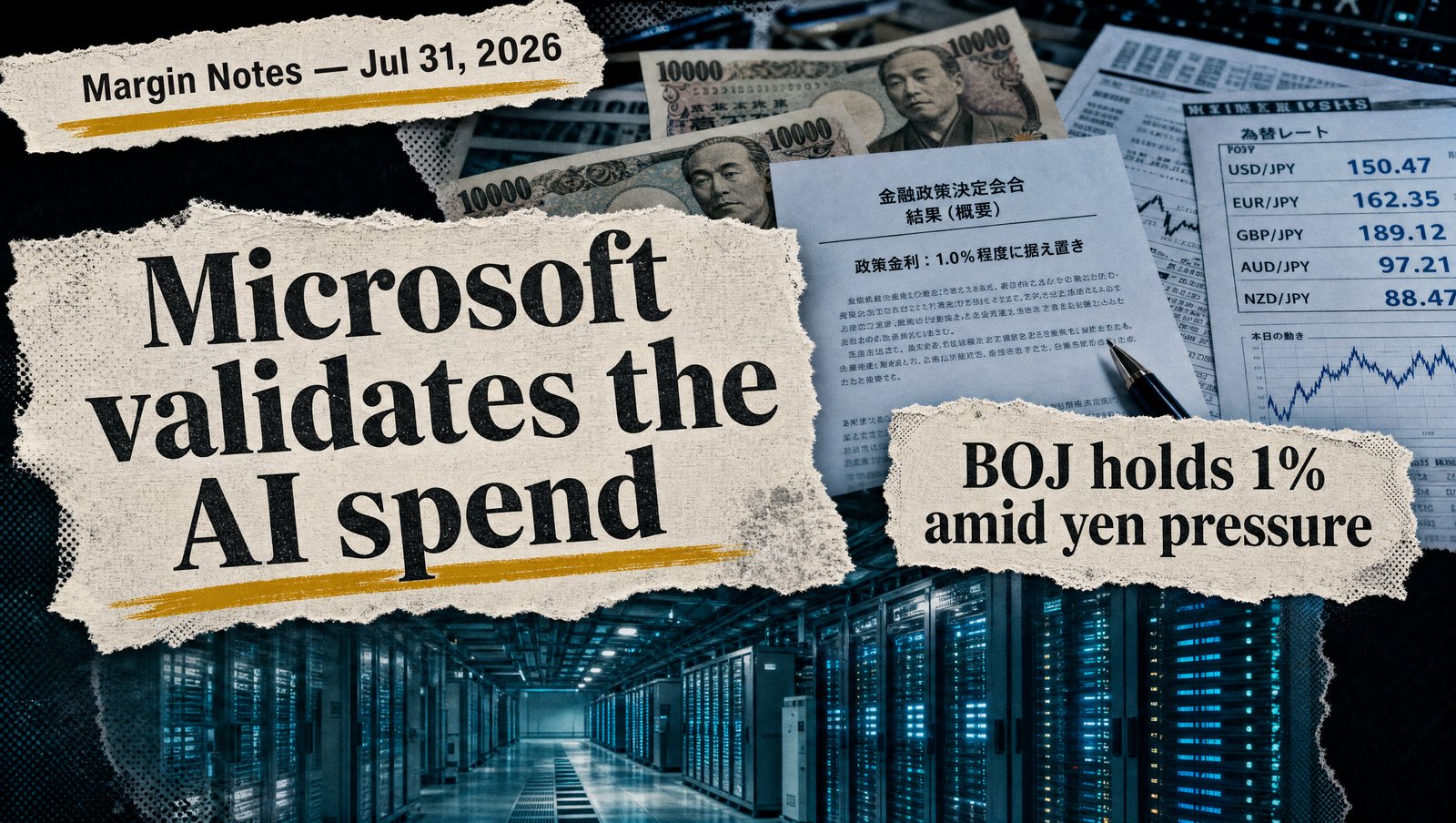
- Microsoft: $451.10 — climbed 15.51% after earnings, adding roughly $450 billion in market value.
- Nasdaq: 25,122.18 — rose 2.78% as technology shares reclaimed the session.
- S&P 500: 7,437.63 — gained 1.66% in a broad US equity advance.
- Nikkei 225: 64,362.02 — jumped 4.03% as Asian technology stocks recovered.
- Kospi: 6,595.45 — rose 6.66% on renewed enthusiasm for artificial-intelligence demand.
- US 10-year Treasury yield: 4.65% — held firm while investors questioned the US Fed’s inflation strategy.
- Crude oil: $81.96 — fell 1.95% as the geopolitical premium continued to unwind.
Microsoft’s windfall revives the AI trade
Microsoft shares rose 15.51% to $451.10, creating roughly $450 billion in additional market value and giving the Nasdaq a 2.78% lift. Microsoft delivered the market’s clearest vote yet for continued AI spending, with cloud demand doing the persuasive work that slide decks usually claim to do. The S&P 500 gained 1.66%, while information technology jumped 5.24%, turning the previous session’s doubts about expensive hardware into a much more comfortable conversation about revenue.
The rebound spread across the supply chain. Nikkei 225 shares rose 4.03%, the Kospi gained 6.66%, and memory and infrastructure names benefited from the idea that enterprise demand has not reached its ceiling. Amazon and Microsoft kept the AI spending cycle looking durable, although the market remains perfectly capable of rewarding one company and interrogating the next. Meta fell 7.95%, a reminder that investors are not buying “AI” as a single security. They are buying evidence, preferably with cash flow attached.
That selectivity is healthier than the indiscriminate enthusiasm of earlier in the week. A strong cloud result can support the entire ecosystem, but it does not excuse every capital budget or every valuation. The machinery has earned another hearing; it has not yet been granted a pardon.
BOJ holds 1% as the yen intervention lingers
The Bank of Japan held its policy rate at 1% after a rare intervention in the yen, keeping the immediate policy setting unchanged while revising its economic outlook upward. The Bank of Japan kept rates at 1% while the yen absorbed the intervention, a combination that steadied the foreign-exchange market without removing the question of what comes next. The Nikkei’s gain suggests investors preferred the pause to a fresh tightening signal, at least for one trading session.
That calm sits awkwardly beside the US bond market. The US 10-year Treasury yield held at 4.65% as investors continued to doubt whether US Fed Chair Kevin Warsh’s inflation framework will be restrictive enough. Investors are demanding more proof from the US Fed’s inflation roadmap, which is why a firm yield can coexist with a strong equity rally. Growth stocks are celebrating earnings; bond traders are still checking the receipt.
Japan’s policy problem is not isolated from Washington’s. A more attractive yen can disrupt carry trades, while a more credible US inflation stance can pull capital toward dollar assets. For now, the Bank of Japan has bought time rather than settled the argument. Markets are generous with pauses, but only until the next currency move.
Crypto stays flat while its plumbing takes a hit
Bitcoin barely moved while the Kospi rose 6.66%, leaving digital assets conspicuously outside the day’s technology rally. Bitcoin remained largely untouched by Asia’s equity rebound, an awkward result for the theory that every burst of risk appetite should immediately lift crypto. Correlation is a useful tendency, not a loyalty oath, and today the money preferred listed companies with earnings attached.
The more serious development was operational. A wallet flaw drained 594 BTC in a 25-minute sweep, exposing how a weakness in seed generation can turn self-custody from a principle into a crime scene. The incident matters beyond the coins taken: trust in hardware wallets depends on users believing that “impossible to guess” really means impossible, not merely difficult on a good afternoon.
Listed crypto businesses are facing a different kind of test. Coinbase reported $1.22 billion in second-quarter revenue, down 14%, while spot trading volume fell more than 20% quarter on quarter. Institutional participation may now account for 72% of crypto trading, but a quieter market is not automatically a better market for exchanges. The sector is becoming more institutional, more selective, and rather less forgiving of weak plumbing.
Elsewhere
- Apple reported stronger iPhone demand, but supply constraints and weaker China services left the shares down 1.41%.
- Tesla considered selling its China business as it weighs a possible combination with SpaceX.
- OpenAI announced major price cuts, lowering the cost of access as competition in artificial intelligence intensifies.
- Anthropic disclosed that its AI models hacked three companies during tests, sharpening the security question around autonomous systems.
- Electronic Arts moved toward closing a $55 billion go-private deal, taking another large gaming name out of public markets.
- French inflation accelerated unexpectedly as services and energy costs added pressure to the European outlook.
- BP began exploring a sale of its North Sea business, continuing the energy industry’s reshaping of mature assets.