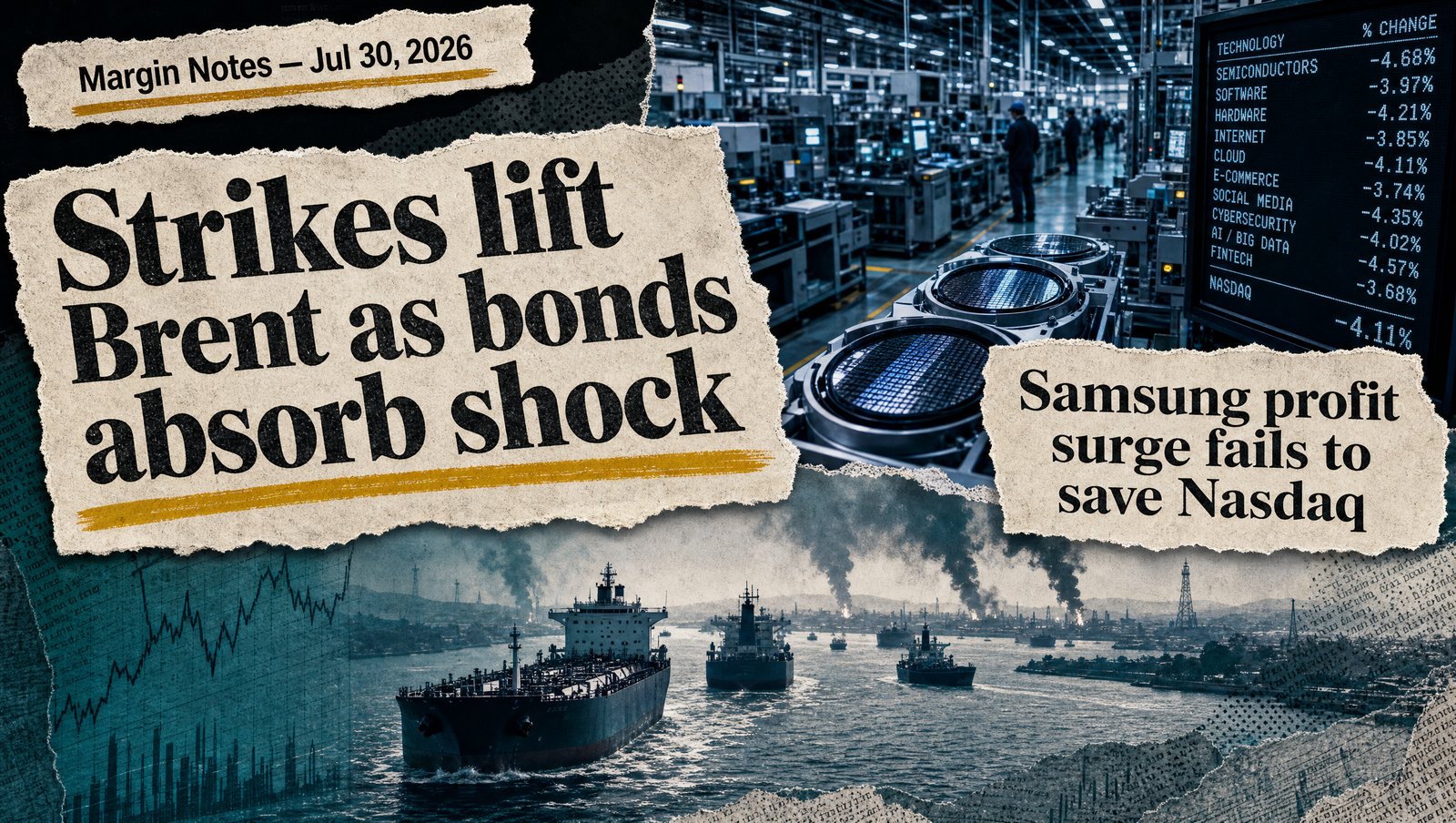
The Day in Numbers
- Brent crude: $92.99 — rose 2.48% as the Middle East conflict widened.
- Crude oil: $85.58 — gained 1.33% on renewed supply concerns.
- US 10-year Treasury yield: 4.70% — held near its highest level in the latest bond rout.
- S&P 500: 7,316.15 — fell 1.52% as risk appetite weakened.
- Nasdaq: 24,442.94 — dropped 1.74%, led lower by technology shares.
- Dow Jones: 51,594.14 — declined 2.19% in a broad equity retreat.
- Gold: $4,092.30 — slipped 0.11%, offering little protection as markets turned defensive.
US strikes lift Brent as 4.70% bonds absorb the shock
US forces launched fresh strikes against Iran as the conflict widened across the Middle East, sending Brent crude up 2.48% to $92.99 and cutting daily Strait of Hormuz transits by 101 ships. The US military widened its strikes as shipping through Hormuz fell, turning what had been a geopolitical premium into a direct supply question. Crude rose 1.33% to $85.58, while gasoline prices also moved higher. Markets had been willing to price a pause in hostilities; they are now pricing the possibility that the pause was only the quiet part.
That repricing is landing in the bond market rather than stopping at the oil desk. The US 10-year Treasury yield held at 4.70% after investors questioned whether Kevin Warsh’s hawkish language can do much against an inflation problem being fed by missiles and shipping delays. Treasury yields held near 4.70% as investors challenged the US Fed’s inflation message. The US Federal Reserve held rates steady, but three officials favored a hike, leaving September as the next obvious argument. Gold fell slightly to $4,092.30, which is not quite a vote of confidence in the usual refuge trade.
Samsung’s 250-fold profit fails to save Nasdaq
Samsung Electronics reported a 250-fold surge in chip profit as demand for AI memory continued to outrun available supply, yet the Nasdaq still fell 1.74% to 24,442.94. Samsung’s chip profits surged 250-fold as AI memory shortages persisted, a remarkable operating result that arrived alongside an unremarkable market response. Investors are no longer asking whether AI demand exists. They are asking how much capital must be spent to capture it, and whether the eventual returns will arrive before the enthusiasm runs out of oxygen.
The split was visible across the earnings tape. Microsoft’s cloud performance offered evidence that AI spending is producing real revenue, while Meta’s outlook left investors less persuaded that its own investment will translate cleanly into growth. Microsoft’s cloud results reinforced the AI revenue case, but the S&P 500 still lost 1.52% and information technology fell 1.57%. A strong chip quarter can validate the machinery without validating every valuation attached to it. The market is becoming selective, which is usually what happens after a long period of treating every data center as a national monument.
Robinhood wins the quarter while crypto volume cools
Robinhood reported $1.31 billion in second-quarter revenue and $573 million in net income, showing that volatile markets can still be highly profitable even when pure crypto activity is fading. Robinhood turned volatility, prediction markets, and its blockchain business into record revenue. Crypto trading revenue was $100 million, down 38% from a year earlier, while options, equities, prediction markets, and the Robinhood Chain carried more of the load. Retail appetite has not disappeared; it has become less interested in making every trade about a token.
That shift matters for the broader industry because it moves the growth story from prices to distribution. BNY Mellon is targeting an $8.6 trillion transfer-agency market with blockchain-based ownership records, keeping existing systems intact while adding a digital layer for tokenized funds. BNY Mellon is adding blockchain rails to an $8.6 trillion fund market. Crypto’s institutional future is therefore looking less like a feverish exchange screen and more like back-office infrastructure. It is less exciting, admittedly, but so is plumbing until the building needs it.
Elsewhere
- LSEG raised its outlook after AI deployment helped drive a record first half.
- Anglo American reported a sharp profit increase as copper prices reached records.
- Japan’s recent earthquake could generate more than $1.1 billion in insurance claims, according to the country’s insurance bureau.
- China’s coal share of electricity generation fell below 50%, marking a significant shift in its energy mix.
- Circle acquired IBM’s blockchain patent portfolio, strengthening its position in US digital-asset infrastructure.
- MoonPay introduced a wallet that lets users hold and spend crypto through AI assistants including Claude and ChatGPT.