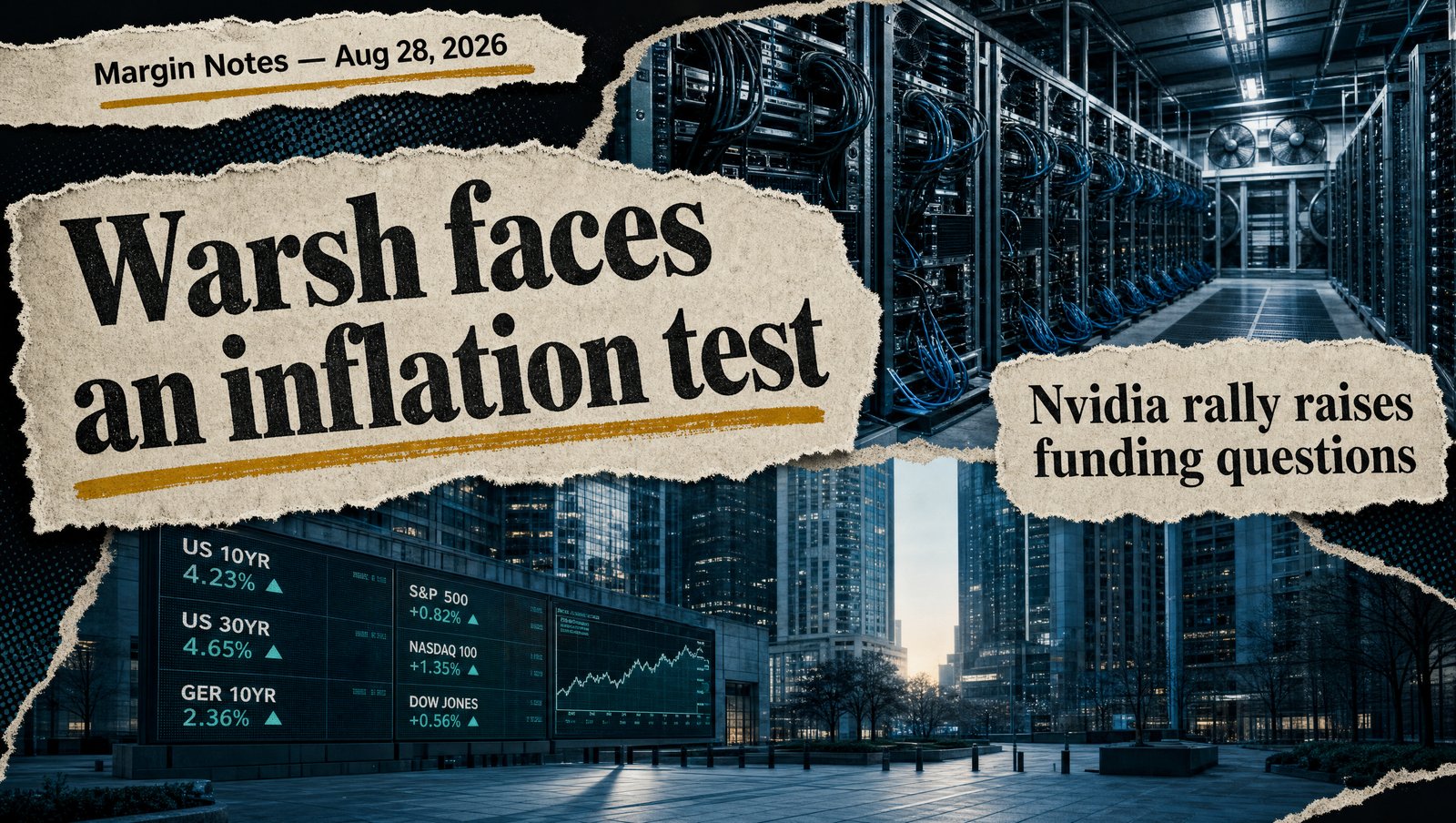
The Day in Numbers
- S&P 500: 7,730.99 — gained 0.72% as investors kept the broader rally intact ahead of Kevin Warsh’s speech.
- Nasdaq: 26,541.35 — rose 1.57%, helped by a powerful technology rebound.
- Nvidia: $227.98 — jumped 8.74% after adding $442 billion in market value.
- US 10-year Treasury yield: 4.67% — remained elevated as inflation and AI borrowing kept bond investors cautious.
- Bitcoin: $80,000 — reclaimed the threshold as fresh US demand appeared in the spot market.
- Crude oil: $82.82 — fell 0.85%, offering a modestly friendlier inflation signal.
- Solana: +20% over the week — led major crypto assets higher before the US Federal Reserve chair’s Jackson Hole appearance.
Warsh Walks Into a Market Asking for Permission
US stock futures slipped before Kevin Warsh’s Jackson Hole speech, while the US 10-year Treasury yield held at 4.67%. The market is not waiting for a rate decision today; it is waiting for a governing principle. Investors want to know whether the new US Federal Reserve chair will treat inflation as the central threat, or whether the pressure of high government borrowing and financial conditions will pull the institution toward accommodation.
JPMorgan and Apollo are arguing for an inflation-first message, a view that could support longer-dated bonds if Warsh sounds sufficiently firm. Wall Street is asking Warsh to put inflation before easier money, which is less a request for drama than for a usable rulebook. The US Fed has been handed a market full of competing demands: long yields are high, equities are near records, and gold remains near $4,600 despite the income available elsewhere. Clarity would help. A promise that rates will stay low would be something else entirely.
The speech is scheduled for 10:00 a.m. ET, so the day’s calm is provisional. The S&P 500 rose 0.72% and the Nasdaq advanced 1.57%, but those gains say more about yesterday’s appetite for technology than today’s tolerance for policy surprise. Warsh is being tested by investors before he has finished his first sentence. A hawkish emphasis could lift the dollar and pressure crypto; a softer interpretation could extend the rally, though it would also make the inflation question harder to dismiss.
Nvidia Turns Growth Into a Funding Question
Nvidia shares rose 8.74% to $227.98, adding $442 billion in market value in their second-largest daily gain on record. That move supplied the day’s clearest evidence that investors still want growth, particularly growth attached to the AI build-out. It also raises the less exciting question that usually arrives after the confetti: who is financing all of it, and at what yield?
Nvidia’s rally restored faith in AI demand, but the bond market is not obliged to share the enthusiasm. Pimco says AI-related debt is arriving “too much, too fast,” helping push borrowing costs higher as companies fund data centers, chips, and power capacity. Nvidia’s pause in some revenue-sharing arrangements with AI cloud companies adds another wrinkle, suggesting that even the sector’s strongest supplier is reassessing how much ecosystem support belongs on its own balance sheet.
That tension explains why the technology surge did not pull every sector along. Information technology gained 3.40%, while financials fell 0.58%, real estate lost 0.92%, and consumer staples declined 1.50%. AI growth is raising the hurdle for every other risk asset: the earnings are real, but so is the cost of capital. Warsh’s speech matters partly because it will help decide whether that hurdle stays high.
Bitcoin Finds Buyers Before the Policy Verdict
Bitcoin reclaimed $80,000 as its Coinbase premium turned positive for the first time since May. That shift matters because it points to actual US spot demand rather than a rally carried mainly by offshore leverage. Bitcoin has gained 9% over the past week, while Solana has risen 20%, so traders are approaching Jackson Hole with more profit at stake and less patience for an unfriendly sentence.
US buyers have returned to Bitcoin’s spot market, giving the move a sturdier foundation than the price alone would show. Bitcoin and gold ETFs have drawn $7 billion, and gold remains close to $4,648.40 even after a 0.33% decline. Both assets are therefore responding to the same unresolved question: whether fiscal pressure and inflation will eventually force policy to accommodate markets, or whether policymakers will defend purchasing power first.
Crypto is still the faster instrument in that argument. A tough Warsh message could hit Bitcoin and altcoins quickly, while a signal that the US Fed will tolerate higher inflation could send money toward both digital assets and precious metals. Solana’s supply-cut proposal is narrowly advancing, but the separate plan for an $800,000 daily burn is trailing, which is a useful reminder that token economics are not magic. Bitcoin has found demand, but Warsh will decide how expensive that demand becomes.
Worth a Mention
- Advent and Stripe abandoned their pursuit of PayPal, ending a potential $50 billion fintech transaction.
- Salesforce shares climbed 22.58% after results and its Anthropic relationship lifted the software group.
- CrowdStrike shares gained 20.50% as record results reinforced the case for resilient enterprise technology spending.
- Nvidia reportedly agreed to acquire Hugging Face for $12.9 billion, bringing open-source AI development closer to the chip industry’s center of gravity.
- The Bank of England received a legal duty to support stablecoin innovation, giving the UK a more explicit role in digital-money development.
- Connecticut filed another challenge against Kalshi, adding to the widening legal dispute over prediction-market jurisdiction.
- Lightning developers warned node operators about an AI-linked bug, with technical details being held back while fixes reach the network.